
 Worksheets
Human Body Part 1 Test
Total questions: 82
Worksheet time: 1hrs 3mins
Joe designs an experiment to test his idea that exercise increases muscle. Joe exercises using weights three days each week. At the end of each week, Joe measures and records the size of his biceps (arm muscles). The first week Joe exercised for 30 minutes. The second week he exercised for 45 minutes. The third week his workouts lasted one hour each.
In Joe’s experiment, what is the independent variable?
amount of muscle
amount of weight lifted
amount of time he exercised
type of exercise
Joe designs an experiment to test his idea that exercise increases muscle. Joe exercises using weights three days each week. At the end of each week, Joe measures and records the size of his biceps (arm muscles). The first week Joe exercised for 30 minutes. The second week he exercised for 45 minutes. The third week his workouts lasted one hour each.
In Joe’s experiment, what is the dependent variable?
amount of muscle
amount of weight lifted
amount of time he exercised
type of exercise
Which is the correct order of organization from complex to simplest?
Tissue → cell → organ system → organ → organism
Cell → tissue → organ → organ system → organism
Organism → Organ → cell → organ system → tissue
Organism → Organ system → organ → tissue → cell
A group of cells that work together to perform the same function.
Cell
Tissue
Organ
Organ System
Basic unit of function and structure of all living things
Cell
Tissue
Organ
Organ System
A group of two or more organs that work together to perform a specific function.
Cell
Tissue
Organ
Organ System
A group of two or more different types of tissues that work together to perform a specific function.
Cell
Tissue
Organ
Organ System
Organ that provides protection of internal structures
Controls all activities in the body
Moves the body or causes movement within the body
Bones
Skin
Brain
Organ that forms a barrier for the body from infection
Controls all activities in the body
Moves the body or causes movement within the body
Bones
Skin
Brain
Major function of the muscular system
Controls all activities in the body
Moves the body or causes movement within the body
Bones
Skin
Brain
Major function of the nervous system
Controls all activities in the body
Moves the body or causes movement within the body
Bones
Skin
Brain
Major organ of the nervous system
Controls all activities in the body
Moves the body or causes movement within the body
Bones
Skin
Brain
The skeletal system is responsible for all of the following except:
Provide shape and support for the body
Absorbing water from food
Protecting the organs
Producing blood cells
The location where the shoulder blade and upper-arm connects permits movement in all directions. This is an example of ___________________ joint.
HInge
Pivot
Gliding
Ball and Socket
During the Dutch Fork vs Irmo softball game, Bobby tore a connective tissue that attaches his thigh bone to his hip-bone. Which tissue was affected?
cartilage
joint
ligament
tendon
__________ can be found in the ear, the tip of the nose, as well as cushioning the ends of the bones.
Cartilage
Marrow
Smooth Muscle
Tendon
Humerus
Wrist
Upper arm
Breastplate/bone
Thighbone
Fingers/toes
Phalanges
Wrist
Upper arm
Breastplate/bone
Thighbone
Fingers/toes
Carpals
Wrist
Upper arm
Breastplate/bone
Thighbone
Fingers/toes
Femur
Wrist
Upper arm
Breastplate/bone
Thighbone
Fingers/toes
Sternum
Wrist
Upper arm
Breastplate/bone
Thighbone
Fingers/toes
Kobe Bryant tore his Achilles tendon, the most important tendon for a jump shot. What is the function of a tendon?
To link bones to bones
To link muscle to bones
To link muscles to ligaments
To bind cells in compact bone closer together
The type of muscle found in the digestive system, for example, the walls of the intestine, is ______.
Cardiac
Smooth
Skeletal
Voluntary
Identify the type of muscle that is voluntary and provides the force to move bones.
Cardiac
Smooth
Skeletal
Voluntary
The type of muscle that forms the heart is _____.
Cardiac
Smooth
Skeletal
Voluntary
Which two systems of a rabbit’s body must be working together for the rabbit to run away from a fox?
digestive and endocrine
reproductive and nervous
muscular and skeletal
excretory and respiratory
A network of nerves that branch out from the spinal cord and connect to the rest of the body and transmit signals to and from the brain through the spinal cord is called _____.
Brain stem
Peripheral nerves
Cerebellum
Which system is composed of the brain, spinal cord, and peripheral nerves?
Integumentary
Skeletal
Muscular
Nervous
What is the organ in the central nervous system which has three parts that control and coordinate the activities of the body?
Brain
Spinal Cord
Peripheral Nerves
Neuron
Which of the following is NOT a main function of the nervous system?
receives stimuli from inside
interprets stimuli
initiates responses
protect the internal organs
Which part of the brain labeled controls thoughts, voluntary actions, and the sensations related to the five senses?
Cerebullum
Cerebrum
Brain Stem
Spinal Cord
Which part of the brain labeled helps with balance and coordination?
Cerebellum
Cerebrum
Brain Stem
Spinal Cord
Which part of the brain labeled controls vital and involuntary processes (for example, breathing, the beating of the heart, and digestion)?
Cerebellum
Cerebrum
Brain Stem
Spinal Cord
Which of the following statements are true about the nervous system?
A- The nervous system works with the muscular and skeletal systems to direct movement.
B - The nervous system controls internal processes in the body (for example digestion and circulation).
Both A and B
Neither A nor B
Which human body systems are directly involved in reflex reactions, such as knee jerk, blinking, and jumping when startled?
circulatory and respiratory
digestive and excretory
nervous and muscular
reproductive and skeletal

Which system does this image represent?
The respiratory system
The nervous system
The circulatory system
The excretory system
The two largest divisions of the nervous system are the
parasympathetic and sympathetic.
central and peripheral.
afferent and efferent.
autonomic and somatic.
somatic and sympathetic.
These three parts work together to make up the Central Nervous System. They are the ________, ______, and _______.
Brain, Spinal Cord, and Nerves
Heart, Lungs, Brain
Cerebrum, Cerebral Cortex, Cerebellum
What is the biggest part of the brain?
Brain stem
Think tank
Cerebrum
Cerebellum
Which part of the brain helps keep your balance so you don't fall flat on your face?
Cerebellum
Medulla oblongata
Pituitary gland
Spinal cord
Which part of your brain keeps you breathing?
Breathe-o-meter
Brain stem
Pituitary gland
Cerebellum


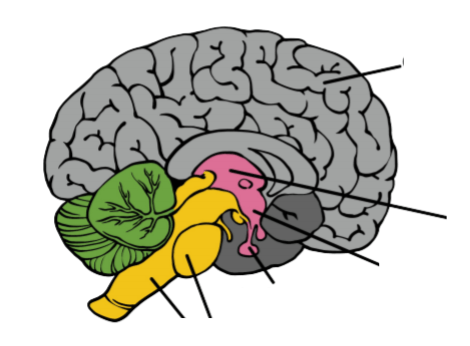
What structure is grey in this picture?
Cerebrum
Cerebellum
Brain Stem
The part of the PNS that controls involuntary actions
autonomic nervous system
somatic nervous system
organic nervous system
reflexive nervous system

_____ neurons carry messages away from the central nervous system and out to muscles or glands. The RED neuron in diagram.
sensory
motor
inter
central

Which lobe is in red?
Frontal
Occipital
Parietal
Temporal
Which lobe is in blue?
Frontal
Occipital
Parietal
Temporal
Which lobe is in yellow?
Frontal
Occipital
Parietal
Temporal
What are the functions of the muscular system. Select all the apply.
Helps you see
Helps you move
Helps fight diseases
Creates heat
Helps your heart beat
Muscles that you control are known as....
Involuntary
Fast Twitch
Voluntary
Slow Twitch
Muscles that you DO NOT control are known as ...
Involuntary
Fast Twitch
Voluntary
Slow Twitch
Of the 3 types of muscles, which muscles attach to bone.
Skeletal Muscle
Cardiac Muscle
Smooth Muscle
Skeletal Muscles is a __________________ muscle.
Voluntary
Involuntary
Cardiac muscle is a _______________ muscle.
Voluntary
Involuntary
Smooth muscle is a __________________ muscle.
Voluntary
Involuntary
Which type of human body tissue can contract, or shorten?
epithelial tissue
muscle tissue
connective tissue
nerve tissue
Which type of muscle is found only in the heart?
cardiac muscle
voluntary muscle
soft muscle
smooth muscle
How do pairs of skeletal muscles work together?
One muscle in the pair pulls on a bone, while the second muscle pulls on the first muscle.
While one muscle in the pair contracts, the other returns to its original length.
Both muscles extend at the same time.
One contracts and the other stretches.
Exercise is important for muscles because it
helps maintain strength and flexibility.
gives muscles more energy.
prevents muscles from becoming tired.
prevents muscle injuries.
Cells form tissues, tissues form organs, organs work together to form
lungs
organ systems
skin
heart

What is a group of cells that are alike and work together?
a cell team
a tissue
a cell family

A group of tissues that work together is a(n) ______________________.
cell
organ
organ system

Organs that work together are part of a(n) ________________________.
cells
tissue
organ system
What is the term for the control center for the entire body that sends signals from throughout the body to the brain?
circulatory system
respiratory system
excretory system
muscular system
nervous system
What is the term for the organ system that allows for the body’s movement, including voluntary and involuntary movement?
excretory system
respiratory system
nervous system
muscular system
digestive system
What organ system includes muscles in your arms and legs?
circulatory system
respiratory system
muscular system
nervous system
excretory system

What is the correct order of organization? (from simplest to most complex)
cells->tissue->organs->organ systems-> organism
tissue->cells->organs->organ systems-> organism
organs->organ systems-> organism->cells->tissue

Which of the following tissues is made up of cells that contract to move substances through the body and help the body move?
Epithelial
Connective
Muscle
What are the four main tissues found in the body?
Epithelial, Connective, Bone, Blood
Muscle, Connective, Blood, Epithelial
Nervous, Muscle, Connective, Epithelial

