wayground logo

Free Printable Worksheets

Font size

S
M
L
XL
Worksheets

U6 DNA

Total questions: 63

Worksheet time: 55mins

Name
Class
Date
1.
What does DNA stand for?
a)
Deoxyribose Nucleic Acid
b)
Denatured Natural Acid
c)
Do Not Accept
d)
I Don't Know
2.
What does DNA do?
a)

It stores and transmits heredity information

b)

It carries oxygen from the lungs to the body.

c)

  It tells you who you are.

d)

  It mostly provides energy to an organism.

3.
What is the shape of a DNA?
a)
Double Helix
b)
Base Pairing
c)
The shape of you
d)
Hydrogen Bonding
4.
Adenine, Cytosine, Guanine and Thymine are examples of
a)
DNA structure
b)
DNA bases
c)
DNA double helix
d)
Paired bases
5.
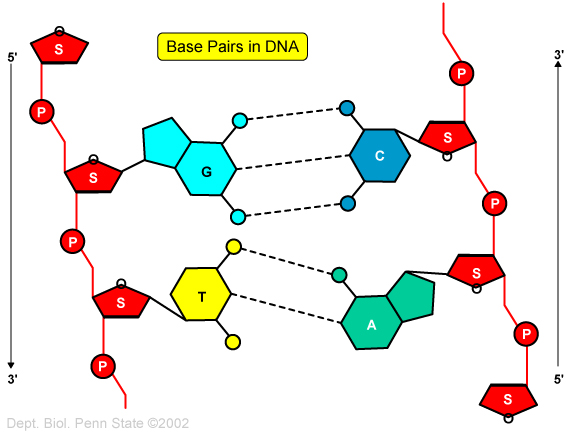
The rules of DNA pairing states that Adenine (A) always pairs up with
a)
Thymine
b)
Cytosine
c)
Adenine
d)
Guanine
6.
The rules of DNA pairing states that Cytosine (C) always pairs up with
a)
Thymine
b)
Cytosine
c)
Adenine
d)
Guanine
7.
The sequence of bases forms the
a)
Genetic Code
b)
DNA base pair
c)
Double Helix
d)
Paired bases
8.
What holds the DNA bases together?
a)
Hydrogen bonds
b)
DNA bases
c)
Double Helix
d)
Paired bases
9.

The 'backbone' or 'ribbon' of the DNA strand is made of:

a)

phosphate and sugar

b)

phosphate only

c)

phosphate and base

d)

sugar and base

10.

What is this a picture of?

a)

nucleotide

b)

DNA strand

c)

chromosome

d)

gene

11.

Who discovered that bacteria could be changed by the process of transformation?

a)

Griffith

b)

Hershey & Chase

c)

Avery

d)

Franklin

12.

Who discovered that A = T and C = G?

a)

Chargaff

b)

Franklin

c)

Watson & Crick

d)

Griffith

13.

Who took a picture of DNA using X-ray diffraction?

a)

Rosalind Franklin

b)

Watson & Crick

c)

Oswald Avery

d)

Hershey & Chase

14.

What is a virus that infects bacteria called?

a)

bacteriophage

b)

infectious virus

c)

transformation

d)

gene change

15.
The scientists who created an accurate model of the DNA double helix and won a Nobel Prize for this discovery
a)
Watson & Crick
b)
Watson, Crick, and Wilkins
c)
Wilkins & Crick
d)
Watson, Crick, Wilkins, and Franklin
16.
Which of the following units are repeatedly joined together to form a strand of DNA?
a)
amino acids
b)
nucleotides
c)
fatty acids
d)
polysaccharides
17.
Which organelle is DNA usually found in?
a)
cell membrane
b)
vacuole
c)
chloroplast
d)
nucleus
18.
Nitrogenous bases are joined by which type of bond?
a)
polar bonds
b)
ionic bonds
c)
covalent bonds
d)
hydrogen bonds
19.
What are the three components of a nucleotide?
a)
sugar, hydrogen, nitrogen base
b)
sugar, oxygen, nitrogen base
c)
sugar, phosphate, nitrogen base
d)
sugar, phosphate, protein
20.
DNA and RNA are macromolecules in the category of
a)
Proteins
b)
Lipids
c)
Nucleic Acids
d)
Carbohydrates
21.
Chargraff's Rule says that
a)
Adenine will be equal to Thymine
b)
Cytosine will be equal to Thymine
c)
Uracil will be equal to Guanine
d)
Adenine will be equal to Cytosine
22.
If there is 37% guanine how much cytosine is there?
a)
77%
b)
47%
c)
37%
d)
57%
23.
Franklin used x-ray crystallography to determine the shape of the DNA molecule is
a)
a cloverleaf
b)
a braided rope
c)
a pleated sheet
d)
a twisted ladder
24.

What process did Griffith discover using mice and altered forms of the pneumonia bacteria?

a)

transcription

b)

mutation

c)

transformation

d)

translation

25.

Which of the following scientists used radioactively labeled viruses to determine whether it was DNA or protein that was genetic material?

a)

Avery

b)

Hershey & Chase

c)

Griffith

26.

Which of the following scientists tried to develop a vaccine agains streptococcus pneumonia

a)

Avery

b)

Hershey & Chase

c)

Griffith

27.

Which of the following scientists used enzymes to break down DNA or protein in an attempt to determine which was heritable material?

a)

Avery

b)

Hershey & Chase

c)

Griffith

28.

Which of the following scientists concluded once and for all that DNA was the heritable material?

a)

Avery

b)

Hershey & Chase

c)

Griffith

29.
How did Rosalind Franklin's photo 51 affect the work of Watson and Crick? (picture is shown)
a)
It was used to determine the physical structure of DNA
b)
It was used to identify the four bases that make up DNA
c)
It was used to determine the theory of independent assortment
d)
It was used to show DNA was the molecule of inheritance
30.
Frederick Griffith named the two types of pneumonia bacteria
a)
R and S strains
b)
adenine and guanine
c)
bad and good strains
d)
watson and crick
31.
S-strain bacteria
a)
caused pneumonia
b)
had a smooth appearance
c)
was covered by a mucus-like coat
d)
all of these
32.
Griffith discovered
a)
that DNA was the genetic material
b)
that R-strain had transformed into S-strain
c)
that x-rays can take pictures of DNA
d)
that mice aren't very good for genetic studies
33.
Oswald Avery discovered
a)
DNA was the transforming principle
b)
that there is more phosphorus in DNA than in protein
c)
how viruses work
d)
the structure of DNA
34.
Which sequence of DNA bases would pair with this partiaal strand
ATG TGA CAG
a)
ATG TGA CAG
b)
TAC ACT GTC
c)
GTA AGT GAC
d)
CAT TCA CTG
35.
Why is DNA important?
a)
it is very small and very complicated
b)
it's in everything
c)
it serves as the blueprint for traits of all living things
d)
because we eat it every day for energy
36.
What are the 4 nitrogen bases?
a)
adenine, thymine, cytoplasm, and guanine
b)
adenine, thymine cytosine, and guanine
c)
adenine, thymine, cytosine, and gylcerol
d)
adenine, thymine, cytosine, and glucose
37.
Nucleotides are made up of a sugar, phosphate, and..?
a)
nitrogenous base
b)
nucleic acid
c)
cholesterol
d)
fatty acid
38.

This is a picture of ?

a)

Gene

b)

Chromosome

c)

Medicine

d)

Genotype

39.
When a mouse was injected with BOTH heat-killed S bacteria AND living R bacteria, the mouse ___________
a)
Died
b)
Lived
40.
Why did Hershey and Chase chose to study bacteriophages?
a)
They are only made of protein and DNA
b)
They are easy to keep alive in the lab
c)
It would help them cure cancer
d)
They are made of only DNA
41.
A bacteriophage is a __________ that infects _________.
a)
bacteria ... humans
b)
bacteria ... viruses
c)
virus ... bacteria
d)
virus ... humans
42.
Hershey and Chase wanted to find out which part of a bacteriophage ____________________.
a)
entered the bacteria cell
b)
was made of nitrogen
c)
was radioactive
d)
contained carbon
43.

What is a double-helix?

a)

A structure where 2 strands wind/twist around each other

b)

A structure where 1 strand winds/twists around itself

c)

A structure where 3 strands wind/twist around each other

d)

A structure where 4 strands wind/twist around each other

44.

Who utilized the "blender experiment" in their research?

a)

Erwin Chargaff

b)

Alfred Hershey & Martha Chase

c)

Francis Crick

d)

Rosalind Franklin

45.
Which enzyme has the job of unzipping the double helix?
a)
Helicase
b)
Polymerase
c)
Ligase
d)
Primerase
46.
Which enzyme fixes the Okazaki fragments in the lagging strand?
a)
Helicase
b)
Polymerase
c)
Ligase
d)
Primerase
47.
What are the gaps between the newly synthesized DNA on the lagging strand called?
a)
Okazaki fragments
b)
Polymer gaps
c)
Helicase fragments
d)
Acidic gaps
48.
This picture is illustrating the ____ nature of DNA.
a)
anti-parallel
b)
deoxyribosic
c)
helical
d)
radioactive
49.
The enzyme that splits open the DNA creates what's called a fork - where the DNA separates into the lagging strand and the ______ strand.
a)
leading
b)
leveraging
c)
Okazaki
d)
ligase
50.
Polymerase is able to replicate the new DNA ______ along the leading strand.
a)
continuously
b)
only in short fragments
c)
very slowly
d)
prokaryotically
51.
A DNA nucleotide contains all of the following, except...
a)
Deoxyribose
b)
Phosphate group
c)
Nitrogenous base
d)
Cholesterol
52.
What is the shape of DNA?
a)
Double helix
b)
Triple helix
c)
Flat, bilayer
d)
Three-pronged rigid ladder
53.
DNA replication turns one strand of DNA into two new strands of DNA. What percent of each new strand is the old strand?
a)
Half of each new DNA is the old DNA
b)
The old strand of DNA was digested, so none
c)
The new DNA is entirely made up of the old DNA
d)
About every sixth base comes from the old DNA
54.
Sometimes, DNA is called "semi-conservative." Why might this be?
a)
The old strand is "conserved" and used to make the new strands
b)
Uracil is "conserved" in that it is only used to make the new strands
c)
ATP is "conserved" via the usage of facilitated diffusion
d)
Ligase is "conserved" in that it is denatured by the process
55.

What enzyme is responsible for replicating DNA?

a)

RNA polymerase

b)

helicase

c)

DNA polymerase

d)

Ribosomes

56.

What does helicase break?

a)

ionic bonds

b)

hydrogen bonds

c)

hearts

d)

legs

57.

What part of the cell cycle does replication occur?

a)

S phase

b)

Prophase

c)

Metaphase

d)

G1

58.
synthesizes a short fragment of RNA that allows DNA polymerase III to bind
a)
ligase
b)
DNA polymerase I
c)
primase
d)
helicase
59.
If a DNA molecule is 18% Guanine which of the following is correct
a)
18% cytosine, 32% adenine, 32% thymine
b)
32% cytosine, 18% adenine, 32% thymine
c)
18% cytosine, 64% adenine, 64% thymine
d)
32% cytosine, 32% adenine, 18% thymine
60.

Which is the first step?

a)

DNA Helicase unwinds original DNA strand

b)

RNA Primase lays down RNA primer for new nucleotide bases.

c)

DNA polymerase builds new strands by bring in new nucleotide bases.

d)

Ligase knits together fragments on lagging strand

61.

Which is the second step?

a)

DNA Helicase unwinds original DNA strand

b)

RNA Primase lays down RNA primer for new nucleotide bases.

c)

DNA polymerase builds new strands by bring in new nucleotide bases.

d)

Ligase knits together fragments on lagging strand

62.

Which is the third step?

a)

DNA Helicase unwinds original DNA strand

b)

RNA Primase lays down RNA primer for new nucleotide bases.

c)

DNA polymerase builds new strands by bring in new nucleotide bases.

d)

Ligase knits together fragments on lagging strand

63.

Which is the fourth step?

a)

DNA Helicase unwinds original DNA strand

b)

RNA Primase lays down RNA primer for new nucleotide bases.

c)

DNA polymerase builds new strands by bring in new nucleotide bases.

d)

Ligase knits together fragments on lagging strand