Worksheets
Evolution Unit Review
Total questions: 63
Worksheet time: 1hrs 6mins


High levels of genetic variation will ______ survival.
increase
decrease
Those with increased "fitness" will most likely...
die from predator attacks
be the strongest in the population
survive and produce offspring
die after a short time and produce no offspring
Fruit bats have developed long thumbs that help them eat fruits.
Some fruit bats have developed especially strong long thumbs that help them remove the pit (seed) from the fruit.
Which of the following most likely led to the development of the fruit bats adaptation?
limited water
competition
food type
Otters are prey to alligators. Recently bobcats have begun to eat otters and they are faster than alligators. What will happen to the otter population?
the otters will force a mutation in their DNA to become faster
the slow otters will workout and train until their legs are faster
the fast otters will survive and reproduce to create a population of fast runners
Similarities in DNA between two different organisms most likely means...
they share a long lost relative
they share the same parents
they share a common ancestor

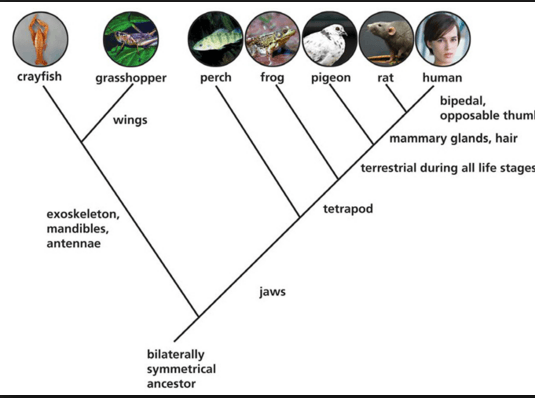
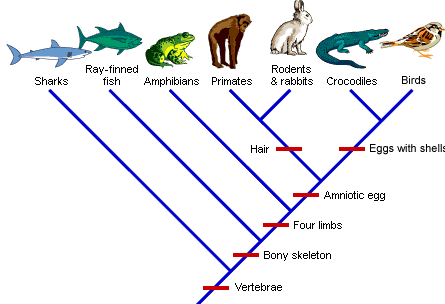
Which is least related to tiger?
lizard
human
shark

Evolution is the __________ of a species over ___________.
change, space
increase, geography
change, time
advancement, land
Which of the following types of evidence for evolution is the MOST reliable (contains the least number of errors)?
fossils
embryology
homologous structures
DNA
The hypothesis that evolution of a species occurs in periods of rapid change separated by periods of little or no change is called...
gradualism
speciation
punctuated equilibrium
isolation
The formation of a new species is called _________, which is typically the product of divergence.
reproductive isolation
subspecies
divergence
speciation
the loss of genetic diversity that occurs when a small number of individuals from a large population of a species establish a new population
founder effect
bottleneck effect
mutation
natural selection
A random change in the allele frequency of a population over successive generations
genetic variation
natural selection
speciation
genetic drift
they process by which traits or alleles become more or less frequent in a population depending on the advantage or disadvantage they confer on the survival and reproduction of the organism
mutation
speciation
natural selection
genetic drift
a change in the nucleotide sequence of an organism's genome (DNA)
natural selection
mutation
variation
adaptation
range of differences in DNA within a population or species
genetic variation
genetic drift
founder effect
mutation
selective breeding of plants and animals by humans
natural selection
bottleneck effect
directional selection
artificial selection
a limited variety of alleles in a population due to a dramatic decrease in population size
founder effect
bottleneck effect
antibiotic resistance
...you should study

Which 2 organisms would be able to reproduce and produce fertile offspring?
2 organisms in the same class
2 organisms in the same family
2 organisms in the same genus
2 organisms in the same species

The scientific name for an organism is made from the:
class and family name
genus and species name
domain and kingdom name
kingdom and phylum name
Term given to describe the 2 part (name) naming system is:
dichotmous key
binomial nomenclature
2 scientific names
binomial key

The taxon with the largest amount of organisms grouped together...
Species
Phylum
Kingdom
Domain

Which taxonomic group will have organisms that share the most traits?
domain
kingdom
species
class

The scientific name for a raccoon is written below in several different ways. Which one is written in the correct form?
Procyon lotor
Procyon lotor
Procyon Lotor
PROCYON LOTOR
How many Domains are there
10
2
3
6
I have cell walls
I am an autotroph
I am multicellular
What am I?
Plant
Animal
Eubacteria
Protist
I have no cell walls
I am eukaryotic
I reproduce sexually
I am multicellular
What kingdom do I belong to?
Plant
Animal
Protist
Fungi
I am unicellular
I am prokaryotic
I am found in extreme ecosystems
What kingdom do I belong to?
Protist
Plant
Animal
Archaebacteria
Which scientist studied taxonomy?
Mendeleev
Leeuwenhoek
Linnaeus
Darwin
I am a type of bacteria
Don't mistake me for archaea
I can be found almost anywhere
What am I?
Fungi
Protist
Eubacteria
Archaebacteria
The 4 eukaryote kingdoms are Animals, Plants, Fungi, and
Bacteria
Archaea
Humans
Protists
Which of these is a eukaryote?
bacteria living in your digestive system
archaea
bacteria living in food
mold
A heterotroph
cannot make its own food.
is able to make its food.
What characteristics are used to divide organisms into kingdoms?
number of cells, nucleus, obtaining energy
number of legs, mammal, reptile
obtaining energy, habitat, nucleus
number of cells, eggs or live birth, aquatic or terrestial
A FAMILY of organisms would be grouped into a LARGER taxonomic level of a
phylum
class
genus
order

Natural selection occurs when which of the following conditions are met?
individual organisms depend on each other to obtain available resources
variations between individual organisms lead to differential survival chances
habitat and nutrient resources in an area are plentiful over a long period of time
the conditions in an ecosystem support a wide range of living organisms
The frequency of a certain trait in a population will increase over many generations if which of the following is true?
the trait is carried by all members of the population but expressed only in a few
those organisms without the trait interbreed freely with those that have the trait
there is a sudden change in the environment that reduces the population with the trait
those organisms with the trait will have better reproductive success than those without it
Which of the following characteristics of eukaryotic cells is used to support the theory that they evolved from the union of free living cells?
the presence of mitochondrial DNA
the ability to transport materials across membrane
reproduction of mitotic cell division
differentiation of stem cells into specialized cells
Earth's early atmosphere was most likely made of carbon dioxide, ammonia and methane, with little or no oxygen. Which of the following supports the theory that organic compounds could have been formed from Earth's early atmospheric gases?
The Oparin-Haldane hypothesis
Photosynthetic cyanobacteria
mitochondrial DNA
The Miller-Urey experiment