wayground logo

Free Printable Worksheets

Font size

S
M
L
XL
Worksheets

PBS KC 2 review

Total questions: 74

Worksheet time: 58mins

Name
Class
Date
1.

Which statement about blood pressure is true?

a)

The top number of blood pressure reading represents the pressure exerted on the vessels when the heart is relaxing

b)

Factors that can increase blood pressure include stress, a high salt diet, and cholesterol buildup in the blood vessels

c)

Blood pressure can be measured directly with an EKG

d)

A blood pressure reading of 160/100 is considered a healthy blood pressure

2.

What is the term for distinct segments of DNA that differ from person to person?

a)

Chromosomes

b)

Traits

c)

Nucleotides

d)

Genes

3.
What are the base-pairing rules in DNA?
a)
A-C, G-T
b)
A-U, G-C
c)
A-T, G-C
d)
A-C, G-U
4.

The parents of a new baby believe they brought the wrong child home from the hospital. Gel electrophoresis was performed using DNA samples from the parents and the child. A section of the gel

electrophoresis results is shown below. Which conclusion is valid based on the gel electrophoresis results?

a)

They have the correct child, because her genetic information is identical to that of the father.


b)

They have the wrong child, because her genetic information does not match that of either parent.

c)

They have the correct child, because her genetic information came from both parents.


d)

They have the wrong child, because her genetic information matches only that of the mother.

5.

Which of the following genotypes is homozygous dominant?

a)

A

b)

Aa

c)

AA

d)

aa

6.

Which of the following genotypes is homozygous recessive?

a)

Tt

b)

tt

c)

TT

d)

tT

7.
Alternative forms of a gene are called
a)
Alleles
b)
Homozygous
c)
DNA
d)
Genetics
8.
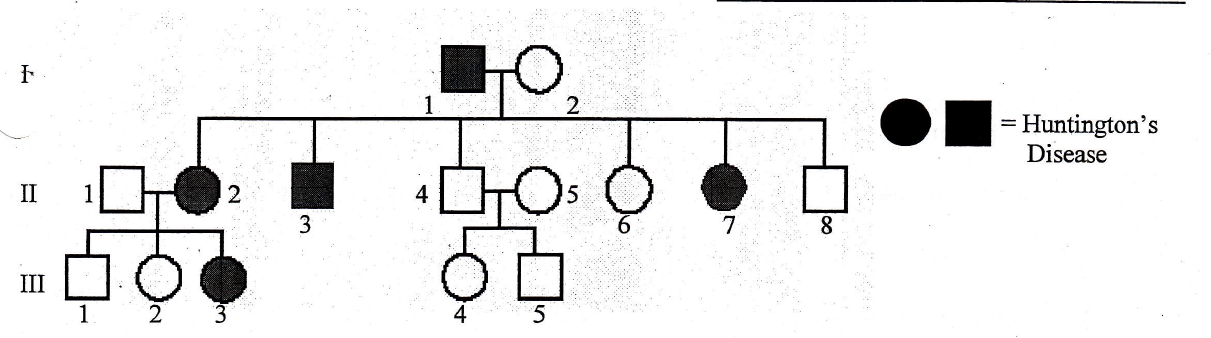
If this pedigree shows an autosomal recessive disorder, what MUST the genotype of individual II-3 be?
a)
HH
b)
Hh
c)
hh
d)
None of the above
9.
There are no carriers for Huntington's Disease- you either have it or you don't. Is Huntington's disease caused by a dominant or recessive trait?
a)
Dominant
b)
Recessive
10.
Determine the sex of the individual whose karyotype is displayed in the image.
a)
female
b)
male
11.
When chromosomes fail to separate correctly during anaphase of meiosis, what can occur?
a)
extra chromosomes are found in the sex cell
b)
chromosomes of the sex cell are doubled
c)
chromosomes of the sex cell are halved
d)
meiosis never completes
12.
Before a cell can divide, what must happen?
a)
Nothing, it is always ready to divide
b)
The number of chromosomes must be cut in half
c)
The number of chromosomes must double
d)
The number of chromosomes must triple.
13.
When you start with 1 cell, at the end of mitosis, how many identical cells will you have?
a)
1
b)
2
c)
3
d)
4
14.
After meiosis is complete, the new cells:
a)
are all identical
b)
are all different
c)
are half identical and half different
d)
are all stretched out
15.

All of the following are vital signs except...

a)

Temperature

b)

Blood Pressure

c)

Headache

d)

Pulse

16.

What is a "normal" blood pressure

a)

120/110 mmHg

b)

120/80 mmHg

c)

100/80 mmHg

d)

140/80 mmHg

17.

A device used to measure the pressure against the arteries of the body.

a)

apparatus

b)

gauge

c)

sphygmomanometer

d)

millimeter

18.

BMP stands for...

(a)  

19.

CBC stands for...

(a)  

20.

How do you analyze a blood test for abnormalities?

a)

Focus in on and interpret results that fall above the normal (healthy) range

b)

Focus in on and interpret results that fall below the normal (healthy) range

c)

Focus in on and interpret results that fall below and above the normal (healthy) range

d)

Focus in on and interpret results fall within the normal (healthy) range

21.

What do carbohydrates (like starch) get broken down into?

a)

proteins

b)

glucose

c)

amino acids

d)

oxygen

22.

What do proteins get broken down into?

a)

glucose

b)

starch

c)

oxygen

d)

amino acids

23.

Known as "Bad Cholesterol" that clogs arteries and can cause heart disease and stroke.

a)

LDL

b)

Trans-fats

c)

HDL

d)

Triglycerides

24.

Type of "Good Cholesterol" that takes extra cholesterol back to the liver

a)

Trans-fats

b)

LDL

c)

Triglycerides

d)

HDL

25.

How can you increase HDL levels?

a)

Increasing body weight

b)

Lower your saturated fat intake

c)

Exercising once a week for 20 minutes

d)

all of the above

26.
Cholesterol is needed by _____ cells in the body.
a)
no
b)
some
c)
most
d)
all
27.
What factors increase your risk for high blood cholesterol?
a)
Obesity
b)
Eating too much junk food
c)
Family History of high cholesterol
d)
All of these answers.
28.
No insulin is produced
a)
Type 1
b)
Type 2
29.

Type of diabetes characterized by insulin resistance

a)

Type I

b)

Type II

30.
The organ responsible for producing both insulin and glucagon is...
a)
Liver
b)
Heart
c)
Pancreas
d)
Gallbladder
31.

What is the function of insulin?

a)

diagnose diabetes

b)

turn glucose into energy

c)

help glucose enter the cells of the body

d)

all choices

32.
What is low blood sugar called?
a)
Hypoglycemia
b)
Hyperglycemia
33.

Which hormone is produced when the blood glucose concentration is below normal?

a)

insulin

b)

glucagon

c)

both insulin and glucagon

d)

neither insulin nor glucagon

34.

Which hormone converts glucose to glycogen?

a)

insulin

b)

glucagon

c)

both insulin and glucagon

d)

neither insulin nor glucagon

35.

Which hormone converts glycogen to glucose?

a)

insulin

b)

glucagon

c)

both insulin and glucagon

d)

neither insulin nor glucagon

36.
What does homeostasis mean?
a)
Temperature
b)
Water
c)
Cells
d)
Steady state
37.

Which of the following is not regulated by homeostasis?

a)

body temperature

b)

blood sugar

c)

blood pH

d)

body movements

38.

____________________ helps warm the human body when we are cold.

a)

sweating

b)

shivering

c)

inhaling oxygen

d)

exhaling carbon dioxide

39.
Homeostasis
a)
allows for a wildly fluctuating internal environment
b)
is impossible in vertebrates
c)
is the maintenance of a relatively stable internal environment and often incorporates a form of feedback regulation
d)
is the maintenance of a relatively stable external environment and often incorporates a form of feedback regulation
40.

Which of the following is an example of positive feedback?

a)

Thermoregulation

b)

Blood Pressure

c)

Childbirth

d)

Blood Sugar Levels

41.
chemical made by glands that tell cells to make something or respond in some way.
a)
acid
b)
enzyme
c)
perspiration
d)
hormone
42.
Negative Feedback Loops:
a)
amplify processes
b)
prevent small changes from getting larger
c)
are initiated during childbirth
d)
are found only in plants
43.
Name the levels of organization in the human body in order from smallest to largest:
a)
Tissue, organ, organ system
b)
Organ system, tissue, organs, cells
c)
Cells, tissue, organs, organ system
d)
Cells , organs, tissue, organ system
44.
The "cause" for something to happen is the
a)
response
b)
effect
c)
stimulus
d)
homeostasis
45.
When glucose levels in the blood rise, your brain sends a signal to your pancreas. The pancreas releases insulin, which opens channels in cell membranes to allow glucose to enter the cell, lowering blood sugar levels. 
a)
Positive Feedback Response
b)
Negative Feedback Loop 
46.
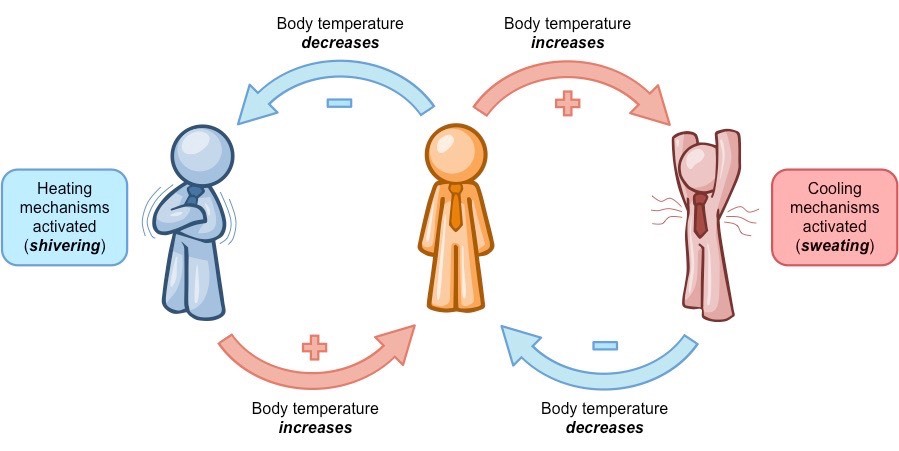
Maintaining body temperature is an example of a:
a)
negative feedback loop
b)
positive feedback loop
47.

In this body temperature feedback loop, predict what would happen if cooling mechanisms were NOT activated?

a)

The body would not warm up.

b)

The body would not cool down.

c)

Your body would get colder and colder.

d)

Your body would release lots of heat.

48.

Which of the following cause frameshift mutations?

a)

insertions and deletions

b)

translocations and nondisjunctions

c)

duplicaitons and deletions

d)

inversions and substitutions

49.
What are the two ways that genetic disorders can be inherited?
a)
Through blood transfusions and meiosis.
b)
Mutations in DNA and changes in structure or number of chromosomes.
c)
Missing chromosomes or premature egg splitting.
d)
Unhealthy environments and heredity.
50.
A doctor may use a _________ to examine the chromosomes in a cell.
a)
x-ray
b)
blood test
c)
karyotype
d)
hemoglobin
51.
In order to trace occurrence of a trait through several generations of a family, you could create a ____________.
a)
karyotype
b)
hemoglobin
c)
pedigree
d)
chromosomal map
52.
What disease is characterized by abnormally shaped red blood cells?
a)
hemophilia
b)
sickle cell anemia
c)
phenylketonuria
d)
Huntington's 
53.
Original: ATC CAT
Mutation: ATC GCAT
What mutation occurred?
a)
deletion
b)
insertion
c)
silent
d)
transverse
54.
Are all mutations bad?
a)
Yes
b)
No
c)
Maybe?
55.

Why are insertion and deletion mutations so harmful?

a)

They change all of the codons from the mutation on down the line, which changes the amino acid sequence

b)

They insert things that an organism doesn't need.

c)

They often delete things that organisms need.

d)

Insertion and deletions are not any more harmful than substitution mutations.

56.

What do gene mutations change?

a)

DNA

b)

RNA

c)

Proteins

d)

Lipids

57.
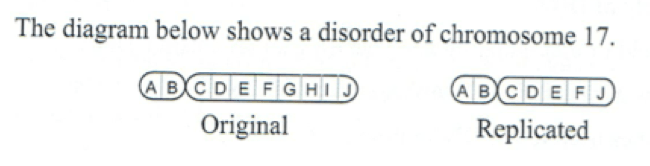
What type of chromosomal mutation has occurred?
a)
substitution
b)
insertion
c)
deletion
d)
nondisjunction
58.
Identify the SUBSTITUTION mutation form the following: 
ATG CCA AAT
a)
ATG TCA AAT
b)
ATG CCT AAA T
c)
ATC CA  AT
d)
ATG CCA AAT
59.

Which of the following are differences in the structure between RNA and DNA

a)

DNA uses deoxyribose sugar, RNA uses sugar ribose

b)

DNA pairs Adenine with Uracil, RNA pairs Adenine with Thymine

c)

DNA is a double helix, RNA is a single helix

d)

DNA pairs Adenine with Thymine, RNA pairs Adenine with Uracil

60.

Which organelle is the location where protein is made?

a)

Ribosome

b)

Nucleus

c)

Cytoplasm

d)

Nucleotide

61.

A string of nucleotides that contain the information to make a specific protein

a)

Ribose

b)

Amino Acids

c)

tRNA

d)

Gene

62.

During translation, this type of ribonucleic acid is responsible for delivering amino acids to help make a protein.

a)

mRNA

b)

rRNA

c)

tRNA

d)

dRNA

63.

Which of the following is the complementary mRNA sequence to this DNA strand: AACTGAA

a)

UUGACUU

b)

TTGACTT

c)

AACTGAA

d)

AACUGAA

64.
The process where DNA is transcribed to mRNA happens in what part of the cell?
a)
Nucleus
b)
Mitochondria
c)
Cytoplasm
d)
Endoplasmic Reticulum
65.
The function of ______ is to combine with proteins to form ribosomes.
a)
rRNA
b)
tRNA
c)
mRNA
d)
DNA
66.
The process where mRNA is read and made into an amino acid chain.
a)
Transcription
b)
Translation
c)
Transportation
d)
Transient
67.
What is the three base sequence of mRNA that codes for a single amino acid?
a)
Anticodon
b)
Codon
c)
Protein
68.
What is the mRNA strand that would result from the DNA template strand CCTA?
a)
GGAT
b)
CCAT
c)
GGAU
d)
CCAU
69.
What molecules do both DNA and RNA contain?
a)
uracil
b)
nucleotides
c)
thymine
d)
deoxyribose
70.
The DNA sequence ATCAGCGCTGGC is part of a gene. how many amino acids are coded for by this message?
a)
4
b)
8
c)
12
d)
20
71.
Which of the following is created in the nucleus and carries the genetic code to the cytoplasm?
a)
DNA
b)
tRNA
c)
mRNA
d)
rRNA
72.
Using the codon identify the amino acid sequence:
AUG-CCA-GUA-GGG-UAA
a)
MET-HIS-ALA-GLY-STOP
b)
MET-PRO-GLY-VAL-STOP
c)
MET-PRO-VAL-GLY-STOP
d)
MET-THR-SER-ASP-STOP
73.
What is the correct sequence?
a)
RNA --> DNA --> Protein
b)
Protein --> RNA --> DNA
c)
DNA --> RNA --> Protein
d)
DNA --> Protein --> RNA
74.
Which amino acid is made from the RNA codon UUA?
a)
Phenylalanine
b)
Leucine
c)
Serine
d)
Tyrosine