wayground logo

Free Printable Worksheets

NEW

Font size

S
M
L
XL
Worksheets

DNA/Protein synthesis and gene regulation

Total questions: 62

Worksheet time: 1hrs 8mins

Name
Class
Date
1.
Which two processes are involved in protein synthesis?
a)
Replication and Transcription
b)
Replication and Translation
c)
Transcription and Translation
2.
Within the eukaryotic cell, where does transcription occur?
a)
Nucleus
b)
Cytoplasm
c)
Ribosome
3.
Which of the following molecules is made during transcription?
a)
DNA
b)
tRNA
c)
protein
d)
mRNA
4.
Within the cell, where does translation occur?
a)
Nucleus
b)
Cytoplasm
c)
Ribosome
5.
Which of the following bases is found only in RNA?
a)
Adenine
b)
Guanine
c)
Thymine
d)
Uracil
6.
Which form of RNA contains the instructions for building a protein?
a)
amino RNA
b)
ribosomal RNA
c)
messenger RNA
d)
transfer RNA
7.
Which form of RNA carries amino acids from the cytoplasm to the ribosome?
a)
amino RNA
b)
ribosomal RNA
c)
transfer RNA
d)
messenger RNA
8.
Which form of RNA reads the instructions for protein assembly?
a)
amino RNA
b)
ribosomal RNA
c)
transfer RNA
d)
messenger RNA
9.
What are the three base segments of mRNA called?
a)
anticodons
b)
codons
c)
triplets
10.
What are the three base segments of tRNA called?
a)
anticodons
b)
codons
c)
triplets
11.
Transcribe the following sequence of DNA into RNA:
AAG   CTT   TGC
a)
TTC  GAA  ACG
b)
UUC  GAA ACG
c)
TTC  GUU  UCG
d)
UUC  GUU  UCG
12.
What is the monomer of DNA and RNA?
a)
amino acids
b)
nucleotides
c)
fatty acids
d)
monosaccharide
13.
Which of the following would be a DNA nucleotide?
a)
phosphate, deoxyribose, uracil
b)
phosphate, deoxyribose, thymine
c)
phosphate, ribose, uracil
d)
phosphate, ribose, thymine
14.
What type of bond holds together the two strands of the DNA double helix?
a)
Hydrogen Bond
b)
Peptide Bond
c)
Ionic Bond
d)
Disulfide Bond
15.
Which of the following terms refers to the two strands of the DNA double helix running in opposite directions?
a)
semi-conservative
b)
antiparallel
c)
inverted strands
d)
perpendicular
16.
What would be the complementary DNA strand for the following nucleotide sequence?
TCG ATA CGA
a)
AGC ATA GCT
b)
AGC TAT GCT
c)
AGC UAU GCU
d)
UGC TUT GCT
17.
Which scientist(s) discovered that in any sample of DNA, the amount of A = T and the amount of C = G?
a)
Griffith
b)
Avery
c)
Chargaff
d)
Franklin
18.
Which of the following terms means that in each molecule of DNA made during replication there is one original strand and one new strand?
a)
Antiparallel
b)
Semi-conservative
c)
Complementary base-pairing
19.
During which phase of the cell cycle is DNA replicated?
a)
G1 Phase
b)
S Phase
c)
M Phase
d)
G2 Phase
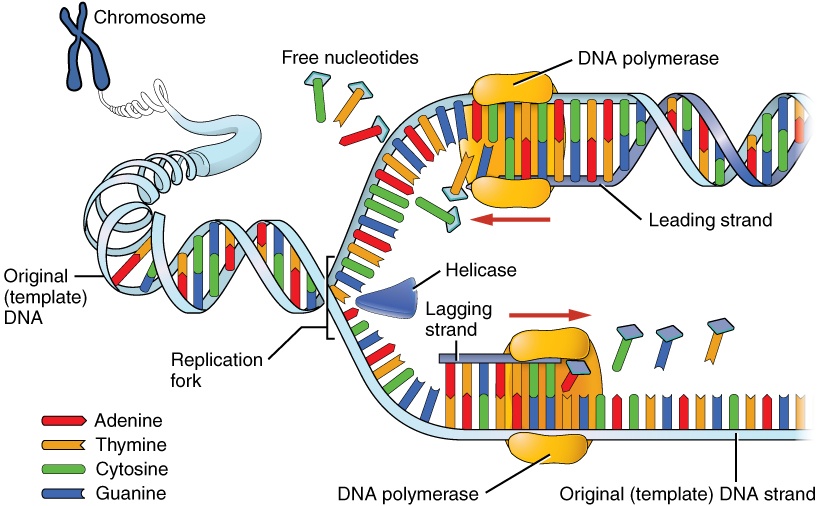
20.

What process is shown in the picture?

a)

commensalism

b)

deletion

c)

passive transport

d)

DNA replication

21.
Which of the following best describes a DNA molecule?
a)
double helix
b)
contains ribose
c)
made of amino acids
d)
contains Uracil
22.
What is the complement to the DNA strand below:
5'-ATGCCAT-3'
a)
5'-TACGGTA-3'
b)
3'-TACGGTA-5'
c)
3'-ATGGCAT-5'
d)
5'-ATGGCAT-3'
23.
What happens during transcription?
a)
DNA is made into amino acids
b)
DNA is made into mRNA
c)
DNA is made into a protein
24.
Where does transcription take place?
a)
Nucleus
b)
Ribosome
c)
tRNA
25.
What enzyme is responsible for making mRNA from DNA?
a)
DNA polymerase
b)
RNA ligase
c)
RNA polymerase
26.
Which of the following is a difference between DNA and RNA?
a)
DNA is single stranded, RNA is double stranded
b)
DNA has thymine, RNA has uracil
c)
There are 3 types of DNA, there is only 1 type of RNA
27.
Why doesn't DNA leave the nucleus?
a)
It could get damaged
b)
It could get locked out of the nucleus
c)
It doesn't want RNA to fell left out
28.
What happens during translation?
a)
mRNA matches up with tRNA to form a protein
b)
tRNA matches up with DNA to make a protein
c)
DNA is copied into mRNA
29.
Where does translation take place?
a)
Nucleus
b)
Ribosome
c)
Mitochondria
30.
What are proteins made of?
a)
DNA
b)
RNA
c)
Amino acids
31.
What is a change in the genetic material of a cell called?
a)
Transcription 
b)
Mutation
c)
Translation
32.
Which of the following is NOT a type of gene mutation?
a)
Deletion
b)
Substitution
c)
Translocation
33.
Which type of gene mutations cause frameshift mutations?
a)
Substitution and insertion
b)
Insertion and deletion
c)
Substitution and deletion
34.
What would the mRNA sequence be for the following DNA code; ATG?
a)
TAC
b)
UAA
c)
UAC
35.
Where are codons located?
a)
tRNA
b)
DNA
c)
mRNA
36.
DNA is changed from AAA to AAC. What kind of mutation is this?
a)
Substitution
b)
Insertion
c)
Deletion
37.
DNA is changed from TTT to TTG T. What type of mutation is this?
a)
Insertion
b)
Deletion
c)
Substitution
38.

The diagram shows a DNA nucleotide. Which of the following describes the components of a nucleotide?

a)

Sugar, phosphate, and nitrogen base

b)

Adenine, thymine, cytosine, guanine

c)

Sugar, phosphate, amino acid

d)

Glucose, phosphate, amino acid

39.

Which of the following best describes the complementary nature of DNA?

a)

In DNA, adenine always bonds with guanine.

b)

In DNA, guanine always bonds with thymine.

c)

In DNA, thymine always bonds with adenine.

d)

In DNA, thymine always bonds with cytosine.

40.

Which of the following best describes the structure of DNA?

a)

DNA is a double stranded molecule composed of 4 nitrogen bases: A, T, G, C

b)

DNA is a double stranded molecule composed of 4 nitrogen bases: A, U, G, C

c)

DNA is a single stranded molecule composed of 4 nitrogen bases: A, T, G, C

d)

DNA is a single stranded molecule composed of 4 nitrogen bases: A, U, G, C

41.

Which of the following best describes the type of bonds in a DNA strand?

a)

Sugars and phosphates are held by covalent bonds, while nitrogen bases are held by hydrogen bonds.

b)

Sugars and phosphates are held by hydrogen bonds, while nitrogen bases are held by nitrogen bonds.

c)

Sugars and phosphates are held by ionic bonds, while nitrogen bases are held by hydrogen bonds.

d)

Sugars and phosphates are held by hydrogen bonds, while nitrogen bases are held by ionic bonds.

42.

Katie is analyzing a particular DNA strand that's composition is 20% adenine. Which of the following represents the percent thymine?

a)

20%

b)

30%

c)

40%

d)

60%

43.

Katie is analyzing a particular DNA strand that's composition is 20% adenine. Which of the following represents the percent guanine?

a)

20%

b)

30%

c)

40%

d)

60%

44.

An mRNA strand is 15 bases long. How many amino acids will this likely produce?

a)

5, because there are 3 mRNA bases per codon

b)

4, because there are 3 mRNA bases per codon

c)

3, because there are 3 mRNA bases per codon

d)

3, because there are 5 mRNA bases per codon

45.

Protein Synthesis is often represented as: DNA --> mRNA --> protein. Which of the following is step 2 of protein synthesis?

a)

Transcription

b)

Translation

c)

Replication

d)

Respiration

46.

Which of the following best describes a stop codon?

a)

A stop codon signals that the protein is finished being built

b)

A stop codon signals that the ribosome needs to pause before continuing to build the protein

c)

A stop codon signals that the amino acid chain should break in half midway through construction

d)

A stop codon signals that the tRNA's should only retrieve 3 more amino acids to finish building the protein

47.

Which of the following best describes tRNA?

a)

tRNA matches the mRNA codon to an amino acid

b)

tRNA carries the genetic message from the nucleus to the ribosome

c)

tRNA is a component of the ribosome

d)

tRNA helps with mRNA construction during transcription

48.

Operons are found in the cells of which of the following types of organisms?

a)

prokaryotes

b)

eukaryotes

c)

animals only

d)

viruses

49.

What is the name of the stretch of DNA where RNA polymerase binds?

a)

operator

b)

promoter

c)

enhancer

d)

regulatory gene

50.

The "on/off" switch for an operon is called the

a)

promoter

b)

enhancer

c)

operator

d)

gene

51.

A key advantage of grouping genes with related functions is that a single "on-off" switch can control the whole cluster.

a)

True

b)

False

52.

What is a gene?

a)

A segment of RNA that encodes for a protein

b)

The portion of the chromosome that does not get transcribed

c)

A segment of DNA that encodes for a protein

d)

The collection of your chromosomes

53.
An operon consists of all the the following EXCEPT
a)
operator
b)
promoter
c)
regulatory gene
d)
genes of the operon
54.

A protein that binds to the operator and blocks the RNA polymerase

a)

inducer

b)

repressor

c)

activator

d)

corepressor

55.
A small molecule that binds to a repressor and makes it active
a)
repressor
b)
regulator
c)
activator
d)
corepressor
56.
A small molecule that binds to the repressor and makes it inactive is
a)
corepressor
b)
inducer
c)
promoter
d)
operator
57.

The repressor is the protein product of a(n)

a)

operator

b)

regulatory gene

c)

lac gene

d)

corepressor

58.

The tryptophan operon is

a)

permanently turned on.

b)

turned on when tryptophan is present in the growth medium.

c)

turned off only when glucose is present in the growth medium.

d)

turned off when tryptophan is added to the growth medium.

59.

In the lac operon model, the genes within the operon will be expressed if

a)

lactose is absent in the cell

b)

glucose is present in the cell

c)

lactose is present in the cell

d)

tryptophan is present

60.

The binding of repressors to operators are not reversible.

a)

True

b)

False

61.

The purpose of the lac operon is to produce enzymes that

a)

synthesize lactose

b)

use lactose

c)

synthesize tryptophan

d)

use tryptophan

62.

The lac operon is referred to as a(n) __________ operon.

a)

inducible

b)

repressible

c)

audible

d)

inaudible