wayground logo

Free Printable Worksheets

Font size

S
M
L
XL
Worksheets

Quarter 3 Review

Total questions: 56

Worksheet time: 1hrs 26mins

Name
Class
Date
1.
During a physics lab, a plastic strip was rubbed with cotton and became positively charged. The correct explanation for why the plastic strip becomes positively charged is that ...
a)
the plastic strip acquired extra protons from the cotton.
b)
the plastic strip acquired extra protons from the charging process 
c)
protons were created as the result of the charging process
d)
the plastic strip lost electrons to the cotton during the charging process 
2.
Insulators are different than conductors in that insulators ____.
a)
do not contain electrons or protons 
b)
 do not contain any charge
c)
have a weaker affinity for electrons 
d)
do not allow charge to freely move 
3.
Consider the conduction charging shown. 
a)
Electrons move from the insulating stand into the sphere.
b)
Protons move from the bar into the sphere.
c)
Electrons move from the charged metal bar into the sphere.
d)
Protons move from the sphere into the negatively charged bar.
4.
 A balloon is rubbed against a student's hair and then touched to a wall. The balloon sticks to the wall due to
a)
magnetic forces between the particles of the balloon and the particles of the wall
b)
electrostatic forces between the particles of the balloon and the particles of the wall
c)
magnetic forces between the particles of the wall
d)
electrostatic forces between the particles of the balloon
5.
A negatively charged plastic comb is brought close to, but does not touch, a small piece of paper. If the comb and the paper are attracted to each other, the charge on the paper
a)
must be positive
b)
must be negative
c)
may be neutral or negative
d)
may be neutral or positive 
6.
A positively charged rod is held near the knob of a neutral electroscope. What best describes what will happen to the leaves?
a)
the leaves will spread apart and be positive
b)
the leaves will spread apart and be negative
c)
the leaves will stay closed and be positive
d)
the leaves will stay closed and be negative
7.
Two electrically neutral metal spheres, A and B, on insulating stands are placed in contact with each other. A negatively charged rod is brought near, but does not touch the spheres, as shown in the diagram below. How are the spheres now charged?
a)
A is positive and B is positive.
b)
A is negative and B is positive.
c)
A is positive and B is negative.
d)
A is negative and B is negative.
8.
Which net charge could be found on an object?
a)
4.8 x 10⁻¹⁹ C
b)
1.8 x 10⁻¹⁹ C
c)
3.0 x 10⁻¹⁹ C
d)
2.8 x 10⁻¹⁹ C
9.
Metal sphere A has a charge of +12 elementary charges and identical sphere B has a charge of +16 elementary charges. After the two spheres are brought into contact and separated, the charge on sphere A is
a)
+14 elementary charges
b)
+28 elementary charges
c)
+2 elementary charges
d)
-2 elementary charges
10.
Electrostatic force F exists between two point charges. If the both charges are doubled, the force between the charges will be
a)
F
b)
4F
c)
2F
d)
F/4
11.
An electrostatic force of magnitude F exists between two metal spheres having identical charge q. The distance between their centers is r. Which combination of changes would produce no change in the electrostatic force between the spheres?
a)
doubling q on both spheres while halving r
b)
doubling q on one sphere while halving r
c)
doubling q on one sphere while doubling r
d)
doubling q on both spheres while doubling r
12.
Two similar metal spheres, A and B, have charges of +2.0 x 10⁻⁶ coulomb and +1.0 x 10⁻⁶ coulomb, respectively. The magnitude of the electrostatic force on A due to B is 4.0N newtons. What is the magnitude of the electrostatic force on B due to A?
a)
2.0N
b)
4.0N
c)
8.0N
d)
1.0N
13.
A metal sphere having an excess of +5 elementary charges has a net electric charge of
a)
8.0 x 10⁻¹⁹ C
b)
8.0 x 10¹⁹ C
c)
1.6 x 10⁻¹⁹ C
d)
5.0 x 10⁻¹⁹ C
14.
A negatively charged rod touches the knob of a neutral electroscope. Which  best represents the distribution of charge on the electroscope.
a)
both the knob and leaves become positive
b)
both the knob and leaves become negative
c)
the knob becomes negative and the leaves become positive
d)
the knob becomes positive and the leaves become negative
15.

Electric lines of force about negative point charge are

a)

Circular, anticlockwise

b)

Circular, clockwise

c)

Radial, outward

d)

Radial, inward

16.
At which point is the electric field the weakest?
a)
A because it is the furthest away
b)
A because the field lines are further apart
c)
C because the field lines are further apart
d)
C  because it is the furthest away
17.
Consider the electric field lines shown in the diagram below. From the diagram, it is apparent that object A is ____ and object B is ____.
a)
+,+
b)
+,-
c)
-,+
d)
-,-
18.
Which of the following is a true statement about the electric field between the two plates?
a)
The field is attractive between the plates and uniform in strength
b)
The field is repulsive between the plates and uniform in strength
c)
The field is attractive between the plates and strongest near the positive
d)
The field is repulsive between the plates and strongest near the positive
19.

Which graph best represents the relationship between the strength of an electric field and distance from a point charge?

a)
b)
c)
d)
20.
What does it mean when the electric field lines are close together?
a)
the field is positive
b)
the field is negative
c)
The field is strong
d)
the field is weak
21.
A point charge Q is far from all other charges. At a distance of 2 m from Q, the electric field is 20 N/C. What is the force a charge of 5 Coulombs feels?
a)
4 N
b)
100 N
c)
40 N
d)
10 N
22.

An electrostatic force of 2 X 10⁻² Newtons is exerted on a charge of 4 micro coulomb at point P in an electric field. The magnitude of the electric field intensity at P is

a)

5 X 10² N/C

b)

5 N/C

c)

50 N/C

d)

5000 N/C

23.
What voltage is needed to cause a 2A current flow through a 10Ω resistor?
a)
5V
b)
0.2V
c)
20V
d)
200V
24.
What resistance is needed to cause a 50A current flow because of a 500V battery?
a)
10Ώ
b)
c)
2500Ώ
d)
550Ώ
25.
This is an example of a _______ circuit
a)
open
b)
series
c)
parallel
d)
square
26.
If the voltage is increased and the resistance stays the same, current will ____.
a)
Increase
b)
Decrease
c)
Stay the same
d)
Not enough info
27.
Find total resistance
total current
and the voltage through resistor 3.
a)
60 Ohms, 0.4 A,  8 V
b)
60 Ohms, 2.5 A,  4 V
c)
90 Ohms, 2.5 A, 24 V
d)
60 Ohms, 0.4 A, 24 V
28.
What is the power of a 3V light bulb with 20 A running through it?
a)
0.15W
b)
6W
c)
60W
d)
6.67W
29.
If a battery produces 12.6 Volts, what would be the current for a 6 Ohm resistor?
a)
2.1 Amps
b)
75.6 Amps
c)
0.5 Amps
d)
15 Amps
30.
Two resistors are connected to a source of voltage as shown in the diagram below. At which position should an ammeter be placed to measure the current passing only through resistor R1?
a)
1
b)
2
c)
3
d)
4
31.
A 2.0-ohm resistor and a 4.0-ohm resistor are connected in series with a 12-volt battery. If the current through the 2.0-ohm resistor is 2.0 amperes, the current through the 4.0-ohm resistor is
a)
1.0 A
b)
2.0 A
c)
3.0 A
d)
4.0 A
32.
Where should an ammeter be located to correctly measure the total current and where should a voltmeter be located to correctly measure the total voltage?
a)
ammeter at 3 and voltmeter at 4
b)
ammeter at 1 and voltmeter at 4 
c)
ammeter at 2 and voltmeter at 3 
d)
ammeter at 1 and voltmeter at 2
33.
Resistors R1 and R2, connected in parallel, have an equivalent resistance of 6 ohms when connected in the circuit shown below. The resistance of R1 could be
a)
1 ohm
b)
4 ohms
c)
5 ohms
d)
8 ohms
34.
How much time is required for an operating 60-watt light bulb to use 120 joules of electrical energy?
a)
2 sec
b)
.2 sec
c)
.5 sec
d)
5 sec
35.
What is the voltage drop across the 36 ohm resistor?
a)
12V
b)
3V
c)
0.33V
d)
24V
36.
Two identical lamps, L1 & L2, are connected to a constant voltage power supply. The voltage drop across L1 is 36V. What is the voltage of the power supply?
a)
18V
b)
36V
c)
6V
d)
72V
37.
Two identical lamps, L1 & L2, are connected to a constant voltage power supply. The voltage drop across L1 is 36V. What is the voltage of the power supply?
a)
18V
b)
36V
c)
6V
d)
72V
38.
What is the power of a 3V light bulb with 20 A running through it?
a)
0.15W
b)
6W
c)
60W
d)
6.67W
39.

16. Which of the following I-V graph represents ohmic conductors?

a)

(a) A

b)

(b) B

c)

(c) C

d)

(d) D

40.

The strongest parts of the magnet are ...

a)

fronts

b)

backs

c)

poles

d)

middle

41.
In a longitudinal wave, the particles move...?
a)
back and forth
b)
up and down
c)
vertically
d)
in the direction of the hertz
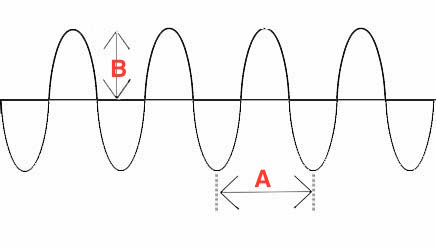
42.

What property of this wave is represented by the letter "A"

a)

amplitude

b)

crest

c)

trough

d)

wavelength

43.
The type of waves that require medium to pass:
a)
Mechanical Waves
b)
Electromagnetic Waves
44.
When the frequency of a wave increases, what happens to the wavelength?
a)
The wavelength is not directly affected by the frequency of a wave.
b)
The wavelength increases.
c)
The wavelength decreases.
d)
More specific information is needed to form a conclusion about the wavelength.
45.
The number of wavelengths that pass a point each per second is:
a)
frequency
b)
period
c)
longitudinal 
d)
transverse wave 
46.
All waves carry
a)
energy
b)
light 
c)
matter
d)
particles
47.

Which type of wave moves parallel to the direction of the wave?

a)

transverse

b)

longitudinal

c)

surface

d)

electromagnetic

48.
When the sound source moves, the frequency changes
ex. police car siren sounding lower pitch after the car passes
a)
pitch
b)
frequency
c)
Doppler Effect
d)
medium
49.

Standing waves are created by

a)

Two identical waves reflecting off each other

b)

Two identical waves being diffracted together

c)

Two identical waves move through each other in opposite directions

d)

Two identical waves are diffracted from two identical sources

50.

In the diagram which letters represent the nodes

a)

A B C

b)

A C E

c)

B D

d)

B D E

e)

A C D

51.

How many antinodes does this standing wave have?

a)

5

b)

6

c)

7

d)

8

52.
A wave in which the particles of the medium move perpendicularly to the direction the wave is traveling
a)
A. surface wave
b)
B. transverse wave
c)
C. electromagnetic  wave
d)
D. longitudinal wave
53.
When two waves combine to form a new wave with a smaller amplitude, it is called 
a)
Refraction
b)
Constructive Interference
c)
Resonance
d)
Destructive Interference
54.
When two waves combine to form a new wave with a smaller amplitude, it is called 
a)
Refraction
b)
Constructive Interference
c)
Resonance
d)
Destructive Interference
55.
 A wave has frequency of 50 Hz and a wavelength of 10 m. What is the speed of the wave?
a)
500 m/s
b)
50 m/s
c)
5 m/s
d)
0.5 m/s
56.
 A wave has frequency of 5 Hz and a speed of 25 m/s. What is the wavelength of the wave?
a)
25 m
b)
125 m
c)
5 m
d)
25 m/s