wayground logo

Free Printable Worksheets

Font size

S
M
L
XL
Worksheets

Final Review

Total questions: 114

Worksheet time: 1hrs 26mins

Name
Class
Date
1.

The voyage of the H.M.S Beagle took Darwin to

a)

Bahama Islands

b)

Italy

c)

China

d)

The Galapagos Islands

2.

Where do plants get the energy for photosynthesis to take place?

a)

nutrients in the soil

b)

the sun

c)

chlorophyll

d)

bee pollination

3.

What two things are the product (end result) of photosynthesis?

a)

Oxygen

b)

Glucose

c)

Chloroplasts

d)

Carbon Dioxide

4.

TRUE or FALSE: Animals can make their own food inside themselves.

a)

True

b)

False

5.

What is the waste product of photosynthesis?

a)

Oxygen

b)

Carbon Dioxide

c)

Glucose

d)

Chlorophyll

6.

Where do the stem and leaves get their green color from?

a)

glucose

b)

carbon dioxide

c)

oxygen

d)

Chlorophyll

7.

Which organelle is responsible making food (Glucose) using sunlight?

a)

Cell Membrane

b)

Nucleus

c)

Chloroplast

d)

Mitochondria

8.

Select all that are products of Photosynthesis.

a)

Water

b)

Carbon Dioxide

c)

Oxygen

d)

Sunlight (Light Energy)

e)

Glucose (Sugar/food)

9.
Why do plants conduct photosynthesis?
a)
To make light
b)
To make mitochondria
c)
To make glucose
d)
To release carbon dioxide
10.

Which of the following is the correct equation for PHOTOSYNTHESIS?

a)

light + carbon dioxide + water --> glucose + oxygen

b)

carbon dioxide + sugar + water --> oxygen + light

c)

oxygen + light + water --> carbon dioxide + sugar

d)

carbon dioxide + oxygen + water --> Light+ Sugar

11.
Which organisms perform Photosynthesis?
a)
Only Autotrophs
b)
Only Heterotrophs
c)
Autotrophs and Heterotrophs
12.
Which of the following is an example of an AUTOTROPH?
a)
Appletree
b)
Dog
c)
Mushroom
d)
Human
13.
Which of the following is the correct equation for PHOTOSYNTHESIS?
a)
CO+ light + H2O --> O+ Sugar
b)
CO+ sugar + H2O --> O+ light
c)
O2 + light + H2O --> CO+ Sugar
d)
CO+ O2 + H2O --> Light+ Sugar
14.
What is the pigment in chloroplasts that performs photosynthesis?
a)
Chlorosynthesis
b)
Chlorophyll
c)
ADP
d)
Electron Transport
15.
Most plants appear green because chlorophyll
a)
absorbs green light.
b)
absorbs violet light.
c)
does not absorb green light.
d)
does not absorb violet light.
16.
Which statement about photosynthesis is correct?
a)
Plants get the energy they need for photosynthesis from water.
b)
Plants get the energy they need for photosynthesis from soil.
c)
Plants get the energy they need for photosynthesis from sunlight.
d)
Plants get the energy they need for photosynthesis from carbon dioxide.
17.
Most plants appear green because chlorophyll
a)
absorbs green light.
b)
absorbs violet light.
c)
reflects green light.
d)
does not absorb violet light.
18.
What are the products of photosynthesis?
a)
Glucose and Chlorophyll
b)
Glucose and Oxygen
c)
Water and Light energy
d)
Carbon Dioxide and Light energy
19.
What are the products of photosynthesis?
a)
water and carbon dioxide
b)
oxygen and glucose
c)
oxygen and carbon dioxide
d)
oxygen and water
20.
Use the diagram to answer the question. Between which parts of the molecule must the bonds be broken to form an ADP molecule?
a)
A and B
b)
A and C
c)
B and C
d)
C and D
21.
What is the name of the simple sugar that is produced in photosynthesis?
a)
Sucrose
b)
Dextrose
c)
Glucose
d)
Lactose
22.
What is the correct equation for cellular respiration?
a)
6O2 + C6H12O6 -> 6CO2 + 6H2O + Energy
b)
6O2 + C6H12O6 + Energy -> 6CO2 + 6H2O
c)
6CO2 + 6H2O -> 6O2 + C6H12O6 + Energy
d)
6CO2 + 6H2O + Energy -> 6O2 + C6H12O6
23.

Which organism go through cellular respiration?

a)

animals

b)

plants

c)

both animals and plants

d)

none

24.

Cellular Respiration occurs in what cell organelle?

a)

chloroplast

b)

cytoplasm

c)

mitochondria

d)

animal

25.

Which molecule is the reactant of Glycolysis?

a)

water

b)

glucose

c)

carbon dioxide

d)

ATP

26.
What are the reactants of cellular respiration?
a)
glucose & carbon dioxide
b)
glucose & oxygen
c)
water & oxygen
d)
water & carbon dioxide
27.
The purpose of cellular respiration is to 
a)
make water
b)
make ATP
c)
make glucose
d)
make  oxygen
28.
When a phosphate group is removed from an ATP molecule, 
a)
a substantial amount of energy is released
b)
an enzyme is formed
c)
energy is stored
d)
activation energy is increased
29.
Please select who performs cellular respiration: 
a)
Animals 
b)
Both animals and plants 
c)
plants 
30.
These organisms get their energy from photosynthesis:  
a)
autotroph
b)
heterotroph
31.
Cellular respiration occurs in 
a)
chloroplasts 
b)
mitochondria
c)
golgi aparatus 
d)
thylakoid 
32.
Examples of a producer
a)
frog
b)
algae
c)
worm
d)
mouse
33.
What is this called?
a)
Food Web
b)
Food Chain
c)
Abiotic Factors
34.
Where does the energy start in this food chain?
a)
Plant
b)
Sun
c)
Deer
d)
Wolf
35.
What do the arrows show in a food chain picture?
a)
They always point to the smallest animals.
b)
They point to the animal that tastes the best.
c)
They always point to the producers.
d)
They point in the direction that energy is flowing.
36.
Which food chain is in the correct order?
a)
cat, grass, bird, snail
b)
bird, snail, grass, cat
c)
grass, snail, bird, cat
d)
grass, cat, bird, snail
37.
Which of these organisms would receive energy from the snake?
a)
Plant
b)
Rabbit
c)
Mouse
d)
Hawk
38.

The main source of energy for all of earth's food chains is the...

a)

sun

b)

water

c)

nutrients

d)

producers

39.

Plants produce their own food through...

a)

symbiosis

b)

photosynthesis

c)

genetics

d)

magic

40.

A herbivore is a...

a)

consumer that eats both plants and other animals

b)

consumer that only eats other animals

c)

consumer that only eats plants

41.

An omnivore is a...

a)

consumer that eats both plants and other animals

b)

consumer that eats only other animals

c)

consumer that eats only plants

42.

Animals that are not hunted and eaten by any animals are called...

a)

herbivores

b)

carnivores

c)

omnivores

d)

apex predators

43.

The level of apex predators in the food chain is...

a)

first

b)

second

c)

tertiary

d)

top

44.

Examples of decomposers are...

a)

plants

b)

animals

c)

bacteria and fungi

45.
What is a producer? 
a)
Organism that creates their own food.
b)
Organism that eat other organisms for energy
c)
Organism that eat other dead organisms
46.

Where do all life forms get their energy?

a)

Food

b)

Water

c)

Plants

d)

The Sun

47.
An animal that eats only plants is an...
a)
carnivore
b)
omnivore
c)
herbivore
d)
decomposer
48.

A food chain is:

a)

an animal that eats only plants.

b)

a diagram that shows how energy moves from one organism to another. (Grass>Mouse>Owl)

c)

An animal that is hunted and eaten by another animal.

49.

which one is a Producer?

a)
b)
c)
d)
50.
Which is the correct food chain order?
a)
Plant-->1st Consumer--> 2nd Consumer 
b)
Plant <-- 1st Consumer <-- 2nd Consumer
c)
2nd consumer     --> 1st consumer  --> Plant
d)
1st Consumer      --> 2nd consumer --> Plant
51.
The fox in this food web would be considered a:
a)
Tertiary Consumer
b)
Producer
c)
Secondary Consumer
d)
Primary Consumer
52.
The mouse in this food web would be considered a:
a)
Primary Consumer
b)
Producer
c)
Tertiary Consumer
d)
Secondary Consumer
53.
Which of the animals in this food web is a secondary consumer?
a)
Hawk
b)
Lizard
c)
Mouse
d)
Snake
54.
The primary consumer in this food chain is the ____________.
a)
Frog
b)
Eagle
c)
Grasshopper
d)
Python
55.

Why do people say adult lions are at the top of the food chain?

a)

Adult lions have no predators in the wild.

b)

Adult lions are prey for many different kinds of animals.

c)

Adult lions are producers and can make food on their own.

d)

Adult lions help other animals get food by hunting for them.
56.
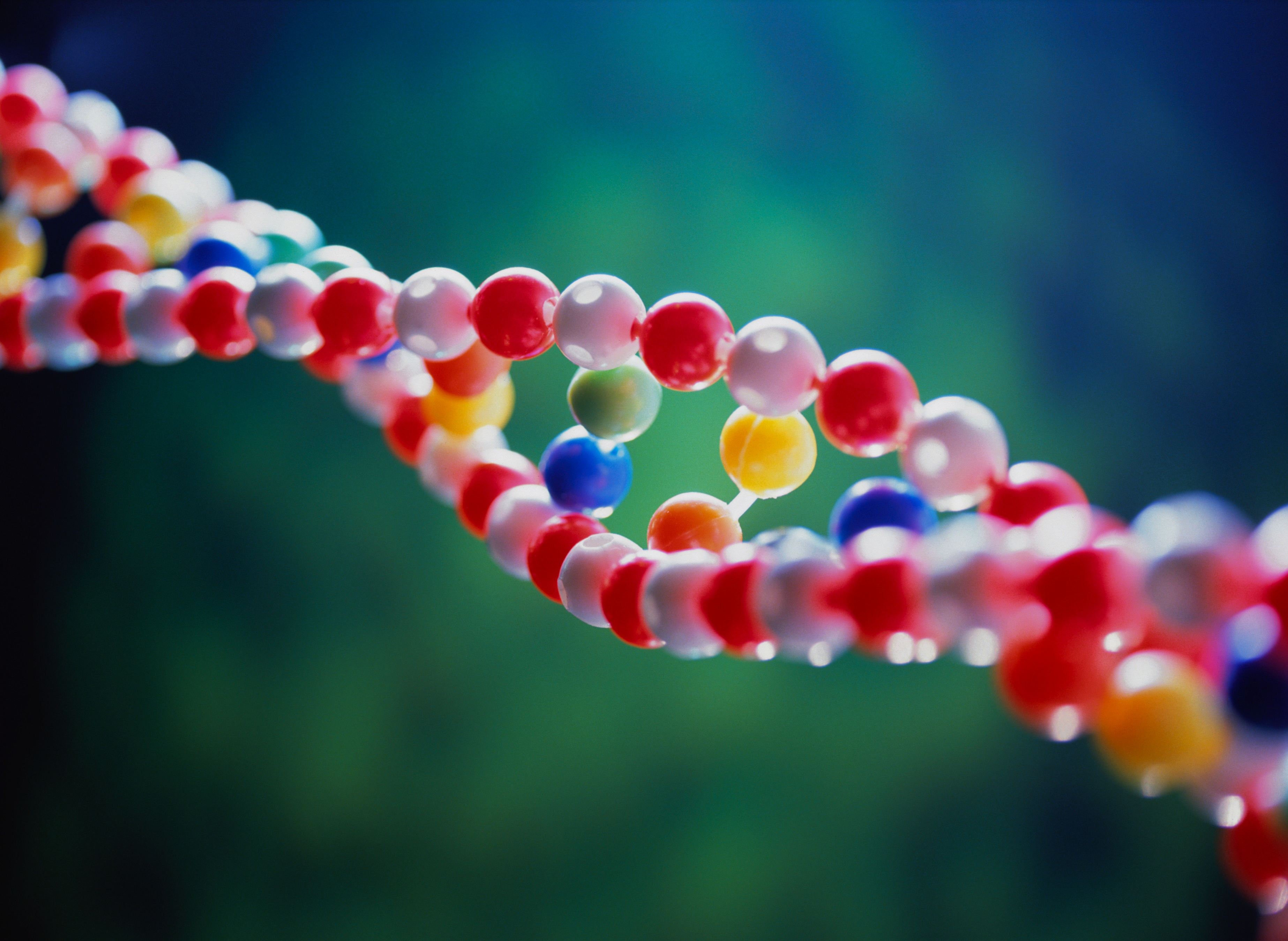
What are the nucleotides made of?
a)
Sugar, Phosphate, nitrogen base
b)
Phosphate, Adenine, nitrogen base
c)
Thymine, Adenine, Cytomine
d)
Phosphate, Nitrogen, Adenine
57.
Adenine bonds with ______________.
a)
Guanine
b)
Thymine
c)
Cytosine
d)
Adenine
58.
Guanine bonds with ______________.
a)
Adenine
b)
Guanine
c)
Cytosine
d)
Thymine
59.
Why is DNA important?
a)
it is very small and very complicated
b)
it's in everything
c)
it serves as the blueprint for traits of all living things
d)
because we eat it every day for energy
60.
Which sequence of DNA bases would pair with this partial strand
ATG TGA CAG
a)
ATG TGA CAG
b)
TAC ACT GTC
c)
GTA AGT GAC
d)
CAT TCA CTG
61.

In eukaryotes, which organelle is DNA usually found in?

a)

cell membrane

b)

vacuole

c)

chloroplast

d)

nucleus

62.
The sugar in DNA is ?
a)
sucrose
b)
glucose
c)
deoxyribose
d)
fructose
63.
What determines the code, or information, of a DNA molecule?
a)
the shape (structure) of the nitrogen bases
b)
the order (sequence) of the nitrogen bases
c)
the color of the nitrogen bases
d)
the frequency (number) of nitrogen bases
64.
The drawing shows the structure of what molecule?
a)
A DNA molecule
b)
A lipid molecule
c)
A carbohydrate molecule
d)
A protein molecule
65.
A long chain of amino acids is a/an
a)
protein
b)
nucleic acid
c)
tRNA
d)
mRNA
66.
If a DNA molecule consists of 29% Guanine, how much cytosine will it contain?
a)
29%
b)
58%
c)
21%
d)
I have no idea.
67.
How does RNA differ from DNA?
a)
RNA contains uracil and deoxyribose
b)
RNA contains ribose and thymine
c)
RNA contains uracil and ribose
d)
RNA contains adenine and ribose
68.
How would the DNA sequence GCTATA be transcribed to mRNA?
a)
GCUAUA
b)
CGATAT
c)
CGAUAU
d)
GCUTUT
69.
The process by which the genetic code of DNA is copied into a strand of RNA is called
a)
translation
b)
transcription
c)
transformation
d)
replication
70.
Which of the following describes RNA?
a)
RNA is usually double-stranded and contains the base thymine
b)
RNA is usually single-stranded and contains the base uracil
c)
RNA is longer than DNA and uses five bases to encode information
d)
RNA is made in the nucleus of eukaryotic cells and stays there to carry out its functions
71.
In messenger RNA, each codon specifies a particular
a)
nucleotide
b)
enzyme
c)
amino acid
d)
promoter
72.
The process of making proteins on the ribosome based on instructions from messenger RNA is called
a)
transcription
b)
transformation
c)
translation
d)
molecular biology
73.

Which type of mutation occurs when there is an addition or removal of a base?

a)

missense mutation

b)

nonsense mutation

c)

frameshift mutation

d)

point mutation

74.

Name the process happening at number 1 in the diagram.

a)

DNA Replication

b)

Translation

c)

Mutation

d)

Transcription

75.

Occurs when the DNA change does not alter the amino acid sequence of the polypeptide.

a)

Frameshift Mutation

b)

Insertion

c)

Missense mutation

d)

Silent Mutation

76.

TRUE or FALSE. The removal of one base to the DNA sequence might lead to a change on the succeeding (next) codon.

a)

True

b)

False

77.

The change in the second codon of DNA sequence from GAA to GAG does not affect the amino acid sequence. This is an example of ........................................

a)

Nonsense mutation

b)

Missense mutation

c)

Silent Mutation

d)

Frameshift Mutation

78.
Which of the following would result in a frameshift mutation?
a)
Insertions only
b)
Substitution only
c)
Deletion only
d)
Insertions and Deletions
79.
Where do mutations occur?
a)
DNA and RNA
b)
DNA 
c)
RNA
d)
mRNA and tRNA
80.

How many nucleotides make up a codon?

a)

1

b)

3

c)

5

d)

15

81.

How many codons: AAU GCG AUG

a)

9

b)

1

c)

3

d)

15

82.

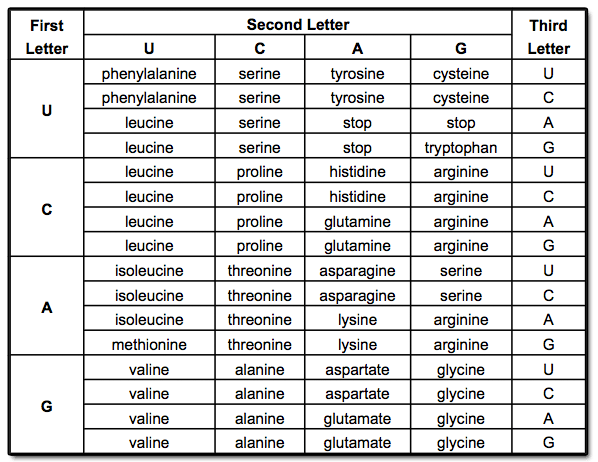
What amino acid would be added to the protein being formed during translation if the mRNA codon reads "CCU?"

a)

Isoleucine

b)

Stop

c)

Methionine

d)

Proline

83.
What is the correct amino acid sequence for the mRNA code AUGCCAGUAUGA
a)
Met-Pro-Ala-Val
b)
Met-Pro-Val
c)
Tyr-Gly-His
d)
Tyr-Gly-Arg-His
84.
Proteins are made of monomers called ___________
a)
Nucleotides
b)
Monosaccharides
c)
Amino Acids
d)
Glycerol and fatty acids
85.
DNA and RNA are examples of 
a)
Carbohydrates
b)
Lipids
c)
Proteins
d)
Nucleic Acids
86.
Nucleotides are monomers of
a)
Carbohydrates
b)
Lipids
c)
Proteins
d)
Nucleic Acids
87.
Monosaccharides are monomers of
a)
Carbohydrates
b)
Lipids
c)
Proteins
d)
Nucleic Acids
88.
Waxes, oils and fats are examples of
a)
Carbohydrates
b)
Lipids
c)
Proteins
d)
Nucleic Acids
89.
What is the function of nucleic acids?
a)
store genetic information
b)
store energy (long-term)
c)
store energy (short-term)
d)
build skin, hair, nails, muscles
90.
Which of the following organic compounds is the main source of energy for living things?
a)
carbohydrates
b)
lipids
c)
nucleic acids
d)
proteins
91.
Which macromolecule stores energy, insulates us, and makes up the cell membrane?
a)
lipids
b)
proteins
c)
carbohydrates
d)
nucleic acids
92.
What are the monomers of DNA?
a)
glycerols
b)
amino acids
c)
fatty acids
d)
nucleotides
93.
Lipids can be digested into what smaller subunits?
a)
nucleic acids
b)
amino acids
c)
fatty acids
d)
glucose
94.
All polymers are made up of...
a)
monosaccharides
b)
monomers
c)
proteins
d)
None of these
95.
Which is an example of a lipid?
a)
Candy
b)
Olive Oil
c)
DNA
d)
Meat
96.
How many sugar units make up polysaccharides?
a)
one
b)
two
c)
more than two
d)
zero
97.
An allele that is masked when a dominant allele is present. The "weaker" gene. 
a)
Dominant Allele
b)
Recessive Allele
98.
An allele whose trait always shows up in the organism when the allele is present. The "stronger" gene. 
a)
Dominant Allele
b)
Recessive Allele
99.
An organism’s physical appearance, or visible traits. 
a)
Genotype
b)
Phenotype
c)
Beanotype
d)
Notype
100.
What is called when a organism has  two different alleles for a trait. Tt or Rr
a)
Heterozygous
b)
Homozygous
c)
Domozygous
d)
Thermozygous
101.
What is called when a organism has two identical alleles for a trait. TT or tt. RR or rr
a)
Heterozygous
b)
Homozygous
c)
Domozygous
d)
Thermozygous
102.
Punnett squares can be used to predict the probability of:
a)
being exposed to a contagious disease and contracting it
b)
having an inherited disease or a genetically determined physical trait
c)
Both
103.
Scientists use capital and small letters to show the _____ of an organism. 
a)
genotype
b)
genetic disorder
c)
phenotype
d)
genome
104.
In a certain species of plant, the color purple (P) is dominant to the color white (p).
According to the Punnett Square, what is the probability of an offspring being purple?
a)
25%
b)
0%
c)
100%
d)
50%
105.
In a certain species of plant, the color purple (P) is dominant to the color white (p).
According to the Punnett Square, what is the probability of an offspring being white?
a)
25%
b)
0%
c)
100%
d)
50%
106.
Homozygous is when...
a)
the alleles are the same
b)
the alleles are different
c)
the alleles are absent
d)
the alleles are present
107.
Heterozygous is when...
a)
the alleles are the same
b)
the alleles are different
c)
the alleles are absent
d)
the alleles are present
108.
In a heterozygous genotype, the ___________ allele takes over in the phenotype.
a)
recessive
b)
dominant
c)
lower case letter
d)
both 
109.
T - tall and t = short
In the punnett square below, what belongs in the missing square
a)
tt
b)
Tt
c)
Bb
d)
TT
110.
B = brown fur  b = white fur
In the punnett square, what is the probability for white fur? 
a)
0%
b)
25%
c)
50%
d)
75%
111.
In the punnett square shown, what must the genotype of the missing parent be?
a)
BB
b)
Bb
c)
bb
d)
Tt
112.
Which of the following is a phenotype?
a)
Aa
b)
black hair
c)
heterozygous genes
d)
mutated DNA
113.
Dominant or recessive?
tt
a)
Dominant 
b)
Recessive
114.
This image shows a...
a)
Punnett Square
b)
Phenotype
c)
Genotype
d)
Dominant allele