
 Worksheets
Periodic Table Target Check #3
Total questions: 57
Worksheet time: 42mins
Density of transition metals is greater than the density of the Group 1 and 2 metals.
True
false
_______ melting and boiling point and high ________ compared with the melting in Groups 1,2 and 3.
middle
High
block
Densities
which of the elements below are defined as transition elements. you can choose more than one element
niobium
zinc
vanadium
platinum
scandium
Which of the following is not a common property of the transition metals?
They form multiple stable ions.
They are good catalysts.
they are mostly liquid or gas at room temperature
They form colorful ions.
The neutral particle in the nucleus of an atom is a:
Proton
Neutron
Electron
Shell
The positively charged particle in the nucleus of an atom is a:
Proton
Neutron
Electron
Shell
A tiny, negatively charged particle that moves around the nucleus of an atom in clouds/shells is called:
An electron
A proton
A neutron
A shell
The total number of protons and neutrons in an atom's nucleus is equal to the:
Atomic number
Atomic mass
Number of valence electrons
Number of electron shells
Q1: Which of the following is not a transition metal?
Cobalt
Rhodium
Zirconium
Potassium
Which of the following statements explains why platinum, palladium, and rhodium are used in converters in car exhausts?
Transition metals make good catalysts
Transition metals react slowly or not at all with acid.
Transition metals have high melting points.
Transition metals form colored compounds.
What is the name of group number 1?
halogens
noble gases
alkali metals
alkaline earth metals
What is the name of group number 2?
transition metals
halogens
metaloids
alkaline earth metals
who discovered the first scientific and systematic periodic table
Henry Mosley
Dmitri Mendeleev
John Dalton
sir Isaac Newton
Which one is correct about mendeleev's periodic law
Properties of elements are periodic function of their atomic mass
the physical and chemical properties of elements are periodic function of their atomic number.
physical properties of elements are periodic function of their atomic weight.
chemical properties of elements are periodic function of their atomic number.
Elements in the same group have __________
Similar Properties
Same number of shells
Similar Mass
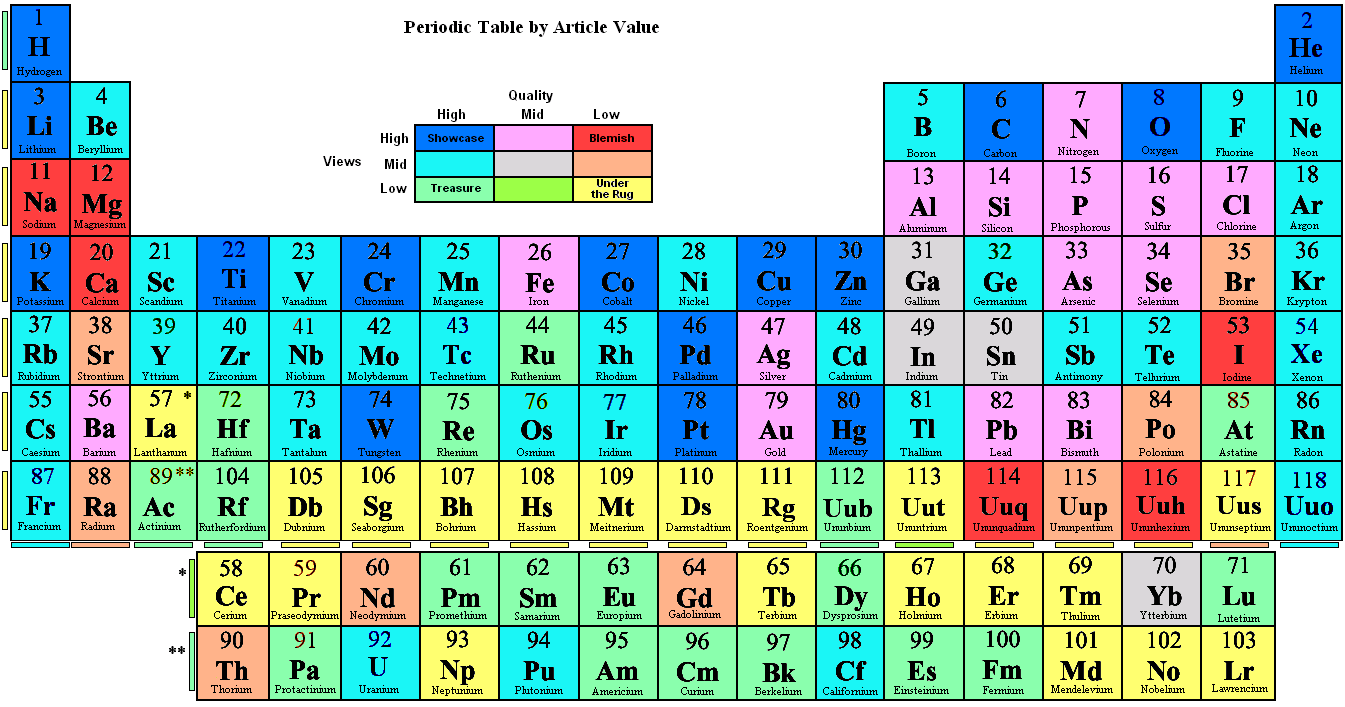



Which color on the image of the periodic table corresponds with the halogens.
red
black
blue
orange
Which color on the image of the periodic table corresponds with the lanthanides.
red
black
blue
orange
Which color on the image of the periodic table corresponds with the noble gases.
red
black
blue
orange
Which color on the image of the periodic table corresponds with the transition metals.
red
black
blue
orange
Which color on the image of the periodic table corresponds with the metalloids.
bright yellow
gold
teal
light blue
Which color on the image of the periodic table corresponds with the alkaline earth metals.
yellow
dark yellow
blue/green
teal

What did Mendeleev use to order the chemical elements?
Atomic weight
Atomic number
Number of protons
Number of electrons
How does the number of metals compare to the number of non-metals?
There are more non-metals than metals
There are more metals than non-metals
The number of metals and non-metals is exactly the same
The number of metals and non-metals is roughly the same
Which halogen is the most reactive?
Iodine
Bromine
Chlorine
Fluorine
How does the reactivity of halogens change as you move down the group?
It increases.
It decreases.
It stays the same.
Halogens do not react.
What do atoms of the same periodic group have in common?
They have the same atomic number.
They have the same chemical symbols.
The have similar chemical properties.
They have the same atomic mass.

Protons have a ____________ charge, neutrons have a ____________ charge, and electrons have a ____________ charge.
positive; negative, neutral
positive, neutral, negative
neutral, negative, positive
negative, neutral, positive

The history of the Atomic Theory involves many changes from its early form. Theories change because
people decide to no longer agree with them.
all theories must be changed after a certain time.
new evidence is found that allows the theory to be changed.
when scientists die, their theories are always changed.


What are the elements in group 1 (the far left) of the periodic table called?
Alkali metals
Alkaline earth metals
Halogens
Noble gases
What are the elements in group 2 of the periodic table called?
Alkali metals
Alkaline earth metals
Halogens
Noble gases
JJ Thomson discovered what subatomic particle
nucleus
neutron
proton
electron
Rutherford discovered what part of the atom
nucleus
neutron
proton
electron
First person to propose the concept of an atom
Rutherford
Democritus
Dalton
Bohr
Who proposed the theory that atoms orbit the nucleus in specific orbits.
Bohr
Democritus
Rutherford
Chadwick
Which of the following shows the correct order of Atomic Theory Timeline
Rutherford, Bohr, Dalton, Democritus, Thomson
Bohr, Democritus, Thomson, Rutherford, Dalton
Dalton, Thomson, Rutherford, Bohr, Democritus
Democritus, Dalton, Thomson, Rutherford, Bohr

