wayground logo

Free Printable Worksheets

NEW

Font size

S
M
L
XL
Worksheets

Weather & Catastrophic Events Test Review

Total questions: 56

Worksheet time: 2hrs 52mins

Name
Class
Date
1.
A sudden shift in the earth's crust is called a...
a)
Earthquake 
b)
Volcano 
c)
Tsunami
d)
Flood
2.
This catastrophic event starts by lightening or a camper...
a)
Volcano
b)
Tornado
c)
Wildfire
d)
Drought
3.
A large storm associated with low pressure, forms over water is called...
a)
Flood
b)
Hurricane
c)
Tsunami 
d)
Blizzard
4.
Debris from space is called...
a)
Tornado 
b)
Wildfire
c)
Volcano 
d)
Meteor
5.
A spinning funnel cloud which causes much destruction is called a...
a)
Tornado 
b)
Earthquake
c)
Tsunami 
d)
Hurricane 
6.
What catastrophic event is caused by an unusually large amount of water for an area?
a)
Hurricane
b)
Flood
c)
Blizzard
d)
Tsunami 
7.
A large wave created by an underwater earthquake is called a...
a)
Earthquake 
b)
Hurricane
c)
Tsunami 
d)
Flood
8.
An extensive amount of snow over a short period is called a...
a)
Blizzard
b)
Flood
c)
Tsunami 
d)
Hurricane 
9.
When lava or ash spew from a mountain vent, what catastrophic event does this describe? 
a)
Volcano 
b)
Drought
c)
Wildfire
d)
Meteor
10.
A long period with no rain is called a...
a)
Earthquake
b)
Wildfire
c)
Drought
d)
Tornado 
11.
One of the best places to seek protection during a tornado is...
a)
in the attic.
b)
beside either the stove or the refrigerator. 
c)
in the garage. 
d)
in the basement of a well-build building.  
12.
Hurricanes typically form over...
a)
cold ocean water. 
b)
tropical rain forests. 
c)
warm ocean water. 
d)
very dry land masses. 
13.

Which of the following devices measures air pressure?

a)
b)
c)
d)
14.

Why does it tend to be cool at the Earth's poles?

a)

They are farthest from the sun

b)

They have high absolute humidity

c)

They have the worst weather

d)

Sunlight strikes them at extreme angles

15.

What are the characteristics of a high-pressure system?

a)

Wind and rain

b)

Humidity and thunder

c)

Extremely hot temperatures

d)

Clear skies and sun

16.
Air pressure is greatest:
a)
closer to Earth
b)
farther from Earth
17.
The boundary  between two air masses is known as:
a)
front
b)
storm
c)
climate
d)
flood
18.
Cold air traveling south from Canada is:
a)
continental tropical
b)
continental polar
c)
maritime tropical
d)
maritime polar
19.
Warm air moving upwards from the Gulf of Mexico is:
a)
continental tropical
b)
continental polar
c)
maritime tropical
d)
maritime polar
20.
Warm air mass that does not carry water:
a)
continental tropical
b)
continental polar
c)
maritime tropical
d)
maritime polar
21.
Cold air mass that is carrying water is:
a)
continental tropical
b)
continental polar
c)
maritime tropical
d)
maritime polar
22.
This type of front can bring strong storms
a)
cold
b)
warm
c)
stationary
d)
occluded
23.
This type of front results in the same weather for several days
a)
warm
b)
cold
c)
stationary
d)
occluded
24.
This weather tool measures wind speed and direction
a)
thermometer
b)
barometer
c)
anemometer
d)
psychrometer
25.
Which front is represented on a map by a line with triangles attached to it? 
a)
Cold Front
b)
Warm Front
c)
Stationary Front
d)
Occluded Front
26.
Which front is represented on a map as a line with half circles attached to it?
a)
Cold
b)
Warm
c)
Stationary
d)
Occluded
27.
Hot air rises because...
a)
it is less dense
b)
it is heavier
c)
it is more dense
d)
it contains Helium
28.
The process the causes plate tectonics, wind, and ocean currents is known as...
a)
Radiation
b)
Conduction
c)
Nuclear Energy
d)
Convection
29.
What type of weather will occur with this symbol?
a)
Thunderstorms, cooler temperatures
b)
Gentle precipitation, warmer temperatures
c)
Sunny skies, warmer weather
d)
Cloudy skies, cooler weather
30.
This is the symbol for a... 
a)
Stationary Front
b)
Occluded Front
c)
Cold Front
d)
Warm Front
31.
This is the symbol for a... 
a)
Occluded Front
b)
Stationary Front
c)
Warm Front
d)
Cold Front 
32.
This is the symbol for a... 
a)
Stationary Front
b)
Occluded Front
c)
Cold Front
d)
Warm Front 
33.
This is the symbol for a... 
a)
Cold Front
b)
Warm Front
c)
Stationary Front
d)
Occluded Front 
34.
Air travels
a)
from high pressure to low pressure
b)
from low pressure to high pressue
35.

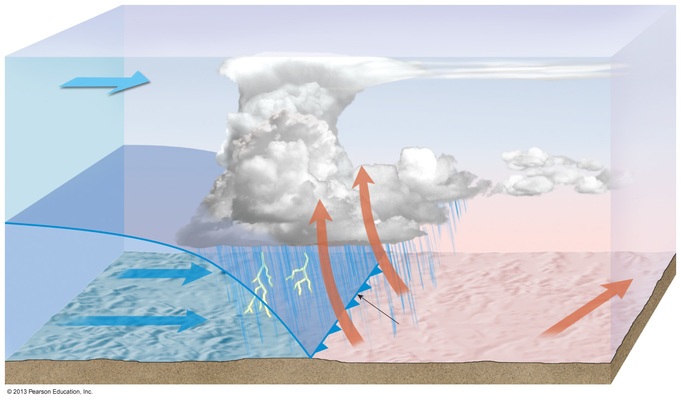
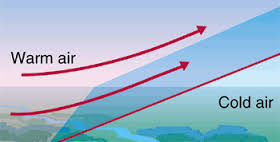
What type of storm front is this?

a)

warm front

b)

cold front

c)

stationary front

d)

occluded front

36.
Which type of front is pictured?
a)
Cold front
b)
Warm front
c)
Occluded front
d)
Stationary front
37.

Which one shows a warm front?

a)
b)
c)
d)
38.
  1. Which of the following is a true statement about hurricanes?
a)

They only affect the tropical areas

b)

They cannot be measured on any scientific scale

c)

Their winds are always above 74 miles per hour

d)

They cause more deaths every year than tornadoes and earthquakes

39.
  1. Which word best describes the eye of a hurricane?
a)

Tranquil

b)

Stormy

c)

Windy

d)

Cold

40.

The scale used to measure the size of hurricanes is called the __________.

a)

Saffir-Simpson Scale

b)

Cal-Ripkin Scale

c)

Richter Scale

d)

Bart-Simpson Scale

41.

The most dangerous type of hurricane has a score of __________.

a)

Category 1

b)

Category 3

c)

Category 5

d)

Category 4

42.

In the northern hemisphere of the earth hurricanes circle __________.

a)

clockwise

b)

counter-clockwise

c)

up and down

d)

front to back

43.

A Tsunami is caused due to

a)

Undersea Earthquake

b)

Lightning

c)

Heavy thunder

44.
Stretching rock so it becomes thinner in the middle is what kind of stress?
a)
tension
b)
compression
c)
shearing
45.
Squeezing rock until it breaks is what stress?
a)
tension
b)
compression
c)
shearing
46.
The hanging wall slides up and over the footwall is what kind of fault?
a)
strike-slip
b)
normal
c)
reverse
47.
What fault has little up or down motion?
a)
strike-slip
b)
normal
c)
reverse
48.
When the hanging wall slips downward below the footwall, what kind of fault is it?
a)
strike-slip
b)
normal
c)
reverse
49.
Which of these boundaries/stresses/faults all correctly go together?  Choose all that apply.
a)
normal, divergent, tension
b)
reverse, convergent, shearing
c)
strike-slip, transform, compression
50.
Rock layers undergo stress when they are squeezed at convergent boundaries. This stress is called:
a)
compression
b)
combining
51.
Rock layers undergo stress when they are stretched apart at divergent boundaries. This stress is called:
a)
tightening
b)
tension
52.
The surface along which rock break and slide past each other is called a:
a)
fracture
b)
fault
c)
joint
53.
A type of fault where rocks on either side move past each other sideways is called:
a)
normal fault
b)
reverse fault
c)
strike-slip fault
54.
How does a reverse fault form?
a)
The hanging wall moves upward relative to the footwall.
b)
Compression thrusts the fault into reverse.
c)
Blocks slide past each other.
d)
The hanging wall moves downward relative to the footwall.
55.
a)
normal fault
b)
reverse fault
c)
strike-slip fault
56.
The cat is standing on the...
a)
foot wall
b)
hanging wall
c)
left
d)
weirdest elevator ever