wayground logo

Free Printable Worksheets

Font size

S
M
L
XL
Worksheets

Geology

Total questions: 41

Worksheet time: 28mins

Name
Class
Date
1.

A rock is

a)

a collection of minerals that grow or are cemented together

b)

a naturally occurring, solid inorganic substance

c)

the remains of a once living organism

d)

any solid, non-living thing

2.

A mineral is

a)

a collection of minerals that grow or are cemented together

b)

a naturally occurring, solid inorganic substance

c)

the remains of a once living organism

d)

any solid, non-living thing

3.

When sediments are pressed together tightly, this is called ____________.

a)

Compaction

b)

Cementation

c)

Weathering

d)

Erosion

4.

The process when rocks and soil break into smaller pieces due to exposure to natural elements is called

a)

erosion

b)

weathering

c)

sediments

5.
This rock was formed by smaller pieces of rock that settled at the bottom of a lake millions of years ago. What type of rock is this?
a)
Sedimentary
b)
Igneous
c)
Metamorphic
6.
What are the 3 major types of rocks?
a)
Igneous, Metamorphic, Sedimentary
b)
Metamorphic, Igneous, Cementation
c)
magma, lava, crystals
7.

When sediments are glued together this is called ____________.

a)

Compaction

b)

Cementation

c)

Weathering

d)

Erosion

8.

The dropping of sediments in layers.

a)

compaction

b)

deposition

c)

erosion

d)

weathering

9.
What is the correct order of making and dropping off of sediments?
a)
weathering, erosion, deposition 
b)
erosion, weathering, deposition
c)
weathering, deposition , erosion
10.

The process by which running water, wind, or ice carry away bits of broken-up rock

a)

weathering

b)

sediment

c)

erosion

d)

cementation

11.
Wind and water have eroded this rock to show the layers of sediment that were laid down millions of years ago. What type of rock is this?
a)
Sedimentary
b)
Igneous
c)
Metamorphic
12.

Sara, a geologist, noticed her sedimentary rock had layers that were different colors. Which is the best reason why the layers were different colors?

a)

The layers were formed by different types of sediments

b)

The layers were exposed to heat which caused a chemical reaction

c)

Over time the layers have changed colors due to the rain and snow the rock was exposed to

13.

Mrs. Norris shook a jar full of jolly ranchers and ground them up in a mortar during our sedimentary rock lab. What natural process did this mimic?

a)

weathering

b)

erosion

c)

deposition

d)

compaction

14.
This rock is made of salts left behind when a shallow sea evaporated. What type of sedimentary rock is it?
a)
clastic sedimentary rock
b)
chemical sedimentary rock
c)
organic sedimentary rock
15.
This rock is made of large bits of gravel cemented together. What type of sedimentary rock is it?
a)
Clastic
b)
Chemical
c)
Organic
16.
This rock is made of the remains of dead sea creatures (which have turned into oil). What type of sedimentary rock is it?
a)
Clastic
b)
Chemical
c)
Organic
17.
A type of rock that forms from the cooling of molten rock at or below the surface of the earth
a)
Igneous Rock
b)
Metamorphic Rock
c)
Sedimentary Rock
d)
chemical Rock
18.
Igneous rock that forms from lava on Earth's surface
a)
Organic Rock
b)
Intrusive Rock
c)
Clastic Rock
d)
Extrusive Rock
19.
Igneous rock that forms when magma hardens beneath Earth's surface
a)
intrusive Rock
b)
compaction
c)
Chemical Rock
d)
Clastic Rock
20.
How do coarse-grained igneous rocks form?
a)
from sedimentary rocks changed under pressure
b)
from large rock particles cemented together
c)
from rapidly cooling lava
d)
from slowly cooling magma
21.

What statement is true about the sample of diorite shown?

a)

Diorite is an extrusive igneous rock--I know this because the crystals are large and easy to see

b)

Diorite is an intrusive igneous rock--I know this because the crystals are large and easy to see

c)

Diorite is fine-grained because its crystals are small and hard to see.

d)

Diorite is a mineral because of its crystal structure.

22.
This rock formed when bits of other rocks became pressed into a solid. What type of rock is it?
a)
Sedimentary Rock
b)
Metamorphic Rock
c)
Igneous Rock
23.
This rock was formed when molten rock cooled into a solid. What type of rock is it?
a)
Igneous Rock
b)
Metamorphic Rock
c)
Sedimentary Rock
24.
True or False: Once a rock is sedimentary, it cannot become an igneous rock.
a)
True
b)
False
25.
The process by which igneous rocks are formed...
a)
heat and pressure
b)
melting and cooling
c)
weathering and erosion
26.
The process by which metamorphic rocks are formed...
a)
heat and pressure
b)
erosion and deposition
c)
melting and cooling
27.

What type of rock might contain evidence of past life?

a)

Sedimentary Rock

b)

Igneous Rock

c)

Metamorphic Rock

28.

Which of the following lists the steps an igneous rock undergoes in order to become a sedimentary rock, in the correct order?

a)

Deposition, erosion, melting, cooling

b)

Erosion, weathering, eruption, cooling

c)

Dissolving, deposition, cooling, fracture

d)

Weathering, erosion, deposition, cementation
29.
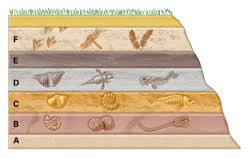
Which rock layer contains the newest fossils?
a)
F
b)
E
c)
B
d)
C
30.

What can the fossil record tell us?

a)

history of life on Earth

b)

groups of organisms changed over long periods of time

c)

Information about the past climate of our Earth

d)

information about the past environments and changes of the Earth's surface

e)

all of these are correct

31.

Which type of fossil is a mold that was filled in and then turned to rock?

a)

Cast Fossil

b)

Mold Fossil

c)

Trace Fossil

d)

True Form Fossil

32.
If heat and pressure inside the Earth cause a rock to melt, the material that formed would be
a)
Metamorphic
b)
Magma
c)
Sedimentary
d)
Igneous
33.
True/False: Igneous rocks can only turn into metamorphic rocks.
a)
True
b)
False
34.

Limestone is a sedimentary rock. During the rock cycle, limestone is changed into marble, a metamorphic rock. The processes that act on limestone and change it into marble are

a)

weather and erosion

b)

heat and pressure

c)

compacting and cementing

d)

melting, cooling, and hardening

35.
When particles are eroded and moved, they are eventually laid down in a process called: 
a)
deposition
b)
weathering
c)
supposition
d)
refraction
36.
Which parts of an organism are more likely to fossilize?
a)
the soft parts - skin, muscle
b)
the hard parts - bones, shells, stems
c)
all parts can become fossilized easily because the organism becomes buried by sediments
37.
According to the law of superposition, which layer is the youngest?
a)
A
b)
B
c)
C
38.

Fossils can provide evidence of how life has changed over time, how Earth's surface has changed, and clues about what past environments were like.

a)

True

b)

False

39.
Which layer formed first?
a)
Rock Layer W
b)
Rock Layer X
c)
Rock Layer Y
d)
Rock Layer Z
40.
If scientists found this fossil, what could they infer?
a)
what fish are like today
b)
that this fish lacked oxygen
c)
what kind of animal ate this fish
d)
that water once covered the area
41.

A paleontologists finds a fossil on a mountain top with foraminifera coiling to the right. Which of the following can they infer? (check all that apply)

a)

The environment used to be a desert

b)

The environment when this fossil formed was warm

c)

The environment used to be an ocean

d)

There were high levels of oxygen in the environment

e)

The mountain formed over 540 million years ago