wayground logo

Free Printable Worksheets

Font size

S
M
L
XL
Worksheets

Biology Leap review 4th period

Total questions: 61

Worksheet time: 1hrs 7mins

Name
Class
Date
1.
Which best represents one fundamental difference between the processes of mitosis and meiosis?
a)
meiosis results in 4 haploid cells, mitosis results in 4 diploid cells
b)
meiosis results in 4 haploid cells, mitosis results in 2 diploid cells
c)
meiosis results in 2 diploid cells, mitosis results in 2 haploid cells
d)
meiosis results in 2 diploid cells, mitosis results in 4 haploid cells
2.
The synthesis of a protein from an mRNA template is called ____________.
a)
transcription
b)
replication
c)
translation
d)
synthesis
3.
How do human diseases caused by bacteria and diseases caused by viruses react to antibiotics? 
a)
Neither responds to antibiotics.
b)
Both respond to antibiotics.
c)
Viral diseases respond to antibiotics; bacterial diseases do not.
d)
Bacterial diseases respond to antibiotics; viral diseases do not.
4.
The alleles Bb are:
a)
homozygous
b)
heterozygous
c)
homozygous recessive
d)
heterozygous dominant
5.
Where in the cell does cell respiration occur?
a)
chloroplast 
b)
central vacuole 
c)
mitochondria
d)
cell membrane
6.
During the winter time many plants lose their leaves, what happens to the process of photosynthesis?
a)
stays the same
b)
decrease
c)
no effect 
d)
increase 
7.
Where in the cell does photosynthesis occur?
a)
chloroplast 
b)
mitochondria 
c)
plasma membrane
d)
none of these 
8.

This type of respiration occurs in the presence of oxygen....

a)

aerobic respiration

b)

anaerobic respiration

c)

fermentation

d)

lactic acid fermentation

9.
This molecule stores and transmits our genetic information and remains in the nucleus 
a)
rRNA
b)
trna 
c)
DNA
d)
mRNA
10.
Building blocks of proteins are
a)
Simple sugars
b)
Amino acids
c)
Monosaccharides
d)
Polysaccharides
11.
Sugar, starch and cellulose are examples of
a)
Lipids
b)
Carbohydrates
c)
Proteins
d)
Nucleic Acids
12.

Which statements are associated with cellular respiration

a)

Occurs in the mitochondria

b)

Converts solar energy into chemical energy

c)

Occurs in the chloroplast

d)

Produces ATP

e)

Chemical Reaction

13.

Similar structures with different purposes found in different species are known as _____

a)

vestigial structures

b)

DNA

c)

homologous structures

d)

the fossil record

14.
The changes of species over time
a)
Embryonic 
b)
Natural selection 
c)
Mimicry 
d)
Evolution 
15.
The opossum and kangaroo both incubate their young in a pouch. This provides evidence that they---
a)
are descended from a common ancestor
b)
Have very similar skeletal structures
c)
belong to the same species
d)
must range great distances to eat
16.
Which is not evidence for evolution?
a)
many animals have homologous structures due to common ancestry
b)
Many animals have vestigial structures from an ancestor
c)
We can observe changes in life forms by observing the fossil record
d)
All of these are evidence for evolution
17.
How do fossils provide evidence that evolution has happened on Earth?
a)
Fossils show how the sizes of certain animals has changed drastically over millions of years
b)
Fossils show that some species have gone extinct
c)
Fossils show how life forms present today are different than those from the past
d)
Different sedimentary rock layers provide evidence for how the environment has changed over time
18.
If two organisms have similar traits of DNA they are probably
a)
share a common ancestor
b)
share a common environment
c)
share a common population
d)
speciation
19.

How does embryology support the Theory of Evolution?

a)

It shows that embryos who develop similarly share a common ancestor

b)

It shows that embryos who develop similarly are not related to one another

c)

It shows that organisms have the ability to evolve, or change, over time

20.
The different forms of genes are known as
a)
environment
b)
probability
c)
traits
d)
alleles
21.
An allele or gene that always shows is
a)
recessive
b)
dominant
c)
hidden
d)
present
22.
Two of the same genes for a trait (sometimes called purebred). BB or bb
a)
homozygous
b)
hetrozygous
c)
protein
d)
chromosome
23.
Two different genes for a trait (sometimes called hybrid). Bb
a)
protein
b)
homozygous
c)
heterozygous
d)
genotype
24.
What would the ratio for genotypes be for this Punnett Square?
a)
2Bb:2bb
b)
2BB:2Bb
c)
1BB:2Bb:1bb
d)
4Bb
25.
Which is a true statements about this picture?
a)
Brown is recessive
b)
Brown is dominant
c)
Blue is dominant
d)
Blue is codominant
26.
What are the possible phenotypes in this punnett square?
a)
Bb, bb, BB
b)
purple, white
c)
Bb, bb
d)
light purple
27.

During transcription, this type of ribonucleic acid is responsible for copying the DNA and brining it out of the nucleus.

a)

tRNA

b)

mRNA

c)

rRNA

d)

dRNA

28.
One human disease is caused by a change in one codon in a gene from GAA to GUA. The disease is a result of 
a)
a mutation
b)
crossing-over
c)
a meiosis error
d)
polyploidy
29.
Genetic info flows in one direction. Which best represents this flow?
a)
DNA-protein-RNA
b)
Protein-RNA-DNA
c)
RNA-protein-DNA
d)
DNA-RNA-protein
30.
The ingredients of photosynthesis are
a)
sugar and water.
b)
sugar and oxygen.
c)
carbon dioxide and water.
d)
carbon dioxide and oxygen.
31.
What are the products of photosynthesis?
a)
Carbon dioxide and water
b)
Carbon dioxide and oxygen
c)
Glucose and oxygen
d)
Glucose and water
32.
How can photosynthesis be related to cellular respiration?
a)
What's produced by one is needed for the other
b)
They both produce the same products
c)
They both have the same reactants (need the same things)
d)
These 2 processes have nothing in common
33.
Why is photosynthesis important?
a)
creates oxygen for animals to breath
b)
creates energy for heterotrophs to use
c)
creates food for plants to use
d)
all of these are correct
34.
The main source of energy for all life comes from ____.
a)
the Earth
b)
the moon
c)
the sun
d)
the food we eat/make
35.

What is the point of a feedback loop?

a)

To provide the body with more energy

b)

To provide the body with more food

c)

To make sure the conditions in the body are always changing

d)

To make sure the conditions in the body remain stable

36.

A feedback loop best fits which characteristic of life?

a)

Cells

b)

Organization

c)

Homeostasis

d)

Adaptation

37.
Failure to maintain homeostasis could result in:
a)
lack of internal balance
b)
eventual death
c)
difficulty carrying on metabolism 
d)
all three
38.

Stem cells becoming specialized cells (e.g. nerve, blood, skin, etc.) is called...

a)

cell fertilization

b)

cell differentiation

c)

cell division

d)

cell cycle

39.
All our cells, except sex cells like eggs or sperm, have ___________ DNA
a)
different
b)
similar
c)
exactly the same
d)
half the amount of 
40.
When you start with 1 cell, at the end of mitosis, how many identical cells will you have?
a)
1
b)
2
c)
3
d)
4
41.
You inherited...
a)
most of your chromosomes from your mother
b)
most of your chromosomes from your father
c)
a random number of chromosomes from each parent
d)
half your chromosomes from your mother and half from your father.
42.
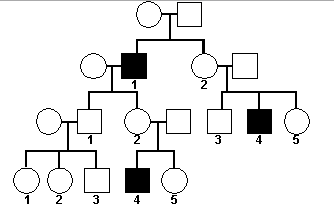
In a pedigree, what shape represents a male?
a)
circle
b)
square
c)
triangle
d)
diamond
43.
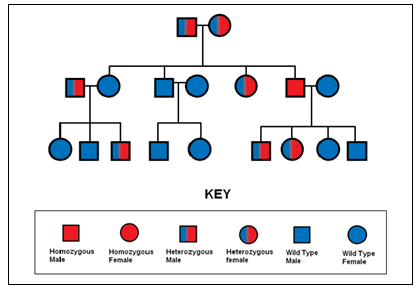
What type of heredity is shown in the pedigree?
(hint: check your notes - "modes of inheritance")
a)
Sex-Linked Dominant
b)
Sex-Linked Recessive
c)
Autosomal Dominant
d)
Autosomal Recessive 
44.
Hemophilia is a recessive sex-linked trait. If H = normal & h = has hemophilia, which genotype represents a male with hemophilia. 
a)
XHY
b)
XHXh
c)
XhXh
d)
Xh
45.

Look carefully at the image. If energy is lost as it moves up the food chain, what trophic level has the most amount of energy?

a)

1st level - producers

b)

2nd level - primary consumers

c)

3rd level - secondary consumers

d)

4th level - tertiary consumers

46.

A primary consumer

a)

makes its own food

b)

eats other animals

c)

is a carnivore

d)

consumes the producer

47.

How much energy is moved from one trophic level to the next trophic level?

a)

100%

b)

1/2

c)

10%

d)

25%

48.
The arrows in a food chain or web represents what?
a)
They point to the organism that is being eaten.
b)
It shows how sunlight flows within an ecosystem.
c)
They show what direction the energy is flowing between organisms. 
d)
They represent how water is transferred within a habitat.
49.

What is biomass energy?

a)

any organic matter that can be used by burning wood and other plant life.

b)

Radiant energy emitted by the sun.

c)

a combustible black or dark brown rock consisting mainly of carbonized plant matter, found mainly in underground deposits and widely used as fuel.

d)

made by tapping into steam or hot water reservoirs underground; the heat is used to drive an electrical generator.

50.

What happens if a population grows past its carrying capacity?

a)

The population keeps growing

b)

The population starts to die off

c)

The entire species will go extinct

d)

The carrying capacity just increases

51.

Something that regulates the size of a population is called...

a)

a limiting measure

b)

a limiting factor

c)

carrying capacity

d)

biodiversity

52.

Needs a HOST to reproduce and spread in

a)

Bacteria

b)

Virus

53.

Can be TREATED with ANTIBIOTICS

a)

Bacteria

b)

Virus

54.

Can infect organisms

a)

Bacteria

b)

Virus

c)

Both bacteria & virus

d)

Neither bacteria nor virus

55.

Who...is non-living, doesn't have a cell structure and can be prevented with a vaccine?

a)

Bacteria

b)

Virus

56.
The chicken pox is spread via contact from person to person. In order to prevent getting the chicken pox, you can get a vaccination. Is chicken pox caused by a virus or a bacterium?
a)
Bacterium
b)
Virus
57.

What is the purpose of cellular respiration?

a)

to make food

b)

to release energy from food

c)

to take in food

d)

to release oxygen

58.
This type of nutrition occurs when organisms make their own food...
a)
heterotroph
b)
autotroph
c)
consumer
d)
primary consumer
59.
Which of the following describes RNA?
a)
RNA is usually double-stranded and contains the base thymine
b)
RNA is usually single-stranded and contains the base uracil
c)
RNA is longer than DNA and uses five bases to encode information
d)
RNA is made in the nucleus of eukaryotic cells and stays there to carry out its functions
60.

How prepared are you for the leap 2025 that takes place May 5 and May 6? 1 being not at all and 5 being totally prepared

a)

1

b)

2

c)

3

d)

4

e)

5

61.
What reactant drives photosynthesis?
a)
carbon dioxide 
b)
oxygen 
c)
water 
d)
sunlight