Wayground logo

Free Printable Worksheets

Font size

S
M
L
XL
Worksheets

Biology Spring Semester Final Review

Total questions: 81

Worksheet time: 2hrs 2mins
Name
Class
Date
1.
Why is DNA important?
a)
it is very small and very complicated
b)
it's in everything
c)
it serves as the blueprint for traits of all living things
d)
because we eat it every day for energy
2.
Which 2 molecules form the sides (backbone) of the DNA ladder?
a)
deoxyribose sugar and adenine
b)
deoxyribose sugar and a hydrogen bond
c)
deoxyribose sugar and the nucleus
d)
deoxyribose sugar and phosphate
3.
Nitrogenous bases are joined by which type of bond?
a)
polar bonds
b)
ionic bonds
c)
covalent bonds
d)
hydrogen bonds
4.
What are the three components of a nucleotide?
a)
sugar, hydrogen, nitrogen base
b)
sugar, oxygen, nitrogen base
c)
sugar, phosphate, nitrogen base
d)
sugar, phosphate, protein
5.
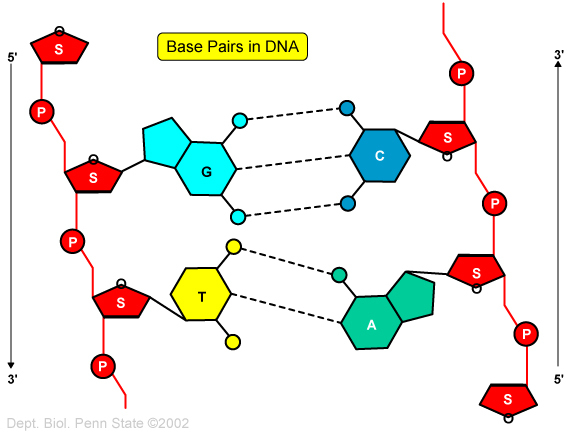
Cytosine always pairs with
a)
Adenine
b)
Thymine
c)
Uracil
d)
Guanine
6.
What is the complement to the DNA strand below:
5'-ATGCCAT-3'
a)
5'-TACGGTA-3'
b)
3'-TACGGTA-5'
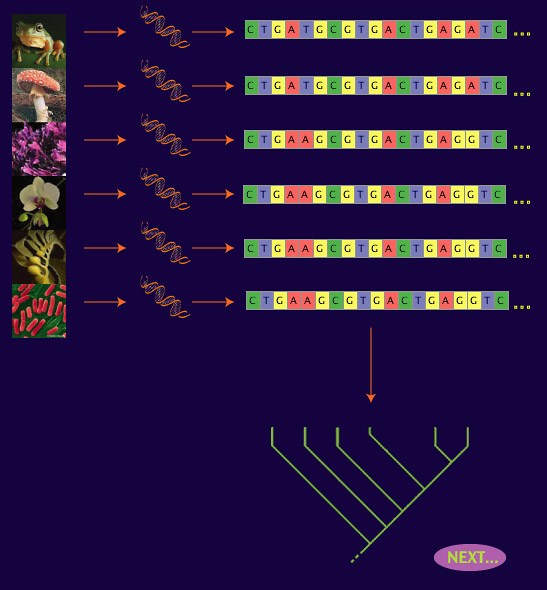
c)
3'-ATGGCAT-5'
d)
5'-ATGGCAT-3'
7.
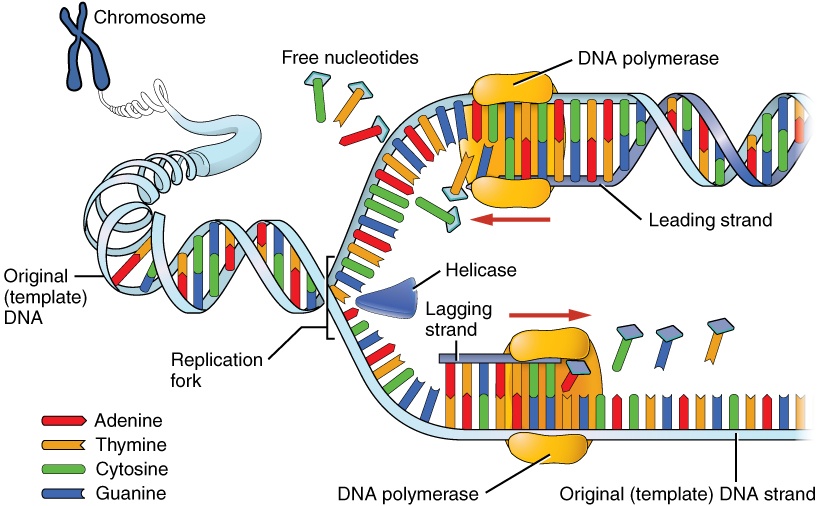
The enzyme that unwinds the DNA to prepare for replication
a)
helicase
b)
replicase
c)
polymerase
d)
synthase
8.
order of replication
a)
3, 4, 2, 1
b)
3, 1, 4, 2
c)
2, 1, 4, 3
d)
3, 4, 1, 2
9.

Site where replication begins

a)

Polymerase action site

b)

Replication fork

c)

Replication Origin

d)

In the front

10.
Bob was found dead in his home.  Crime scene analysis showed signs of a struggle.  Blood was collected from the crime scene, the victim, and three suspects.  Which suspect likely committed the crime? 
a)
Sue
b)
Lisa
c)
John
d)
None of these
11.
Which of the following is the template for the production of RNA within a cell?
a)
DNA
b)
protein
c)
ATO
d)
carbohydrate
12.
Which of the following best describes how DNA and RNA are similar?
a)
they both contain A and T
b)
They both have a double helix
c)
They are both composed of 5 different nucleotides
d)
they both have C and G
13.
The DNA sequence ATCAGCGCTGGC is part of a gene. how many amino acids are coded for by this message?
a)
4
b)
8
c)
12
d)
20
14.
The process to go from DNA to mRNA is _______
a)
translation
b)
transcription
c)
replication
15.
The main function of tRNA is to...
a)
carry a message that, when translated, forms proteins
b)
form a portion of ribosomes
c)
string together complementary RNA and DNA strands
d)
bring amino acids from the cytoplasm to the ribosomes
16.
The process to go from mRNA to a protein is called ____
a)
transcription
b)
rRNA
c)
replication
d)
translation
17.
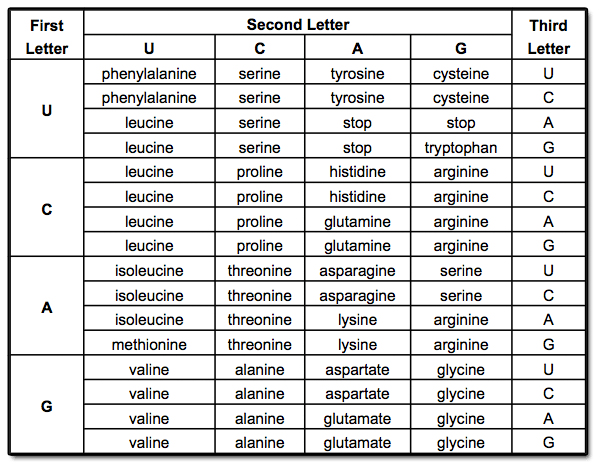
What amino acid is represented by the codon UUA?
a)
Phenylalanine
b)
Tyrosine
c)
Leucine
d)
Stop codon
18.
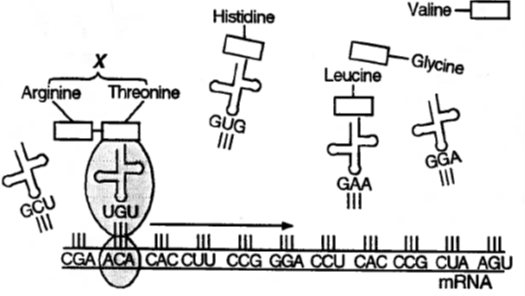
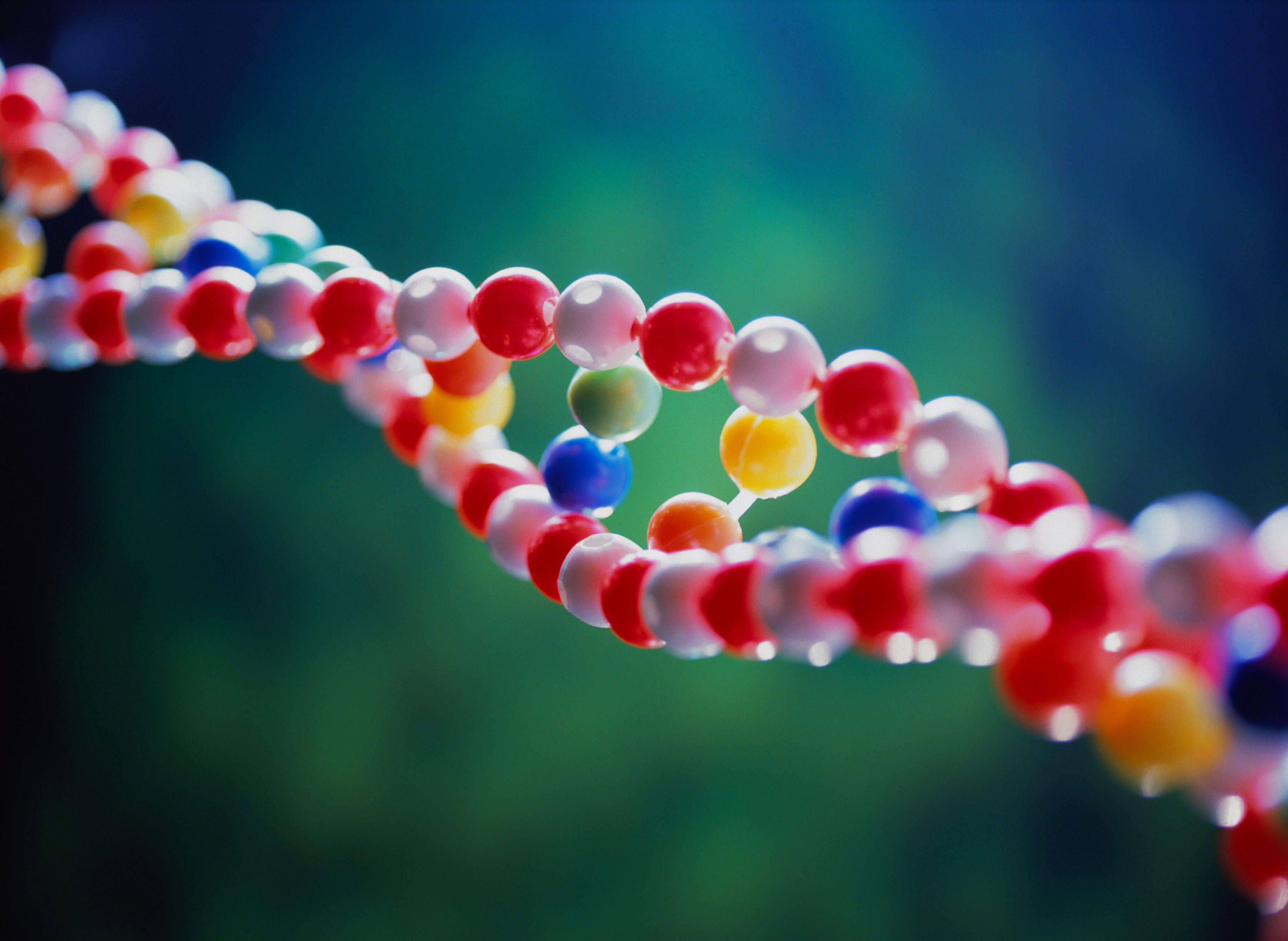
What process is going on in this photo? 
a)
Transcription 
b)
Translation 
c)
Replication 
d)
All the above 
19.
A virus acts like a...
a)
leukocyte
b)
parasite
c)
parachute
d)
paramedic
20.
Among the following, the term that includes the others is ___.
a)
interphase
b)
nuclear division
c)
mitosis
d)
cell cycle
21.

Identify the phase of mitosis shown

a)

prophase

b)

metaphase

c)

anaphase

d)

telophase

22.
Which phase comes NEXT?
a)
prophase
b)
metaphase
c)
anaphase
d)
telophase
23.
During which stage of the cell cycle does the cell spend a majority of its time?
a)
Prophase
b)
Interphase
c)
Metaphase
d)
Cytokinesis
24.
How does cytokinesis differ in plant and animal cells?
a)
Cytokinesis only takes place in animal cells.
b)
Cytokinesis only takes place in plant cells.
c)
Plant cells form a cell plate, animal cells form a cleavage furrow.
d)
Animal cells form a cell plate, plant cells form a cleavage furrow.
25.
Why would it be important to replicate DNA before a cell divides in mitosis or meiosis?
a)
In order for genetic information to be transferred into daughter cells.
b)
In order for the cell to be able to increase in size.
c)
In order for the DNA to be contained in the nucleus.
d)
In order for the cell to re-order the DNA sequencing in the new cells.
26.

Meiotic cell division makes sperm and egg cells. In humans, sperms and ova each have _____ chromosomes. Therefore a fertilized egg would create a cell with _____ chromosomes.

a)

23, 46

b)

46, 23

c)

2, 4

d)

50, 100

27.
What is the cell cycle?
a)
The gradual development of something, especially from a simple to a more complex form.
b)
The study of heredity and the variation of inherited characteristics.
c)
The branch of biology that deals with the relations of organisms to one another and to their physical surroundings.
d)
The series of events that take place in a cell leading to its division and duplication of its DNA to produce two daughter cells.
28.
During interphase, a cell grows, duplicates organelles, and
a)
copies DNA
b)
divides the nucleus
c)
divides the cytoplasm
d)
produces a new cell
29.
During meiosis I, what happens? 
a)
Sister chromatids are split
b)
Homologous chromosomes are split
c)
Four cells are created
d)
None of the other choices are correct
30.
During meiosis II, what happens? 
a)
Sister chromatids are split
b)
Homologous chromosomes are split
c)
Two cells are created
d)
None of the other choices are correct
31.

Our body are to adjust to changes because of the growth and repair that takes place at the _________ level?

a)

Tissue

b)

Organ

c)

Atomic

d)

Nuclear

e)

Cellular

32.
Stem cells are
a)
cells that grow uncontrollably.
b)
undifferentiated and can develop into many types of cells.
c)
cells that never go through cell division.
d)
only found in embryos.
33.
Chromosomes are made up of two identical sister _____________.
a)
chloroplasts
b)
nuclei
c)
chromatids 
d)
gens
34.
What is the result of mitosis?
a)
1 cell
b)
2 genetically identical cells
c)
2 genetically different cells
d)
4 genetically identical cells
35.
The type of reproduction in which the genetic material from two different cells combine
a)
budding
b)
chromosomes
c)
diploid
d)
sexual reproduction
36.
How many cells are produced during telophase I ?
a)
4
b)
8
c)
2
d)
0
37.
Crossing over occurs in which phase ?
a)
metaphase I
b)
anaphaseII
c)
telophaseII
d)
prohase I
38.
What is one of the advantages, why is it better to reproduce sexually versus asexually?
a)
survival of the fittest
b)
overproduction
c)
genetic variation
d)
cloning
39.
Females have ____ and males have _____ chromosomes.
a)
XX, XY
b)
XY, XX
c)
XX, XX
d)
XY, XY
40.

Which of the following is NOT a source of genetic diversity?

a)

mutation

b)

segregation of homologs

c)

independent assortment of homologous pairs

d)

mitosis

41.

This law describes how each homologous pair separates independently of any other pairs during Anaphase I of meiosis

a)

Law of Segregation

b)

Law of Independent Assortment

c)

Law of Gravity

d)

Law of Mathematical Order

42.

Any change in the sequence of DNA is a

a)

recombination

b)

mutation

c)

chromatin

d)

independent assortment

43.
Which of the following alleles is homozygous (purebred) recessive?
a)
Tt
b)
tt
c)
TT
d)
t
44.
In a heterozygous genotype, the ___________ allele takes over in the phenotype.
a)
recessive
b)
dominant
c)
lower case letter
d)
both 
45.
In a heterozygous genotype, the ___________ allele takes over in the phenotype.
a)
recessive
b)
dominant
c)
lower case letter
d)
both 
46.
G = green, g = yellow
The genotype for a yellow plant is...
a)
GG
b)
Gg
c)
gg
d)
all of the choices result in yellow
47.
Who is considered the "father of genetics"?
a)
Gregor Mendel
b)
Reginald Punnett
c)
James Watson
d)
Justin Bieber
48.
How many alleles (letters) do each person carry for a trait?
a)
1
b)
2
c)
3
d)
4
49.
How many chromosomes are in a sex cell?
a)
46
b)
23
c)
26
d)
43
50.
The passing of physical characteristics from parent to offspring is __________.
a)
genetics
b)
heredity
c)
genes
d)
traits
51.
characteristic that is inherited; can be either dominant or recessive
a)
genes
b)
allele
c)
chromosome
d)
trait
52.

What are the chances of having a male or female?

a)

1:1

b)

2:1

c)

3:1

d)

4:1

53.
What did Mendel call the two kinds of traits exhibited by the pea plants (one coming from the father, one from the mother)?
a)
Genesis
b)
Elective traits
c)
Alleles
d)
Quadrants
54.

What is the name given to all the genetic information that an organism possesses?

a)

Genome

b)

Book of Information

c)

Genus

d)

Geneticology

55.
In mussels, the allele for brown coloring (B) is dominant, and the allele for blue coloring(b) is recessive. For which parental genotypes are 100% of the offspring expected to be blue?
a)
BbxBb
b)
bbxbb
c)
BBxbb
d)
BBxBB
56.
In guinea pigs, the alleles for black hair(B) is dominant to the allele for brown hair(b). Two black-haired guinea pigs are crossed. One of the pigs is homozygous for black hair and one is heterozygous. What percentage of their offspring are expected to have black hair?
a)
25%
b)
50%
c)
75%
d)
100%
57.
Mark is a tall, 11 year old boy. He has a scar on his right cheek. He is intelligent and an excellent drummer. Which of his traits did he most likely inherit?
a)
height
b)
the scar
c)
his intelligence
d)
ability to play drums
58.
This is an example of ___________.
a)
 Incomplete Dominance
b)
 Codominance
59.
In chickens, feather color is codominant.  If a black chicken BB is mated with one that is black and white (BW) what are the chances of having a chicken that is black and white?
a)
50%
b)
0%
c)
25%
d)
100%
60.
If a gene is found only on the X chromosome and not the Y chromosome, it is said to be 
a)
sex-linked trait
b)
polygenic trait
c)
codominant trait
d)
incomplete dominance trait
61.
Hemophilia is a recessive x-linked disorder.
Which genotype represents a female who is a carrier for hemophilia?
a)
XHXh
b)
XhXh
c)
XHXH
d)
XhY
62.
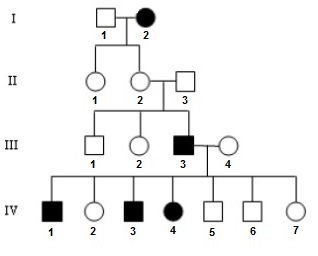
How many generations are shown in this pedigree?
a)
1
b)
2
c)
3
d)
4
63.
How many kids did the mother and father from the first generation have?
a)
2
b)
4
c)
5
d)
6
64.
This pedigree represents the inheritance of hemophilia in this family. How many of the females have the hemophilia trait?
a)
8
b)
5
c)
2
d)
3
65.
Darwin wrote that organisms with traits that are best suited to the environment will ________________
a)
increase in number
b)
become extinct
66.
Which of the following is NOT an example of natural selection? 
a)
People selectively breeding hamsters.
b)
Insect populations developing resistance to certain pesticides.
c)
Bacteria becoming resistant to antibiotics.
d)
Male birds of certain species developing colorful feathers to attract female mates.
67.
Which term refers to the process by which individuals that are better suited to the environment survive and reproduce therefore passing down their genes to their offspring? 
a)
Evolution 
b)
Variation 
c)
Adaptation
d)
Natural Selection 
68.
Which species’ DNA is most similar to the DNA of the toothed whale? 
a)
Hippopotamus 
b)
Baleen Whale
c)
Grazing Mammals
d)
Camels
69.
When an organism completely dies out, it is called.....
a)
Adaption
b)
Extinction
c)
Fossilization
d)
Mutation
70.
The separation of a group of individuals from the rest of the population is referred to as 
a)
genetic drift
b)
natural selection
c)
geographic isolation
d)
survival of the fittest
71.
Two organisms that are closely related would have
a)
very similar DNA sequence
b)
exactly the same DNA sequences
c)
no proteins in common
d)
completely different DNA sequence
72.
The scientific theory of evolution is supported by different types of evidence. The diagrams below show the skeletons of two different animal species. How does comparing the skeletons of these animals provide support for the scientific theory of evolution?
a)
 It provides information about the organisms' habitats.
b)
 It shows possible common ancestry between organisms.
c)
It provides information to determine the organisms' ages.
d)
It shows possible chromosomal similarities between organisms.
73.
According to fossil records, the horses that lived 50 million years ago were much smaller, weaker and slower than modern horses. Which process is most likely responsible for the changes that have led to the increased size, strength, and speed in horses?
a)
commensalism
b)
inbreeding
c)
migration
d)
evolution by natural selection
74.
The diagram illustrates an embryonic stage of two organisms.Which of the following can be determined by observing the embryos shown in the diagram? 
a)
The organisms share a common ancestry.
b)
The organisms belong to the same genus.
c)
The organisms are native to the same geographic areas.
d)
The organisms will grow into anatomically similar adults.
75.
Scientists have found evidence that about 2.4 million years ago a gene regulating jaw muscles mutated and may have led to the more graceful human jaw we see today. The diagram below shows the skulls of 3 hominid species.Which statement below most closely explains the link between jaw size and hominid evolution? 
a)
The jaws of hominids evolved to be smaller and less protruding over time. 
b)
The jaws of hominids evolved to be smaller and less protruding over time. 
c)
There appears to be no change in the jaws of hominids over time.
d)
The jaws of hominids changed over time due to a change in brain size. 
76.
Which kingdom do humans belong to?
a)
Plantae
b)
Fungi
c)
Animalia
d)
Protista
77.
The scientific name for an organism is made from the:
a)
class and family name
b)
genus and species name
c)
domain and kingdom name
d)
kingdom and phylum name
78.
Term given to describe the 2 name naming system is:
a)
dichotmous key
b)
binomial nomenclature
c)
2 scientific names
d)
binomial key
79.
The 8 levels of classification, most broad to most specific.
a)
Domain, Genus, Family, Order, Class, Phylum, Kingdom, Species
b)
Domain, Species, Kingdom, Genus, Phylum, Family, Class, Order
c)
Domain, Kingdom, Phylum, Class, Order, Family, Genus, Species
d)
Order, Kingdom, Species, Domain, Phylum, Family, Class, Genus
80.

Which is more closely related?

a)

Lamprey and tiger

b)

Gorilla and Human

c)

Salamander and Tiger

81.

The lizard has all these derived characteristics EXCEPT

a)

Jaws

b)

Lungs

c)

Bipedal