
 Worksheets
Ecology Test
Total questions: 80
Worksheet time: 1hrs 9mins
Which of the following is the correct order of organization in living things from most basic (simple) to most complex?
organism, cell, tissue, organ, organ system
organ system, organ, tissue, cell, organism
cell, tissue, organ, organ system, organism
cell, organ, tissue, organism, organ system

Atom → molecule → organelle → cell→ tissue → organ
→ system → organism
→ population → community
→ ecosystem → biosphere.
Taxonomic System
Classification system
Levels of Organization
Periodic Table

The smallest unit that makes up the known elements.
Molecule
Organelle
Cell
Atom

The basic building block of living things, made up of organelles.
Tissue
Organelle
Cell
Atom

Groups of cells with similar functions.
Organs
Molecules
Tissues
Organelles

Group of tissues with similar functions.
Organelles
Cells
Tissues
Organs

Group of organs with similar functions.
Organism
Cell
Organ
Organ System
Any single living individual, and can refer to a single human, animal, plant,
Protista, bacteria, or fungi.
Community
Cell
Population
Organism

Organisms who are members of the same species in an ecosystem.
Organism
Population
Organ
Community

Group of populations in an area.
Organism
Ecosystem
Community
Biosphere

A biological community that includes various species and their physical environment (Biotic and Abiotic Factors).
Organism
Community
Biosphere
Ecosystem

Where life is found on earth.
Community
Habitat
Ecosystem
Biosphere

In the food web shown, who is the secondary consumer?
grass
mouse
rabbit
fox
For an energy pyramid, the 10% rule states that
10% of the energy is transferred from one organism to the next.
10% of the energy is gained.
10% of the animals will starve.
10% of the producers are eaten.
What does a primary consumer eat?
tertiary consumers
secondary consumers
producers
decomposers


Grass > Grasshopper > Bird > Snake

What level consumer is the deer?
primary
secondary
tertiary
producer


If the producer has 20,000 kJ of energy, how much energy should the secondary consumer have?
2,000 kJ
500 kJ
200 kJ
1,000 kJ
Symbiosis means:
relationship
sharing
helping
harming
Predation means:
Living on or in another organism at that organisms expense
consuming another organism
getting a benefit from another organism without harming or helping it
getting a benefit from another organism while helping it
belonging in the same niche with limited resources
Parasitism means:
Living on or in another organism at that organisms expense
consuming another organism
getting a benefit from another organism without harming or helping it
getting a benefit from another organism while helping it
belonging in the same niche with limited resources
Commensalism means:
Living on or in another organism at that organisms expense
consuming another organism
getting a benefit from another organism without harming or helping it
getting a benefit from another organism while helping it
belonging in the same niche with limited resources
mutualism means:
Living on or in another organism at that organisms expense
consuming another organism
getting a benefit from another organism without harming or helping it
getting a benefit from another organism while helping it
belonging in the same niche with limited resources
competition means:
Living on or in another organism at that organisms expense
consuming another organism
getting a benefit from another organism without harming or helping it
getting a benefit from another organism while helping it
belonging in the same niche with limited resources

Define the relationship: Sea anemone and clown fish
Parasitism
Predation
Commensalism
Mutualism
Competition

The clownfish and anemone are mutualistic because:
the clown fish gets protection
the anemone gets food
they live together
both get eaten by other fish

Define the relationship: humans and mosquitoes
Parasitism
Predation
Commensalism
Mutualism
Competition
Mosquitoes are parasitic with humans because:
They feed off human blood
The human host is harmed
They are annoying
they spread disease

Bromeliads and trees share a relationship where bromeliads grow on the branches or trunks of trees without harming them. The bromeliads use the tree as a support structure, allowing them to access sunlight high up in the canopy. In return, the tree remains unaffected, as the bromeliads do not take nutrients from the tree itself. Instead, bromeliads gather moisture and nutrients from the air, rain, and debris that collects around them. This allows the bromeliads to thrive without impacting the tree's health. Define the relationship: bromeliads and trees
Parasitism
Predation
Commensalism
Mutualism
Competition
bromeliads and trees are in a commensal relationship because
the tree provides shelter and an environment for the bromeliad
the tree is harmed from the bromeliad taking food from it
the tree is not harmed or helped by the bromeliad
the tree takes nutrients from the bromeliad

The relationship between a wasp and a caterpillar involves the wasp laying its eggs on or inside the caterpillar's body. As the wasp larvae develop, they feed on the caterpillar’s tissues, using it as a food source while the caterpillar remains alive. Eventually, this process leads to the caterpillar’s death. The wasp benefits by providing its offspring with nourishment and a protected environment, while the caterpillar is harmed in the process. Define the relationship: wasp and caterpillar
Parasitism
Predation
Commensalism
Mutualism
Competition
The wasp is a parasite to the caterpillar because
The larvae live in the caterpillar
the larvae eat the caterpillar
the caterpillar takes the eggs away from the parents
the caterpillar eats the flowers the wasps pollinate

In the relationship between a rhino and an egret, the egret perches on the rhino’s back, feeding on ticks, parasites, and insects that are found on the rhino's skin. The egret benefits by getting a steady food source, while the rhino also gains from this relationship as the egret helps remove pests that can irritate or harm it. Both animals benefit from the interaction, with the egret feeding and the rhino receiving pest control. Define the relationship: rhino and cattle egret
Parasitism
Predation
Commensalism
Mutualism
Competition
The rhino and egret are in a mutualistic relationship because:
the egret eats the rhino's parasites
the rhino protects the egret from other predators
the egret gets a free ride
the rhino gets covered in mud

The relationship between two male peacocks involves a display of dominance, where they showcase their vibrant feathers and perform elaborate dances to attract females. Both males hope for the attention of potential mates, each trying to outshine the other in terms of appearance and behavior. Their interaction centers around gaining reproductive opportunities, with each male aiming to demonstrate his superiority to secure a mate. This creates a rivalry as they both strive for the same goal. Define the relationship: two male peacocks
Parasitism
Predation
Commensalism
Mutualism
Competition
The peacocks are in a competitive relationship because:
they occupy the same ecological niche
they both want the attention of the peahen
they need to see who is biggest
they need to see who is prettiest

The relationship between giant anteaters and termites involves the anteater using its long, sticky tongue to extract termites from their nests. The anteater relies on the termites as a primary food source, using specialized claws to break into the termite mounds and consume large quantities of the insects. The termites, in turn, attempt to defend their colony, but the anteater is adapted to efficiently feed on them while causing minimal destruction to the mound, allowing the colony to rebuild and persist over time. Define the relationship: giant anteater and termites
Parasitism
Predation
Commensalism
Mutualism
Competition
The anteater is a predator to the termites because:
They eat the termites
the termite population is controlled
termites are a pest
termites eat trees and wooden structures
This biome has hot summers, cold winters, diverse grasses, trees, and shrubs, and is common in central US.
savanna
temperate grassland
temperate forest
tundra
Which biome consists of very low precipitation and can be hot or cold?
savanna
tropical rainforest
tundra
desert
Which biome consists of warm weather year-round, a dry season and a rainy season, and diverse trees, shrubs, and grasses?
tropical rainforest
temperate grassland
savanna
desert
Which biome consists of lakes, rivers, and streams and only includes 3% of the Earth’s water?
Marine open ocean
Marine coastal
Tundra
Freshwater
Which biome consists of long bitter winters, cool summers, and diverse coniferous trees?
Taiga
Tundra
Temperate forest
Grassland
Which biome consists of grasses, shrubs, cold temperatures, and the permafrost?
Taiga
Tundra
Temperate forest
Temperate grasslands
Which biome consists of salt water from land out to 600ft depth?
Marine open ocean
marine coastal
freshwater
ocean
Which biome consists of salt water from 600ft and deeper?
Marine Coastal
marine open ocean
freshwater
ocean

Density-dependent variables are factors that affect a population based on its size, like food availability, while density-independent variables impact a population regardless of its size, such as natural disasters. When a specific population grows past the ecosystem's carrying capacity, what happens to the population?


What is an Abiotic Factor?
A NON-living factor that can affect an ecosystem
A living factor that can affect an ecosystem
The carrying capacity of an ecosystem
What is a Biotic Factor?
The carrying capacity of an ecosystem
A NON-living factor that can affect an ecosystem
A living factor that can affect an ecosystem
Check all of the boxes that show examples of biotic factors.
Rain
Humans hunting
Predators
Wildfire
Check all of the boxes that are examples of abiotic factors.
Prey
Rainfall
A pack of wolves
A tornado
What is a limiting factor?
Factors that always increase a population
Factors that always decrease a population
Resources that are unlimited
Factors/resources that limit how many organisms can live in an area at the same time
If there was a wildfire in the forest that destroyed the plant life, what would happen to the herbivore population?
Herbivores would decrease due to a lack of food
Herbivores would increase due to an increase of food
Herbivores would not be affected
Herbivores would decrease due to an increase in predators
Choose the 4 limiting factors.
Food
Water
Time
Space
Shelter

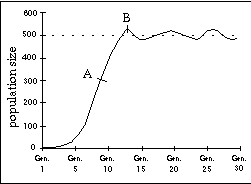
What type of growth is demonstrated in the graph?
Exponential
Carrying capacity
Linear
Negative
Which of the following demonstrates population growth when there is limited available water in an area?


When Yellowstone National Park was created in the late 1800s, wolves were on the decline. The last wolves in Yellowstone were killed in 1926, but in the 1800s, there were between 100-160 wolves in the park. In 1995, gray wolves were reintroduced to the park.
Which graph (drawn in red) below shows a prediction of how the population would change if there was less water available in the ecosystem?


There would be no change to carrying capacity.

A baby turtle crawling towards the ocean right after it's born is called?
mimicry
camouflage
instinct behavior
What is NOT a physical adaptation?
A turtle having a hard thick shell.
Herons having long legs to wade in the water.
A bird having a sharp beak to help them catch their prey.
Baby Cheetahs learning to hunt from their mom.

Hibernation, migration, and dormancy or all examples of ___________ adaptations.
behavioral
physical
special
environmental

Both animals and people are born with ___________, like crying.
instincts
experiences
adaptations
dormancy

Camouflage and mimicry are examples of ___________ adaptations.
behavioral
special
physical
predatory

The male peacock uses these spectacular tail feathers in a display to try to attract the attention of females of the same species, and to try to find a mate. What is this called?
hibernation
migration
courtship behavior
territorial behavior

