wayground logo

Free Printable Worksheets

Font size

S
M
L
XL
Worksheets

Protein Synthesis

Total questions: 71

Worksheet time: 1hrs 4mins

Name
Class
Date
1.

Which of the following are differences in the structure between RNA and DNA

a)

DNA uses deoxyribose sugar, RNA uses sugar ribose

b)

DNA pairs Adenine with Uracil, RNA pairs Adenine with Thymine

c)

DNA is a double helix, RNA is a single helix

d)

DNA pairs Adenine with Thymine, RNA pairs Adenine with Uracil

2.

Which organelle is the location where protein is made?

a)

Ribosome

b)

Nucleus

c)

Cytoplasm

d)

Nucleotide

3.

During transcription, this type of ribonucleic acid is responsible for copying the DNA and brining it out of the nucleus.

a)

tRNA

b)

mRNA

c)

rRNA

d)

dRNA

4.

When these bond together, they form a protein

a)

Amino Acids

b)

Peptide Bonds

c)

Ribose

d)

Nucleotides

5.

These building blocks consist of a sugar, phosphate, and nitrogen base.

a)

Ribose

b)

Nucleotide

c)

Gene

d)

Protein

6.

A string of nucleotides that contain the information to make a specific protein

a)

Ribose

b)

Amino Acids

c)

tRNA

d)

Gene

7.

During translation, this type of ribonucleic acid is responsible for delivering amino acids to help make a protein.

a)

mRNA

b)

rRNA

c)

tRNA

d)

dRNA

8.

There are a total of ____ different amino acids

a)

20

b)

1

c)

4

d)

unlimited

9.

mRNA occurs during this process

a)

Translation

b)

Transcription

c)

Replication

d)

Delivery

10.

How many amino acids are found on one tRNA?

a)

20

b)

4

c)

1

d)

3

11.

Which of the following is the complementary mRNA sequence to this DNA strand: AACTGAA

a)

UUGACUU

b)

TTGACTT

c)

AACTGAA

d)

AACUGAA

12.

Which of the following is the tRNA that will be used to decode to this DNA strand: AACTGA

a)

AAC and TGA

b)

TTG and ACT

c)

UUG and ACU

d)

AAC and UGA

13.
The central dogma of biology states that information flows in one direction from 
a)
nuclei to RNA to cytoplasm
b)
ribosomes to proteins to DNA
c)
genes to nuclei to ribosomes
d)
DNA to RNA to proteins
14.
Choose the nucleotide sequence of the RNA strand that would be complementary to the following strand: 
GTAGTCA
a)
UATUAGA
b)
ACGACTG
c)
CAUCAGU
d)
CATCAGT
15.
The main function of tRNA is to...
a)
carry a message that, when translated, forms proteins
b)
form a portion of ribosomes
c)
string together complementary RNA and DNA strands
d)
bring amino acids from the cytoplasm to the ribosomes
16.
Which of the following events occurs directly after RNA polymerase recognizes a gene?
a)
The polymerase strings amino acids into a polypeptide
b)
Free-floating nucleotides pair up with exposed DNA bases
c)
A complementary RNA strand detaches itself from the DNA
d)
The DNA strand begins to unwind, separating the two strands
17.
What is the term for a three-nucleotide sequence that codes for an amino acid?
a)
base
b)
codon
c)
amine
d)
serine
18.
Which phrase best describes translation?
a)
converts mRNA into a polypeptide
b)
catalyzes bonds between amino acids
c)
produces RNA from DNA molecules
d)
recycles tRNA molecules for reuse
19.
Which of the following is the site of transcription?
a)
vacuole
b)
lysosome
c)
nucleus
d)
ribosome
20.
Which of the following is the site of translation?
a)
vacuole
b)
lysosome
c)
nucleus
d)
ribosome
21.
Which of the following is created in the nucleus and carries the genetic code to the cytoplasm?
a)
DNA
b)
tRNA
c)
mRNA
d)
rRNA
22.
A tRNA that carries the amino acid methionine pairs with which type of codon?
a)
serine codon
b)
tRNA codon
c)
start codon
d)
anticodon
23.
What would happen if we did not have start codons?
a)
Polypeptide chains would continue to grow
b)
Amino acids would bind to tRNA
c)
Protein synthesis wouldn't occur
d)
mRNA would form a double strand
24.
DNA holds the code for
a)
lipids
b)
carbohydrates
c)
protein
d)
sugar
25.
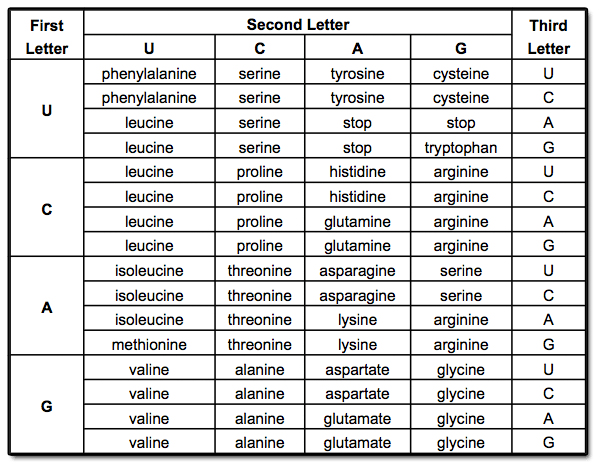
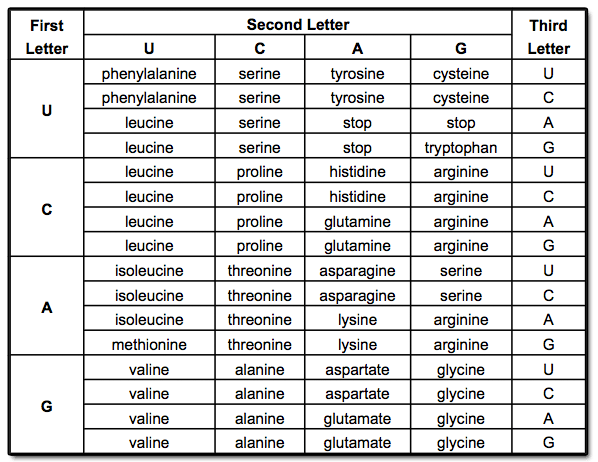
What amino acid is represented by the codon UUA?
a)
Phenylalanine
b)
Tyrosine
c)
Leucine
d)
Stop codon
26.
What process is going on in this photo? 
a)
Transcription 
b)
Translation 
c)
Replication 
d)
All the above 
27.
Which component of DNA determines the traits of an organism? 
a)
Nitrogen Bases
b)
Sugar-Phosphate Backbone
c)
Hydrogen bonds
28.
Translation is the process where
a)
mRNA is created in the Nucleus
b)
mRNA is decoded to form a protein 
c)
glucose molecules are made
d)
is where lipids are synthesised
29.
Does the order of amino acids in a protein matter?
a)
YES!
b)
NO!
30.

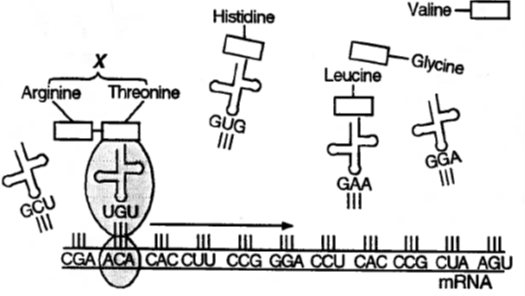
What process is happening in the diagram?

a)

transcription

b)

translation

c)

dna replication

d)

mitosis

31.
What is the correct amino acid sequence for the mRNA code AUGCCAGUAUGA
a)
Met-Pro-Ala-Val
b)
Met-Pro-Val
c)
Tyr-Gly-His
d)
Tyr-Gly-Arg-His
32.
Which is the mRNA molecule that would be transcribed from this DNA template:
TGGCAAGTACGT
a)
ACCGTTCATGCA
b)
UGGCAAGUACGU
c)
UCCGUUCUUGCU
d)
ACCGUUCAUGCA
33.

What is the role of ribosomes in protein synthesis?

a)

To transcribe DNA into RNA

b)

To translate mRNA into a polypeptide

c)

To transport amino acids

d)

To replicate DNA

34.

Which of the following is a stop codon in mRNA?

a)

GCU

b)

UAA

c)

AUG

d)

UGG

35.

Which enzyme is responsible for synthesizing RNA from a DNA template?

a)

RNA polymerase

b)

Helicase

c)

Ligase

d)

DNA polymerase

36.

Label the diagram.

37.

- DNA is ​ (a)   ​ stranded with the Bases- (b)  

DNA ​ (c)   leave the nucleus 

- RNA  is ​ (d)   stranded  with the bases ​ (e)  

RNA CAN​ leave the nucleus​

Choose from the below words
double
A, T, G, C
cannot
single
A, U, G, C
38.

Complete the strands of nucleic acid above with the correct nitrogen bases.

a)

DNA: CGCAUAUC

RNA: TACAGACT

b)

DNA: GCGTATAG

RNA: AUGUCUGA

c)

DNA: GCGUAUAG

RNA: AUGUCUGA

d)

DNA: GCGTATAG

RNA: ATGTCTGA

39.

Who Am I?

Categorize the following

I am arranged as a double-helix.

I include the base thymine.

I am found only in the nucleus (in Eukaryotes).

I have the sugar deoxyribose.

I am a nucleic acid.

I include the bases guanine, cytosine, adenine.

I am made of nucleotides.

My nucleotides include a phosphate, sugar, and nitrogenous base.

I am single-stranded.

I can leave the nucleus.

I contain the base uracil.

I have the sugar Ribose.

put me in none

DNA
Both
RNA
None
40.

Organize these options about DNA or RNA into the right categories

Categorize the following

Double Stranded

Single Stranded

Deoxyribose Sugar

Ribose Sugar

Has Thymine

Has Uracil

Found only in the nucleus

Found in the nucleus & the cytoplasm

DNA
RNA
41.
RNA is read in sections called:
a)
Triplets
b)
Genes
c)
Codons
d)
Genes
42.
tRNA molecules match the mRNA codons with a(n):
a)
Codon
b)
Anti-Codon
c)
Intron
d)
Methylated Cap
43.
Translation is a process that produces
a)
mRNA
b)
Protein
c)
Polypeptide Chains
d)
tRNA
44.
What process is going on in this photo? 
a)
Transcription 
b)
Translation 
c)
Replication 
d)
All the above 
45.
Set of nitrogen bases that are complementary to one codon
a)
peptide bond
b)
polypeptide
c)
anti-codon
d)
amino acid
46.
What structure of this molecule binds with the mRNA molecule?
a)
Amino Acid
b)
tRNA
c)
Anticodon
d)
Codon
47.

What is the order for Protein Synthesis?

a)

Transcription -> Translation -> Protein

b)

Translation - > Transcription -> Protein

c)

Protein -> Transcription -> Translation

d)

Translation -> Protein -> Transcription

48.
tRNA is involved in
a)
carrying amino acids 
b)
carrying ribosomes
c)
carrying glucose
d)
carrying lipids
49.
Amino acids are joined together in order to form
a)
DNA
b)
ribosomes
c)
proteins 
d)
RNA
50.
Which Seq could be found in RNA?
a)
ACCTGT
b)
CGCATT
c)
AUGCUU
51.
What is the location in the cell for translation?
a)
nucleus
b)
mitochondria
c)
ribosome
d)
chloroplast
52.

When the mRNA sequence leave the nucleus, what organelle does it travel to?

a)

mitochondria

b)

smooth ER

c)

ribosome

d)

vacuole

53.

What best explains the interaction between tRNA and mRNA during translation?

a)

anticodons on the mRNA line up with complementary codons on the tRNA

b)

anticodons on the tRNA line up with complementary codons on the mRNA

c)

tRNA attach amino acids to the complementary mRNA sequence

d)

mRNA attach amino acids to the complementary tRNA sequence

54.

What does tRNA "transfer"?

a)

amino acids

b)

nucleic acids

c)

nucleotides

d)

AUG

55.

What do amino acids come together to join?

a)

a growing polypeptide chain (protein)

b)

a growing lipid

c)

a growing carbohydrate

d)

a growing nucleic acid

56.

codons are located on __________

a)

mRNA

b)

tRNA

c)

rRNA

d)

snRNA

57.

anti-codons are located on __________

a)

mRNA

b)

tRNA

c)

rRNA

d)

snRNA

58.

How many nucleotides make up a single codon?

a)

3

b)

5

c)

4

d)

1

59.

The following codon is translated into which amino acid?


AUU

a)

Methionine

b)

Isoleucine

c)

Histidine

d)

Arginine

60.

The following codon is translated into which amino acid?


CAU

a)

Methionine

b)

Isoleucine

c)

Histidine

d)

Arginine

61.

The following codon is translated into which amino acid?


UAA

a)

STOP

b)

Phenylalanine

c)

Valine

d)

Aspartic acid

62.
The process of making proteins on the ribosome based on instructions from messenger RNA is called
a)
transcription
b)
transformation
c)
translation
d)
molecular biology
63.
Which of the following describes RNA?
a)
RNA is usually double-stranded and contains the base thymine
b)
RNA is usually single-stranded and contains the base uracil
c)
RNA is longer than DNA and uses five bases to encode information
d)
RNA is made in the nucleus of eukaryotic cells and stays there to carry out its functions
64.
In messenger RNA, each codon specifies a particular
a)
nucleotide
b)
enzyme
c)
amino acid
d)
promoter
65.

What type of bonds are forming during translation?

a)

Peptide bonds (covalent)

b)

Hydrogen bonds

c)

Acid bonds

d)

ionic bonds

66.
How many amino acids are coded for by this sequence of nucleotides:
ATG GGA ACT CCA
a)
4
b)
2
c)
6
d)
12
67.

Which process does this picture show?

a)

Transcription

b)

Translation

c)

Replication

68.
What would be the tRNA anticodon for the mRNA codon CAG?
a)
GTC
b)
GUC
c)
CUG
d)
CAG
69.
What is the correct sequence?
a)
RNA --> DNA --> Protein
b)
Protein --> RNA --> DNA
c)
DNA --> RNA --> Protein
d)
DNA --> Protein --> RNA
70.

Overall, protein synthesis consists of these steps

a)

DNA synthesis, RNA synthesis and transcription

b)

transcription and translation

c)

DNA synthesis, transcription and translation

71.
What is the monomer (building block) of proteins?
a)
Monosacchrides
b)
Polysaccharides
c)
amino acids
d)
Triglycerides