
Font size
 Worksheets
Geologic Time & Formation of Earth Review
Total questions: 76
Worksheet time: 56mins
A smaller unit of geologic time into which eras are divided up into:
period
eons
epochs
ages
The Oceans formed from: (may have to pick more than one)
Earthquakes
comets
Asteroids
Outgassing from volcanoes
Which of the following helps to date the age of the earth?
intrusions
outgassing volcanoes
ice cores
meteorites

What is the arrow showing?
disconformity
angular unconformity
nonconformity
reconformity
What was created from volcanic activity, radioactive decay & collisions of meteorites/comets.
1st atmosphere
2nd atmosphere
3rd atmosphere
current atmosphere
What is the longest time unit in the geologic time scale, that is measured in billions of years?
epochs
eras
eons
periods
Means "middle life" and last 2% of geologic time
Cenozoic
Paleozoic
Precambrian
Mesozoic
A layer of rock or sediments whose absolute age can be determined and is used to help determine ages of rock layers over vast distances.
index fossils
key beds
principle of superposition
stromatolites
The oldest known mineral on Earth that is 4.2 billion years old.
varves
key beds
zircon
coprolite
This means "recent life" and takes up 1% of geologic time.
Precambrian
Cenozoic
Mesozoic
Paleozoic
Horizontal layers that were eroded and then new horizontal layers were deposited on top of the eroded layers.
reconformity
disconformity
angular unconformity
nonconformity
A trace fossil of waste that helps determine what the organism was eating & the environment around it.
gastrolith
index fossil
cast
coprolite
The only atmosphere that contained huge amounts of oxygen & ozone gas.
1st
2nd
3rd
4th
These help to determine age of object and show an annual change in climate (dark in the summer, light in the winter)
Varves
tree rings
banded iron formations
ice cores
The numeric age of an object or event, that is usually determined by radiometric dating
relative age
geologic age
absolute age
radiometric age
Which of the following is not a requirement for being an index fossil
Easily recognizable
abundant
widely distributed over the earth
lived during a specific eon
A fault or intrusion is ALWAYS younger than the rock layers that it cuts through.
Principle of crosscutting relationships
Principle of superposition
Principle of inclusions
Principle of original horizontality
Matching layer of one outcrop of land to another in a different geographic regions by fossils, types of rocks, or minerals.
correlation
horizontaltity
uniformitarianism
inclusions
Animals that get stuck into a pool of tar at earth's surface is an example of what?
trace fossil
index fossil
cast
altered hard parts
original preservation
Means ancient life and lasted 7% of geologic time.
Mesozoic
Precambrian
Paleozoic
Cenozoic
Preserved remains or evidence of an ancient organism.
inclusions
strata
isotopes
fossil
Tilted or folded strata that have been eroded and horizontal layers are deposited on top of the eroded layers.
reconformity
disconformity
angular unconformity
nonconformity
A science dealing with prehistoric life through the study of fossils.
parentology
radiography
paleontology
fossilography
Made up of hydrogen and helium, and was lost into space due to solar winds, heat and impacting objects.
1st atmosphere
2nd atmosphere
3rd atmosphere
pre-atmosphere
The standard method used to divide Earth's long natural history into manageable parts.
radioactive decay
geologic time scale
stromatolites
relative age
Yearly sediment layer deposits from glaciers that helps determine age. (dark in the winter, & light in the summer)
Varves
tree rings
banded iron formations
ice cores
Yearly rings that help determine age and tell about the climate conditions during that season/year. (light and thick in summer, dark and think in winter)
Varves
tree rings
banded iron formations
ice cores
Sedimentary rock layers are deposited in horizontal layers.
Principle of superposition
Principle of original horizontality
Principle of uniformitarianism
Principle of inclusions
The half life of carbon -14
7350 years
7530 years
5370 years
5730 years
This is used to date organic fossils up to around 80,000 years old.
Uranium -238
Nitrogen-13
Iodine-131
Carbon-14
Current geologic processes that shape the earth today are the same geologic processes that have shaped the earth in the past.
Principle of lateral continuity
Principle of uniformitarianism
Principle of original horizontality
Principle of inclusions
Sediment layer that serves as a time marker in the rock record and helps determine age of other layers. (Examples, volcanic ash, meteorite impact debris, coal)
varves
isotopes
key beds
index fossils
An ordered arrangement of rock layers that is based on the relative ages of the rocks and in which the oldest rocks are at the bottom and the youngest at the top,
Geologic time scale
relative age
absolute age
geologic column
Science of comparing annual growth rings of trees to determine dating and events in Earth's history.
Geologic time scale
Differentiation
Dendrochronology
Paleontology
Which of the following did not help to determine the age of the earth?
Zircon
Moon rocks
Continental rocks
Cyanobacteria
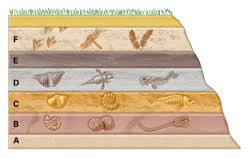


What is the order of rock layers from oldest to youngest?
A, B, C, D, E
E, D, C, B, A
C, B, A, D, E
C, B, A, E, D

This picture shows what?
Principle of superposition
Principle of Permineraliziation
Principle of lateral continuity
Principle of crosscutting relationships
Process of a planet separating into layers because of density.
correlation
differentiation
dendrochronology
intrusions
Second longest time unit of geologic time that is broken down into million of years.
epoch
eons
eras
periods
The process of measuring of absolute age of geologic material by comparing the ratios of parent element to daughter element.
radiometric dating
radioactive decay
isotopes
petrification
Elements changing into new elements through the ejection of radioactive particles.
absolute age
radiometric dating
radioactive decay
geologic column
Fossils that have gone through a chemical change.
original preservation
altered hard parts
trace fossil
index fossils
Bacteria that can carry out photosynthesis.
carbon dating
cyanobacteria
altered hard parts
inclusions
A mass of igneous rocks that formed from magma, when it was injected into rock layers and then cooled and crystalized.
key bed
intrusion
inclusion
imprint
A type of fossil formed when a shell or other hard parts of an organism dissolves, leaving an empty space in the shape of the part/organism.
cast
mold
index fossil
altered hard parts
Hardened tree sap that is usually a source of insect fossils is an example of what?
altered hard parts
trace fossil
original preservation
index fossil
If 10 mg of iodine 131 is given to a patient, how much of the daughter element is there after 24 days? The half-life of iodine-131 is 8 days.
1.25mg
5 mg
8.75 mg
10mg
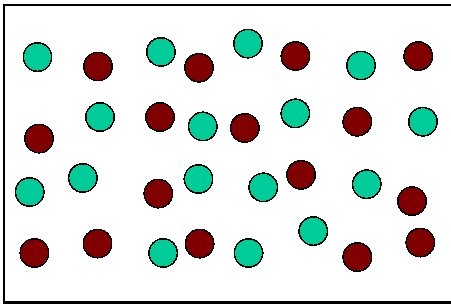
The diagram shows 32 atoms.
16 of the Red are parent isotopes
16 of the Green are daughter isotopes
How many half-lives have occurred?
0
1
2
3
hardened tree sap, often the source of insect fossils is known as _____.
intrusions
stromatolites
petrification
amber
The process of minerals replacing the organic matter.
permineralization
original preservation
paleontology
parentification
A break or crack in the earth's crust.
intrusion
inclusion
fault
varve
An atom that has the same number of protons but different numbers of neutrons which affects it's mass.
parent element
daughter element
isotope
radioactive decaY

What is the bold line showing
reconformity
disconformity
angular unconformity
nonconformity
A fossil that is a copy of an organism's shape that is formed when minerals fill in a mold.
cast
imprint
mold
index fossil
Fossils that have not gone through any type of chemical change when being preserved.
cast
trace fossil
original preservation
altered hard parts
The age of the earth.
13 billion years old
4.6 billion years old
3.8 billion years old
4.2 billion years old
Age that is determined by comparing one layer or fossil to another by their position.
absolute age
relative age
index age
petrified age

What are the arrows showing
reconformity
nonconformity
disconformity
angular unconformity
Which of the following environmental factors will not create an original preservation organism?
carbon-free environments
dry conditions
freezing conditions
oxygen free conditions
Has no alternate name and lasts 90% of geologic time. Finding fossils during this time is extremely rare.
Paleozoic
Precambrian
Mesozoic
Cenozoic
Large mats or mound of cyanobacteria.
intrusion
inclusions
stromatolites
gastroliths
Smallest unit of geologic time that divides up periods. Only found in the Cenozoic due to excessive fossil record.
eon
epoch
period
era
Digestive stone found in dinosaurs.
coprolite
intrusion
gastrolith
stromatolites
indirect evidence of life preserved in rock that doesn't contain any direct fossil of the organism.
index fossil
trace fossil
original preservation
permineralization
Length of time for half of the radioactive atoms in a sample to decay.
imprint
half life
isotopes
parent element

Which layer is OLDER? Intrusion M or Layer D?
Intrusion M
Layer D
A whale bone that originally contained 200 grams of radioactive carbon-14 now contains 25 grams of carbon-14. How many half-lives have passed since this whale was alive?
1
2
3
4
Compared to the length of time for the first half-life of a sample of a radioactive isotope, the length of time for the second half-life is
less
greater
the same

This diagram represents a sample of 87Rb. Which diagram represents the correct proportion of 87Rb to its decay product, 87Sr, after two half-lives?


This graph shows the relationship between mass and time for a radioactive element during radioactive decay. What is the half-life of the element?
50 billion years
60 billion years
350 billion years
100 billion years
This graph shows the relationship between mass and time for a radioactive element during radioactive decay. What fraction of the daughter element is left after 250x 10^9 years?
1/2
31/32
3/4
1/32
15/16
Fossils are only found in _________.
igneous rock
sedimentary rock
metamorphic rock
inclusions

