wayground logo

Free Printable Worksheets

Font size

S
M
L
XL
Worksheets

Electromagnetism

Total questions: 101

Worksheet time: 1hrs 23mins

Name
Class
Date
1.
As electrons move, they make
a)
A. electromagnetism.
b)
B. auroras.
c)
C. ferromagnetism.
d)
D. magnetic fields.
2.
The attraction or repulsion created by spinning electric charges
a)
A. electric generator
b)
B. magnetic force
c)
C. solenoid
d)
D. electromagnet
3.
A device that converts electrical energy into mechanical energy
a)
A. electromagnet
b)
B. electromagnetic induction
c)
C. electric motor
d)
D. electromagnetism
4.
A device that converts mechanical energy into electrical energy
a)
A. electric generator
b)
B. electric motor
c)
C. electromagnetic induction
d)
D. electric generator
5.
What is created when a magnet moves through a coil of wire?
a)
A. an electromagnet
b)
B. a ferromagnet
c)
C. a solenoid
d)
D. an electric current
6.
Which of the following are two effects of Earth’s magnetic field?
a)
A. compass points to geographic north, auroras seen at both poles  
b)
B. compass points to magnetic north, auroras seen at both poles
c)
C. compass points to geographic south, auroras seen at the equator
d)
D. compass points to geographic north, auroras seen at the equator
7.
Which of the following are two kinds of magnets?
a)
A. atoms, domains
b)
B. magnetic fields, magnetic poles
c)
C. ferromagnets, electromagnets
d)
D. magnesia magnets, magnetite magnets
8.
What kind of magnet can be turned on and off?
a)
refrigerator magnet
b)
electromagnet
c)
magnetite
d)
iron
9.
If you wrap more coils around an electromagnet, it will become 
a)
brighter
b)
stronger
c)
weaker
d)
invisible
10.
What is the flow of electricity?
a)
electric motor
b)
Electric current
c)
Electric eel
d)
electric circuit
11.
What is inside a toy car that turns the wheels?
a)
generator
b)
electric motor
c)
electromagnet
12.
A device that converts electrical energy into kinetic energy
a)
A. electromagnet
b)
B. electromagnetic induction
c)
C. electric motor
d)
D. electromagnetism
13.
How do you make an electromagnet stronger?
a)
Add a motor and/or lightbulbs
b)
Add more light bulbs and/or wire coils
c)
add more wire coils and/or a switch
d)
add more wire coils and/or batteries
14.
What is true about electricity and magnetic fields?
a)
Electricity is needed to create any magnet.
b)
Electricity always creates a magnetic field.
c)
Electricity is stronger than a magnetic field.
d)
Electricity prevents magnetic fields from occurring.
15.
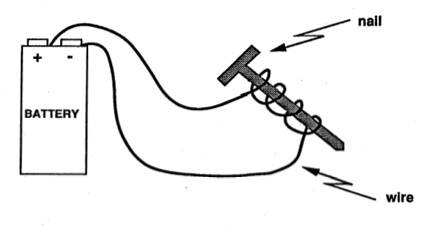
This is a picture of a simple electromagnet. How can the electromagnet be made stronger?
a)
Add more coils of wire to the nail.
b)
Use a smaller battery.
c)
Reverse the poles of the magnet.
d)
Remove all the coils and the nail.
16.
A compass needle responds to a magnetic field, because the compass needle is a
a)
A. generator.
b)
B. motor.   
c)
C. magnet.
d)
D. transformer.
17.

What is magnetic force?

a)

A force exerted by electrically charged particles

b)

A force exerted by magnets that can be felt by objects near a magnet

c)

A force exerted by magnets that makes an object become electrically charged

d)

A force exerted by a magnet only when it physically touches an object

18.

Which of the following is not a good conductor?

a)

Copper

b)

Silver

c)

Aluminium

d)

Plastic

19.

Particles with opposite charges ____________ and particles with same (or like) charges ____________.

a)

attract, repel

b)

repel, repel

c)

attract, attract

d)

repel, attract

20.

The picture above is an example of what?

a)

Magnetic field

b)

Electric field

c)

Repulsion

d)

Attraction

21.

What would happen with the magnets in the picture above?

a)

They would repel

b)

Nothing

c)

They would attract

d)

They would repel and then attract

22.
The ability of some materials to attract certain metals is called
a)
Electricity
b)
Magnetism
c)
Electromagnetism
d)
Atoms
23.

If the north pole of a magnet is brought close to the south pole of another magnet, what will happen?

a)

They will atrract each other

b)

They will repel each other

c)

They will demagnitize

d)

The south pole will turn around so the north pole is facing the other magnet.

24.

Which sides of the magnet repel each other?

a)

A) North and North Pole

b)

B) South and South Pole

c)

C) The North and South Pole

d)

D) A and B

e)

E) A, B,C

25.

Which answer describes a magnet best.

a)

A material that has two north poles

b)

A material that has a two south poles

c)

A material that has a north and a south pole

d)

An electron

26.

Which sides of the magnet attract each other?

a)

A) North and North Pole

b)

B) South and South Pole

c)

C) The North and South Pole

d)

D) A and B

e)

E) A, B,C

27.

A magnet will pick up an object that is made of...

a)

plastic

b)

iron or steel

c)

glass

d)

copper

28.

The strongest parts of the magnet are ...

a)

fronts

b)

backs

c)

poles

d)

middle

29.

What would happen is a north pole of a magnet came close to a north pole of another magnet?

a)

they would be attracted to each other

b)

they would be repelled from each other

30.

The area around a magnet is called the .....

a)

attraction zone

b)

work area

c)

magnetic field

d)

hot zone

31.
A north pole and a south pole will attract.
a)
True
b)
False
32.
True or False: All metals stick to magnets.
a)
True
b)
False
33.

Why does the compass needle move at different locations?

a)

Because the needle is attracted to the magnetic field produced by the magnet

b)

Because north is up

c)

Because it is being attracted to the Magnetic North Pole

d)

Because north is down

34.

Every magnet has a:

a)

East and West pole

b)

North and South pole

c)

East and South pole

d)

North and West pole

e)

Chicago and Saint pole

35.

To make this electromagnet stronger you could:

a)

use less wire

b)

have fewer wire coils around the nail

c)

have more wire coils around the nail

d)

use a plastic core

36.
Are the magnetic field lines in the picture correct?
a)
Yes, because they point from north to south.
b)
No, because they point from north to south (they're supposed to go the other way).
c)
Yes, because the North pole is on the left in all pictures.
d)
No, because the North pole is on the left in all pictures (it's supposed to be on the right).
37.

When running a current through a wire, what do the blue lines represent?

a)

The wire spinning

b)

A magnetic field that was created

c)

Electrons leaving

d)

Electricity

38.

Which one represents the magnetic field lines of magnets repelling?

a)

A

b)

B

39.

Which one represents the magnetic field lines of magnets attracting?

a)

A

b)

B

40.

What happens to the strength of a magnetic field as you move away from the magnet?

a)

The strength of the magnetic field increases.

b)

The strength of the magnetic field doesn't change.

c)

The strength of the magnetic field is doubled.

d)

The strength of the magnetic field decreases.

41.

What type of core is best for electromagnets?

a)

Steel

b)

Iron

c)

Plastic

d)

Copper

42.

As the strength of a magnetic field increases, the ability to attract metal objects ____________.

a)

increases

b)

decreases

c)

stays the same

43.

What conclusion can you draw from this graph?

a)

As current increases, magnetic strength decreases.

b)

As current increases, magnetic strength increases.

c)

As current decreases, magnetic strength increases.

d)

There is no relationship between current and magnetic strength.

44.
The ability of some materials to attract certain metals is called
a)
Electricity
b)
Magnetism
c)
Electromagnetism
d)
Atoms
45.
Choose the best option to complete this gap:
A magnetic field is the ________ around a magnet in which the magnetic force acts.
a)
pole
b)
electron
c)
space
d)
iron
46.
When you put the poles of two magnets together they will either attract or repel each other.  Which of these sentence is correct?
a)
If the two poles are the same the magnets repel each other.
b)
If the two poles are the same the magnets attract each other.
c)
If the two poles are different the magnets repel each other.
47.
The needle of a compass points towards the north because...
a)
the Earth's magnetic south pole is situated near the Geographic North Pole.
b)
there is a battery inside the compass.
c)
The Earth attracts the south pole of the needle.
d)
There is a mass of iron inside the compass.
48.
What happens when we rub a needle on a magnet several times?
a)
The needle breaks
b)
The needle becomes a magnet.
c)
We get a compass.
d)
The needle floats.
49.
Hans Christian Oersted observed that if we put a compass near to an electric current...
a)
it points to the West.
b)
we intensify the electric current.
c)
the needle moves.
50.
Which components do you need to build an electromagnet?
a)
a wire, a conductor, a battery and some paper clips.
b)
a wire, a compass, a battery and some paper clips.
c)
wool, a conductor, a battery and some paper clips.
51.
What is an atom made of?
a)
Three different types of particles: electrons, protons and neutrons.
b)
Three different types of particles: electrons, protons and nanotrons.
c)
Three different types of particles: electrons, molecules and oxygen.
52.

What is magnetic force?

a)

A force exerted by electrically charged particles

b)

The attractive and repulsive forces between two poles

c)

A force exerted by magnets that makes an object become electrically charged

d)

A force exerted by a magnet only when it physically touches an object

53.

Which part of a circuit is responsible for "pushing" charges around a circuit?

a)

Electrical devices

b)

Power source

c)

The wire

d)

None of the above

54.

What is responsible for creating a magnetic field around Earth?

a)

Earth's crust

b)

Earth's iron core

c)

Earth's mantle

d)

Earth's atmosphere

55.

What is a magnetic material?

a)

A material that becomes positively charged when a magnet is brought near it.

b)

A material that produces a magnetic force.

c)

A material that becomes negatively charged when a magnet is brought near it.

d)

A material that is attracted or repelled by a magnet.

56.

Why is Earth's magnetosphere important?

a)

It deflects dangerous solar wind from the sun

b)

It keeps us in orbit around the sun

c)

it keeps the moon in orbit around the earth

d)

it prevents extraterrestrial objects from crashing into earth

57.

What is the difference between a conductor and insulator?

a)

conductor: allows electricity to flow easily.

insulator:does not allow electricity to flow easily

b)

conductor: does not allow electricity to flow easily

insulator: allows electricity to flow easily

58.

How can you make a magnetic material a temporary magnet?

a)

heat it

b)

drop it

c)

strike it on a magnet in the same direction

d)

electrify it

59.

What happens if you cut a magnet in half?

a)

Nothing

b)

The magnets repel

c)

There will be two magnets

60.

Which is not a way to strengthen an electromagnet?

a)

Use a bigger power source

b)

Use a plastic wire

c)

Use a bigger magnetic material

d)

Wrap the wire around the magnetic material more times.

61.

True or false: All objects made of iron, nickel, and cobalt are magnetic material?

a)

True

b)

False

62.

What must the electrons do in an object to give it a magnetic field?

a)

Flow in the same direction

b)

Flow in the opposite direction

c)

Collide into one another

d)

Equal the number of protons and neutrons

63.

Why are these magnets not touching?

a)

They are like poles and are repelling

b)

They are opposite poles and are repelling

c)

There is an electric field

64.
A wave with a large wavelength will have a ______ frequency and _____ energy
a)
high, low
b)
high, high
c)
low, high
d)
low, low
65.
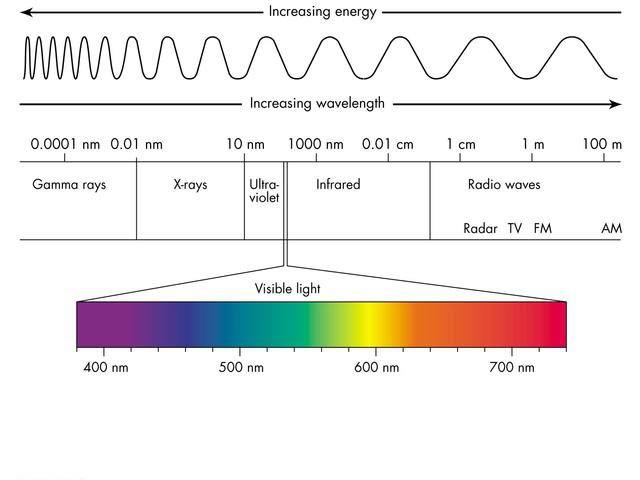
Which has the LONGEST wavelength and, therefore, the lowest frequency/energy
a)
Gamma Rays
b)
Radio Waves
c)
Visible Light
d)
Infrared rays
66.
Which has the SHORTEST wavelength and, therefore, the highest frequency/most energy
a)
Radio waves
b)
Ultraviolet Rays
c)
Gamma Rays
d)
X-rays
67.
How are electromagnetic waves different from other waves? 
a)
They have very short wavelengths 
b)
They transmit energy instead of matter 
c)
They can travel through empty space
d)
They can change direction by reflection 
68.
Which of the following electromagnetic waves has the lowest energy?
a)
gamma ray
b)
infrared wave
c)
visible light wave
d)
microwave
69.
As the frequency of an electromagnetic wave increases, the amount of energy in that wave...
a)
increases.
b)
decreases.
c)
stays the same.
70.
High frequency waves have _________ wavelengths.
a)
varying
b)
long
c)
the same
d)
short
71.
The distance between two crests or two troughs of a wave is called:
a)
frequency
b)
amplitud
c)
wavelength
d)
hertz
72.
The height of the wave from the rest position is known as the _____________.
a)
amplitude
b)
crest
c)
trough
d)
wavelength
73.

Which of the following has the longest wavelength?

a)

microwaves

b)

UV rays

c)

Infrared

d)

Gamma rays

74.

Which of the following has the most energy?

a)

Red

b)

Blue

c)

Green

d)

Yellow

75.

Which of the following would have the highest frequency?

a)

Gamma rays

b)

The color red

c)

X-rays

d)

UV rays

76.

Which of the following has the highest frequency?

a)

The color blue

b)

The color orange

c)

The color yellow

d)

The color violet

77.
The frequency of infrared waves is..
a)
1012 Hz
b)
1020 Hz
c)
104 Hz
d)
1015 Hz
78.

What is the correct order of the visible light spectrum starting with the longer wavelength?

a)

Red, yellow, orange, blue, violet, indigo

b)

Violet, indigo, blue, green, yellow, orange, red

c)

Green, yellow, blue, indigo, red, orange

d)

Red, orange, yellow, green, blue, indigo, violet

79.

The wavelength of an infrared ray is --

a)

10-5 m

b)

1012 Hz

c)

105 m

d)

10-12 Hz

80.
If the wavelength of an electromagnetic wave is longer, what is true about the energy? 
a)
Energy is higher.
b)
Energy is lower. 
c)
Energy is not dependent on wavelength. 
81.
Which of the following electromagnetic waves is given off as heat? 
a)
ultraviolet light
b)
x-rays
c)
gamma rays
d)
infrared rays
82.
EM waves are always____________
a)
Transverse
b)
Compression
c)
Longitudinal
d)
Seismic
83.

A magnet will pick up an object that is made of...

a)

plastic

b)

iron or steel

c)

glass

d)

copper

84.

The area around a magnet is called the .....

a)

attraction zone

b)

work area

c)

magnetic field

d)

hot zone

85.
A north pole and a south pole will attract.
a)
True
b)
False
86.
True or False: All metals stick to magnets.
a)
True
b)
False
87.

Every magnet has a:

a)

East and West pole

b)

North and South pole

c)

East and South pole

d)

North and West pole

e)

Chicago and Saint pole

88.
The picture is an example of an:
a)
Electric circuit
b)
Electromagnet
c)
Electric nail
d)
Electric power cell
89.

To make this electromagnet stronger you could:

a)

use less wire

b)

have fewer wire coils around the nail

c)

have more wire coils around the nail

d)

use a plastic core

90.
What is true about electricity and magnetic fields?
a)
Electricity is needed to create any magnet.
b)
Electricity always creates a magnetic field.
c)
Electricity is stronger than a magnetic field.
d)
Electricity prevents magnetic fields from occurring.
91.

Which one represents the magnetic field lines of magnets repelling?

a)

A

b)

B

92.

Which one represents the magnetic field lines of magnets attracting?

a)

A

b)

B

93.

Electric current is measured in ____________.

a)

Newtons (N)

b)

Amperes (A)

c)

Hertz (Hz)

94.

Opposite charges do what?

a)

Attract

b)

Repel

95.

How can a magnet be used to produce an electric current?

a)

Hold a magnet next to a piece of wire.

b)

Wrap wire around a magnet.

c)

Spin the magnet around inside a coil of wire.

96.

A _____________ transforms mechanical energy into electrical energy.

a)

generator

b)

electromagnet

c)

circuit

d)

magnetic field

97.

What is/are the difference(s) between a magnet and an electromagnet?

a)

An electromagnet can be turned on/off.

b)

A magnet can be turned off.

98.

What is/are the difference(s) between a magnet and an electromagnet?

a)

An electromagnet can be turned on/off.

b)

A magnet can be turned off.

99.
A device that converts electrical energy into kinetic energy
a)
A. electromagnet
b)
B. electromagnetic induction
c)
C. electric motor
d)
D. electromagnetism
100.

Unlike an electromagnet, a permanent magnet

a)

does not need electricity to work.

b)

cannot lift heavy objects and release them.

c)

can easily increase or decrease its magnetic field.

d)

can shut down its magnetic field with the flip of a switch.

101.

What is the unit of measurement for resistance?

a)

Voltage

b)

Ampere

c)

Watts

d)

Ohms