wayground logo

Free Printable Worksheets

NEW

Font size

S
M
L
XL
Worksheets

Review

Total questions: 56

Worksheet time: 53mins

Name
Class
Date
1.
GOLD
a)
Al
b)
Ag
c)
Ar
d)
Au
2.
CHLORINE
a)
C
b)
Ca
c)
Cl
d)
Cu
3.
CALCIUM
a)
C
b)
Ca
c)
Cu
d)
Cl
4.
Elements which are shiny, conduct electricity and heat are called
a)
metal
b)
nonmetal
c)
metalloid
d)
nonexistent
5.
The atomic number tells you what?
a)
number of electrons
b)
number of protons
c)
number of neutrons
d)
both electrons and protons in an atom.
6.
Which is a halogen?
a)
Helium
b)
Chlorine
c)
Oxygen
d)
Neptune
7.
If an atom had the same properties as fluorine (F), it would probably be located in
a)
period 1.
b)
period 2.
c)
group 2.
d)
group 17.
8.
Atoms with similar properties are most likely located...
a)
in the same period.
b)
in the same group.
c)
in different periods.
d)
to the right and left of each other.
9.
What is the element symbol for boron? 
a)
B
b)
Bo
c)
Bn
d)
W
10.
The atomic number of this pictured element is
a)
28
b)
58.6934
c)
Ni
d)
Nickel
11.
Group Name and Number for Neon
a)
Alkaline Earth Metals 2 or 2A
b)
Noble Gases 18 or 8A
c)
Halogens 17 or 7A
d)
Alkali Metals 1 or 1A
12.
Group Name and Number for Flourine
a)
Transition Metals 3-12
b)
Noble Gases 18 or 8A
c)
Halogens 17 or 7A
d)
Alkali Metals 1 or 1A
13.
A proton is....
a)
A negatively charged subatomic particle
b)
A positively charged subatomic particle
c)
A neutrally charged subatomic particle
d)
The only subatomic particle located in the nucleus
14.
Which elements have the most similar chemical properties?
a)
K and Na
b)
K and Ca
c)
K and Cl
d)
K and S
15.
Which is a neutron?
a)
A
b)
B
c)
C
16.
What is the atomic mass of Neon?
a)
10
b)
30
c)
10.18
d)
20.18
17.
What is the formula to solve for the neutron?
a)
Mass + Atomic Number= Neutrons
b)
Mass x Atomic Number = Neutrons
c)
Mass - Atomic Number = Neutrons
d)
Mass + Number of Protons = Neutron
18.
How many elements are in C6H12O6?
a)
1
b)
2
c)
3
d)
4
19.
How many atoms of carbon (C) are in  C6H12O6?
a)
3
b)
6
c)
12
d)
24
20.
Element or compound?
H2O
a)
element
b)
compound
21.
How many Sodium (Na) are in 6NaCl?
a)
1
b)
12
c)
6
22.
What is the Law of Conservation of Mass?
a)
It states that no matter can be created or destroyed.
b)
It states that no energy can be created or destroyed.
c)
It states that matter can be created or destroyed.
d)
It states that no sound can be created or destroyed.
23.

Why must chemical equations be balanced?

a)

So that the equation doesn't explode

b)

The reaction won't happen until it is balanced

c)

Based on the Law of Conservation of Matter, matter cannot be created or destroyed.

d)

Based on the Law of Conservation of Energy, energy cannot be created or destroyed.e

24.
Chemical reactions occur when _________ are broken and new bonds are formed.
a)
mixtures
b)
osteoclasts
c)
physical bonds
d)
chemical bonds
25.
Balance this equation...
H2 + Cl2 --> HCl
a)
It is balanced 
b)
3H2 + Cl2 --> 6H2Cl
c)
H2 + Cl2 --> 2HCl
26.

Which are the reactants in the following reaction?

2Mg + O2 ---> 2MgO

a)

Mg and O2

b)

MgO

c)

Mg and MgO

d)

O2 and MgO

27.

Which of the following is NOT an indication of a chemical reaction?

a)

new gas formed

b)

temperature change

c)

new smell detected

d)

two liquids form a mixture

28.

Which of the following is NOT an indication of a chemical reaction?

a)

new gas formed

b)

temperature change

c)

new smell detected

d)

two liquids form a mixture

29.
regular disturbances that carry energy through matter or space
a)
crest
b)
energy
c)
wave
d)
trough
30.
In a longitudinal wave, the particles move...?
a)
back and forth
b)
up and down
c)
vertically
d)
in the direction of the hertz
31.

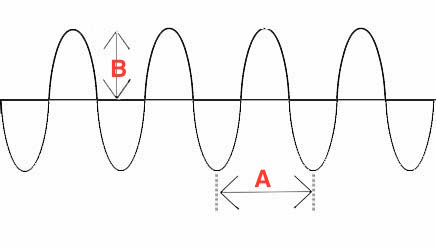
What property of this wave is represented by the letter "A"

a)

amplitude

b)

crest

c)

trough

d)

wavelength

32.
The type of waves that require medium to pass:
a)
Mechanical Waves
b)
Electromagnetic Waves
33.
When the frequency of a wave increases, what happens to the wavelength?
a)
The wavelength is not directly affected by the frequency of a wave.
b)
The wavelength increases.
c)
The wavelength decreases.
d)
More specific information is needed to form a conclusion about the wavelength.
34.
A mechanical wave cannot travel through...
a)
a vacuum(empty space).
b)
water.
c)
air. 
d)
glass.
35.
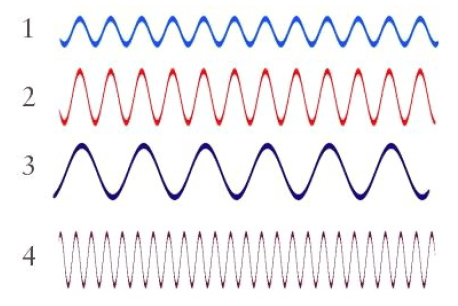
Which wave in the diagram has the greatest frequency?
a)
1
b)
2
c)
3
d)
4
36.
Which of the following can sound travel through?
a)
solid
b)
liquid
c)
gas
d)
all of the above
37.

Electromagnetic waves include the following except

a)

radio waves

b)

X-rays

c)

ocean waves

d)

microwaves

38.

Which wave is from a combination of parallel and perpendicular motions?

a)

transverse wave

b)

longitudinal wave

c)

surface wave

d)

electromagnetic wave

39.
All waves carry
a)
energy
b)
light 
c)
matter
d)
particles
40.
What kind of wave is pictured below?
a)
compressional wave
b)
transverse wave
c)
sound wave
d)
mechanical wave
41.
Which type of wave is pictured here?
a)
Longitudinal
b)
Transverse
c)
Light 
d)
Electromagnetic
42.

It is the high pressure part of the wave where the particles are close together. It is part A on this picture.

a)

Compression

b)

Amplituide

c)

Rarefaction

d)

Wavelength

43.

How are musical instruments grouped?

a)

by frequency

b)

by pitch

c)

by wavelength

d)

by amplitude

44.
What force holds the planets in motion around the sun?
a)
Magnetic
b)
Electrical
c)
Gravitational
d)
Air Resistance
45.
What does the strength of gravity between two objects depend upon?
a)
Mass & distance
b)
Mass & weight
c)
Gravity & inertia
d)
Inertia & mass
46.
All objects in the universe have a gravitational attraction to each other. 
a)
True
b)
False
47.
What force brings the pencil down?
a)
Applied
b)
Magnetic
c)
Normal
d)
Gravitational
48.
What force ultimately slows the roller coaster to a stop?
a)
Applied
b)
Normal
c)
Friction
d)
Magnetic
49.
Jupiter has about 317 times more mass than Earth. What can you infer from this fact? 
a)
That Jupiter’s gravitational force is much weaker than on Earth’s gravitational force.
b)
That Jupiter’s gravitational force is much stronger than Earth’s gravitational force.
c)
That Jupiter’s and Earth’s gravitational forces are equal.
d)
Mass has no effect on the gravitational force between two objects
50.
An _______ force must act on an object for it to CHANGE it's motion
a)
balanced
b)
unbalanced
c)
gravitational
d)
electrical
51.
Balanced forces do not change the objects speed or 
a)
direction
b)
distance 
c)
time
d)
mass
52.
Forces that have a net force of zero ( the object is still).
a)
Balanced force
b)
Unbalanced force
53.
Jonny and Patty are pushing against a basketball. Both of them push against theball on opposite sides with a force of 20 N to keep the ball still. What is the net force?
a)
400 N
b)
24 N
c)
0 N
d)
40 N
54.
What is the net force in this picture?
a)
50 Newtons to the right
b)
950 Newtons to the right
c)
950 Newtons to the left
d)
50 Newtons to the left
55.
What is the net force in this picture?
a)
50 Newtons to the right
b)
950 Newtons to the right
c)
950 Newtons to the left
d)
50 Newtons to the left
56.
What is the net force in this picture?
a)
50 Newtons to the right
b)
950 Newtons to the right
c)
950 Newtons to the left
d)
50 Newtons to the left