
 Worksheets
Module 6 Review
Total questions: 60
Worksheet time: 2hrs 30mins
The energy of movement is ___.
potential energy
kinetic energy
mechanical energy
The more energy that particles have, the ___ they move.
slower
faster
The force of attraction between molecules is ___.
intermolecular forces
bridge forces
chemical bonds

These properties describe a ___.
solid
liquid
gas

These properties describe a ___.
solid
liquid
gas

These properties describe a ___.
solid
liquid
gas
Collisions in which particles transfer all their kinetic energy to other particles are called ___.
elastic
inelastic
Which one of these is NOT an Ideal Gas Assumption?
Gas particles are hard, round spheres.
Gas particles are strongly attracted to one another.
Gas particles do not take up space.
Gas particles collide perfectly elastically.
What is the first assumption of the Kinetic Theory of Matter?
Matter consists of molecules and atoms
Gases are the same in all matter
Matter is the same as kinetic energy
Which is not a phase of matter?
Solid
Liquid
Plasma
Gas
Nuclear
Which of the physical states of water contains particles with the lowest kinetic energy?
Water
Ice
Steam
Melting ice
_______ is an explanation of how particles in matter behave
Boyle's Law
Charles' Law
Kinetic Molecular Theory
Temperature is a direct measure of:
The density of the particles within a substance.
The average speed of the particles within a substance.
How often the particles collide with the walls of their container.
As the temperature of a substance increases:
The speed, and average kinetic energy of the particles, both increase.
The speed, and average kinetic energy of the particles, both decrease.
The speed of the particles increases, but the average kinetic energy of the particles decreases.
The speed of the particles decreases, but the average kinetic energy of the particles increases.
Absolute Zero is defined as:
The lowest temperature which can be achieved by scientists.
The lowest temperature which can be recorded on a thermometer.
The theoretical temperature at which all particles stop moving.
The temperature of a cold block of copper.
Gas pressure is caused by ______.
gravity.
gas molecules colliding with each other.
gas molecules colliding with surfaces of the container.
gas molecules reacting with each other.
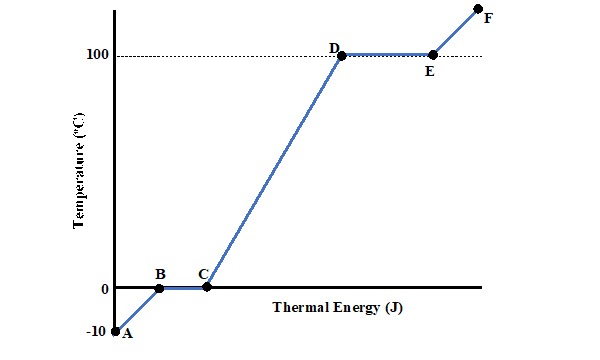
Between which two points is the solid cooling?
A <---- B
B <----> C
C <---- D
D <----> E
E <---- F
Between which two points is the gas heating up?
A ----> B
B <---- C
C ----> D
D ----> E
E ----> F
Between which two points is the gas condensing?
A <---- B
B <---- C
C <---- D
D <---- E
E <---- F
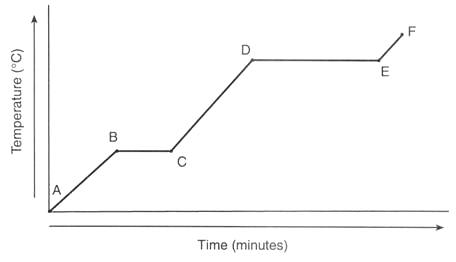


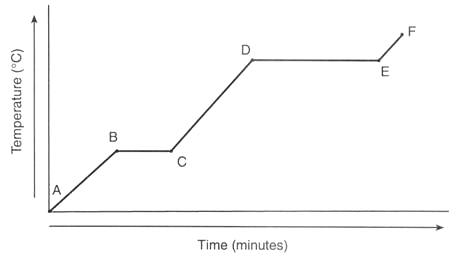
What is happening to the particles in the substance between points A and B?
Melting
Freezing
Speeding Up
Slowing Down

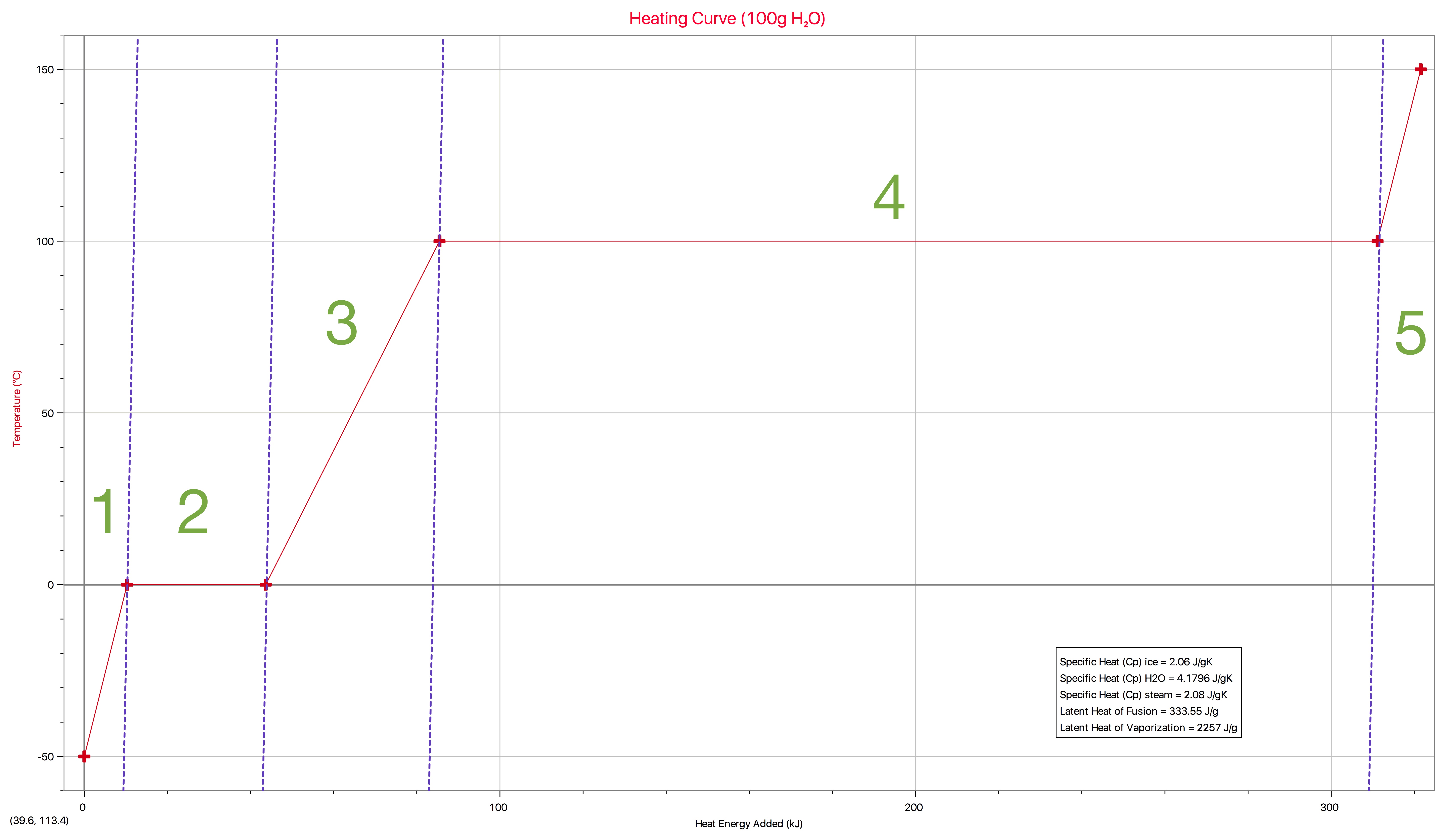
Where on the graph are phase changes taking place?
1
2
3
4
5
Which of these explain how a natural phenomenon works or happens?
theory
law
Which of these describes a natural phenomenon or relationship that always occurs under specific conditions
theory
law
If a gas has constant temperature and number of moles and its Pressure goes up, what happens to its volume?
It goes up
It goes down
It stays the same
If a gas has constant volume and number of moles and its temperature goes up, what happens to its pressure?
It goes up
It goes down
It stays the same
If a gas has constant pressure and number of moles and its temperature goes down, what happens to its volume?
It goes up
It goes down
It stays the same
If a gas has constant temperature and pressure and its number of moles goes up, what happens to its volume?
It goes up
It goes down
It stays the same
What is the correct formula for Boyle's Law?
T1V1=T2V2
T1P1=T2P2
P1V1=P2V2
n1V1=n2V2
What is the correct formula for Charles's Law?
T1V1=T2V2
T1P1=T2P2
P1V1=P2V2
n1V1=n2V2
What is the correct formula for Gay-Lussac's Law?
T1V1=T2V2
T1P1=T2P2
P1V1=P2V2
n1V1=n2V2
What is the correct formula for Avogadro's Law?
T1V1=T2V2
T1P1=T2P2
P1V1=P2V2
n1V1=n2V2
1. A sample of carbon dioxide occupies a volume of 3.50 liters at 125 kPa pressure. What pressure would the gas exert if the volume was decreased to 2.00 liters?
219 KPa
222 KPa
567 KPa
654 KPa
A sample of hydrogen at 1.5 atm had its pressure decreased to 0.50 atm producing a new volume of 750 mL. What was its original volume?
245 ml
345 ml
123 ml
250.mL
Determine the pressure change when a constant volume of gas at 1.00 atm is heated from 20.0 ˚C to 30.0 ˚C.
.75 atm
.93 atm
1.03 atm
2.96 atm
A gas thermometer measures temperature by measuring the pressure of a gas inside the fixed volume container. A thermometer reads a pressure of 248 kPa at 0˚C. What is the temperature when the thermometer reads a pressure of 345 kPa?
380 K
420 K
460 K
580 K

How many moles of argon gas are present in 18.83 liters?
4.22 mols
421.79 mols
0.84 mols
0.79 mols

Determine the volume, in liters, occupied by 42 mols of oxygen gas.
944 L
940.8 L
0.420 L
1.875 L
At room temperature and pressure condition, How many liters of NH3 are needed to react completely with 30.0L of NO?
4NH3+6NO --> 5N2 + 6H2O
5.0 L
20.0 L
7.5 L
120.0 L
2CO (g) + O2 (g) --> 2CO2 (g)
How many liters of carbon dioxide (CO2) are produced from 10L of carbon monoxide (CO)?
10
20
1
5

Determine the amount of moles of BaCl2 that are in 436 g of the compound.
3.5 mol
2.1 mol
4.6 mol
2.7 mol

Determine the amount of moles in CuBr that are in 276.9 g of the compound.
3.2 mol
1.7 mol
2.1 mol
1.9 mol
PV=nRT
A 7.50 liter sealed jar at 18 °C contains 0.125 moles of oxygen and 0.125 moles of nitrogen gas. What is the pressure in the container?
7.38 atm
0.796 atm
0.684 atm
0.398 atm
When 0.250 moles of a gas is placed in a container at 25 °C, it exerts a pressure of 700 mm Hg. What is the volume of the container?
0.557 Liters
6.57 Liters
8.74 Liters
0.0087 Liters

