wayground logo

Free Printable Worksheets

NEW

Font size

S
M
L
XL
Worksheets

Genetics Vocabulary: Mitosis: Reproduction

Total questions: 51

Worksheet time: 57mins

Name
Class
Date
1.

What type of Genotype is this: AA?

a)

Homozygous

b)

Heterozygous

2.

What type of Genotype is this: Aa?

a)

Homozygous

b)

Heterozygous

3.

What type of Genotype is this: aa?

a)

Homozygous

b)

Heterozygous

4.

What type of Genotype is this: Tt?

a)

Homozygous

b)

Heterozygous

5.

What type of Genotype is this: DD?

a)

Homozygous

b)

Heterozygous

6.

What type of Genotype is this: pp?

a)

Homozygous

b)

Heterozygous

7.

What type of Genotype is this: Mm?

a)

Homozygous

b)

Heterozygous

8.

What type of Genotype is this: TT?

a)

Homozygous

b)

Heterozygous

9.

What type of Genotype is this: ii?

a)

Homozygous

b)

Heterozygous

10.
The physical appearance of an organism based on traits
a)
Genotype
b)
Phenotype
c)
Meiosis
d)
Genetics
11.
Which of the following is a phenotype?
a)
Aa
b)
red hair
c)
heterozygous genes
d)
mutated DNA
12.
different forms of the same gene are called
a)
alleles
b)
genetics
c)
p generation
d)
law of segregation
13.
What is a recessive allele?
a)
A trait that is always shown (capital letter)
b)
A trait that can be hidden (lower case letter)
c)
Alleles that are the same
d)
Alleles that are different
14.
Mark is heterozygous. If B is for brown hair, and b is for blonde hair, what is Mark's genotype?
a)
BB
b)
bb
c)
Bb
d)
bB
15.
Mark is heterozygous. If B is for brown hair, and b is for blonde hair, what is Mark's phenotype?
a)
Brown Hair
b)
Blonde Hair
c)
Brown and Blonde Hair
d)
Black Hair
16.
How many letters does a genotype contain?
a)
1
b)
2
c)
3
d)
4
17.
Hair colour is an example of
a)
genotype
b)
phenotype
18.
Having the genes for baldness is an example of
a)
genotype
b)
phenotype
19.
How tall you are is an example of
a)
genotype
b)
phenotype
20.

Dominant alleles are written with:

a)

Upper case always

b)

Lower case always

21.

Recessive alleles are written with:

a)

Upper case always

b)

Lower case always

22.

TT and Tt are both

a)

Dominant

b)

Recessive

c)

Both

d)

None

23.

dd would look

a)

Dominant

b)

Recessive

c)

Both

d)

None

24.

Dd would look

a)

Dominant

b)

Recessive

c)

Both

d)

None

25.

TT and Tt are both

a)

Dominant

b)

Recessive

c)

Both

d)

None

26.

If Black phenotype is Dominant then its genotype will be

a)

BB

b)

Bb

c)

bb

d)

Both BB and Bb

27.

If White phenotype is Recessive then its genotype will be

a)

aa

b)

AA

c)

Aa

d)

None of the above

28.

Select the recessive genotype

a)

TT

b)

Tt

c)

tt

d)

None

29.
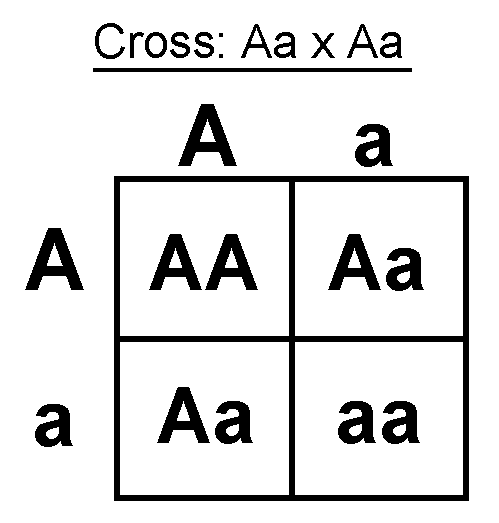
What allele combination should go in the missing box?
a)
AA
b)
Aa
c)
aa
d)
none of these
30.
If B = brown hair and b = blonde hair, what is the probability of brown hair?
a)
25%
b)
50%
c)
0%
d)
75%
31.

What is the dominant trait here?

a)

Bb

b)

Recessive eyes

c)

Blue eyes

d)

Brown eyes

32.

What does a punnet square show us?

a)

The age of the offspring

b)

The chance of a genotype (trait) showing up in offspring

c)

Numbers

d)

Blue eyes

33.
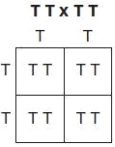
T - tall and t = short
In the punnett square below, what belongs in the missing square
a)
tt
b)
Tt
c)
Bb
d)
TT
34.
In rabbits, black fur (B) is dominant over brown fur (b). If a rabbit has brown fur, what can you conclude about its genotype?
a)
It is BB.
b)
It is Bb
c)
It is brown
d)
It is bb.
35.
A ________________________ is used to predict the possible genotype from certain parents
a)
Mendel Grid
b)
Genetic Tic Tac Toe
c)
Punnett Square
d)
Pedigree Plot
36.
What percent of offspring will have the recessive trait?
a)
25
b)
50
c)
75
d)
100
37.
What is a phenotype
a)
The genetic make up (code)
b)
The physical trait
38.
What is the probability of heterozygous offspring?
a)
25%
b)
50%
c)
0%
d)
100%
39.
Which of the following genotypes is homozygous dominant?
a)
A
b)
Aa
c)
AA
d)
aa
40.
What is the probability of homozygous dominant offspring?
a)
0%
b)
100%
c)
50%
d)
25%
41.
What ratio of the offspring from the cross shown will be homozygous recessive for the  trait of tallness? 
a)
0 in 4
b)
1 in 4
c)
2 in 4
d)
4 in 4
42.

A sperm and an egg join together in a process called

a)

mitosis

b)

meiosis

c)

fertilization

d)

fission

43.

___________ reproduction has the advantage of increasing genetic variation.

a)

Sexual

b)

Asexual

c)

Fission

d)

Budding

44.

Sex cells are produced by _____________.

a)

photosynthesis

b)

zygotes

c)

meiosis

d)

mitosis

45.
Which of the following cells is a gamete?
a)
egg
b)
bone
c)
heart
d)
muscle
46.
The fertilized egg is termed a/an _____.
a)
gamete
b)
allele
c)
homolog
d)
zygote
47.
In mitosis cells are genetically _______, but in meiosis cells are genetically ______.
a)
diverse, identical
b)
identical, diverse/different
48.

Is the following cell diploid or haploid?

a)

Diploid

b)

Haploid

49.

Mitosis makes sure that all daughter cells are _____.

a)

genetically identical, diploid

b)

genetically identical, haploid

c)

genetically diverse, diploid

d)

genetically diverse, haploid

50.
Responsible for creating sex cells are gametes called sperm and egg. 
a)
Meiosis
b)
Mitosis
c)
Metaphase I
d)
Photosynthesis
51.
A human being has a somatic cell that has 46 chromosomes.  What is the haploid number found in a gamete?
a)
23
b)
46
c)
69
d)
92