
NEW
Font size
 Worksheets
Biology Final Review
Total questions: 80
Worksheet time: 48mins
Which of the following is not part of mitosis?
cell division
duplication of chromosomes
reduction of chromosome number
production of new cells

What phase is this?
prophase
metaphase
anaphase
telophase
What is crossing over?
two homologous chromosomes trade pieces
genes on chromosomes each shift positions
a chromosome is removed from a cell's nucleus
part of a chromosome breaks off
What kind of cells are made at the end of mitosis?
identical cells
genetically different cells
haploid cells
polyploidy cells
What is a gamete?
sperm cell
egg cell
somatic cell
sperm and egg cells
Why is sexual reproduction advantageous over asexual reproduction?
Requires less energy
Higher rate of success producing offspring
Results in a genetically varied offspring that will have a better chance of survival if the environment changes
Results in identical offspring
How many chromosomes do humans have?
46
48
56
58

What is the order of mitosis?
prophase, metaphase, anaphase, telophase
metaphase, prophase, anaphase, telophase
prophase, anaphase, metaphase, telophase
telophase, anaphase, prophase, metaphase
What process creates gametes?
meiosis
mitosis
crossing over
DNA replication
What kind of cells does meiosis create?
2 diploid cells
4 diploid cells
2 haploid cells
4 haploid cells
Which of the following is not a type of asexual reproduction?
binary fission
budding
pollination
regeneration
If the diploid number of a goldfish is 42, what is the haploid number?
21
84
21.5
100
When does cytokinesis occur?
mitosis
meiosis
mitosis and meiosis
DNA replication

What is advantageous about sexual reproduction?
Not time consuming
Creates genetically different offspring
Doesn't require a mate
Creates identical offspring

What is this process known as?
DNA replication
mitosis
crossing over
transcription
Which of the following is a somatic cell?
egg cell
sperm cell
zygote
skin cell
What do asexual and sexual reproduction have in common?
Quick
Do not need a mate
Create new daughter cells
Use the same amount of energy
What is advantageous about asexual reproduction?
takes a long time
not time consuming
produces only 1 offpsring
requires a mate
What is a genotype?
blonde hair
attached earlobes
RR
non-rolling tongue
What does a karyotype show?
sex-linked trait
autosomal dominant disorder
non-disjunction
autosomal recessive disorder
What type of mutation results in one base replacing another in a DNA codon?
insertion
deletion
germ mutation
substitution
If a mother has Type O blood and a father has Type B blood, what type of blood can their children not have?
AB
B
O
not enough information
What type of mutation results in a base added to a DNA sequence?
substitution
point
insertion
deletion
What does a karyotype show?
an organism's chromosomes paired and numbers
DNA separated by size
a family tree
DNA fingerprint
What is the Law of Dominance?
recessive allele masks the dominant allele
dominant allele masks the recessive allele
all alleles are recessive
alleles are neither dominant nor recessive
What percent of the percentage will show the recessive phenotype when Tt is crossed with Tt?
100%
75%
50%
25%
What type of disorder significantly affects more males than females?
sex-linked disorder
autosomal dominant disorder
autosomal recessive disorder
None of the above

What is a sex-linked trait?
Appears in only males or only females but never in both
Carried on the X or Y chromosome
Expressed only during asexual reproduction
Trait is carried on one of the autosomal chromosome pair
Which of the following demonstrates codomoninace?
a green pea plant and a yellow plant producing green pea plants
a white and black cat producing a white and black striped kitty
a red and white flower producing a pink flower
a color blind female and a normal vision male producing a color blind son
What causes variation in skin color?
incomplete dominance
codomoninance
polygenic traits
multiple alleles
If a homozygous mouse with white fur is crossed with a homozygous mouse dominant for brown fur, what percentage of the offspring will have brown fur?
25%
50%
75%
100%
What priniciple states that during gamete formation genes for different traits separate without influence each other's inheritance?
Principle of Dominance
Principle of Independent Assortment
Principle of Probabilities
Principle of Segregation
What is a carrier?
any individual that is homozygous recessive
a male that only has one recessive allele
a female that is colorblind
a female that has one recessive allele but does not express the disorder
What is it called when scientists insert a gene from one organism into the DNA of another organism?
cloning
gel electrophoresis
DNA fingerprinting
gene splicing
If a homozygous dominant blue spotted lizard is crossed with a heterozygous blue spotted lizard, what is the phenotypic ratio?
2:2
4:0
4:4
3:1
A blue tulip and red tulip produce all purple tulips. What type of inheritance is this?
codominance
sex-linked
incomplete dominance
multiple alleles
What is it called an individual has two different alleles for a trait?
homozygous
heterozygous
dominant
recessive
What describes organisms best suited for the environment will survive and reproduce?
punctuated equilibrium
natural selection
adapative radiation
artificial selection
What does Darwin's Theory of Evolution include?
comparative anatomy
embryo development
molecular biology
all of the above
What best illustrates analogous structures?
bones of a whale fin and bones of a cat leg
human appendix and wisdom teeth
wing of an eagle and wing of a butterfly
shell on a turtle and fangs of a snake
How would Lamarck explain why cheetahs are fast?
Environment chose fast cheetahs
Survival of the fittest
Cheetahs were forced to run faster so the more they ran the faster they became
Cheetahs that were born fast were more likely to survive and pass on this trait to their offspring
What characteristics increase the chance of survival?
adaptations
vestigial structures
homologous structrues
analogous structures
What will happen to bacteria if they are treated with antibiotics?
The bacteria will increase rapidly.
The bacteria will be able to obtain more food.
The bacteriawill increase then stabilize at carrying capacity.
Some bacteria will become resistance and survive.
What type of structure once has a purpose but no longer has a specific function like the appendix?
analogous
homologous
vestigial
successive
What are protective shells, fangs, claws, and fur an example of?
structural adaptations
physiological adaptations
behavioral adaptations
geological adaptations
Many species hunt only at night because of lower temperature or extra protection. What is this an example of?
structural adaptations
physiological adaptations
behavioral adaptations
geological adaptations

The most recent common ancestor of species A, B, and C is
J
F
I
H
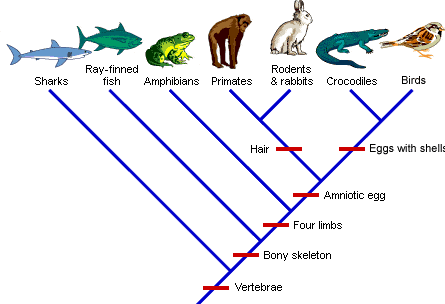
According to the cladogram, which of the following does a frog (amphibian) have?
hair, four limbs, eggs with shells, and bony skeleton
amniotic egg, four limbs, and hair
four limbs, bony skeleton, and vertebrate
eggs with shells, hair, and amniotic egg

the initial favored population as the average variation and the final favored populations as both extreme variations
directional selection
stabilizing selection
geographic selection
disruptive selection
What can we conclude by analyzing the bone structure of a human arm, whale fin, and bat wing?
They are all members of the same species
They share a common ancestor
They never had a common ancestor
They contain the same genetic information
If two species are separated by a river and can no longer mate, what is this called?
habitat isolation
temporal isolation
geographical isolation
behavioral isolation
Starlings produce an average of five eggs in each clutch. If there are more than five, the parents cannot adequately feed the young. If there are fewer than five, predators may destroy the entire clutch. What is this an example of?
stabilizing selection
disruptive selection
directional selection
none of the above
A frog can use poisonous mucus to ward off predators. What type of adaptation is this?
behavioral adaptation
structural adaptation
temporal adaptation
physiological adaptation
What is a method of artificial selection?
genetic drift
sexual selection
selective breeding
geographical isolation
If is a species cannot mate because of their specific mating call, what is this known as?
geographical isolation
behavioral isolation
habitat isolation
temporal isolation
What is the best way to determine evolutionary relationships between organisms?
common behaviors
similar physical features
DNA analysis
fossilized ancestors that they may have in common
Fungi get their energy through breaking down nutrients in organisms then using the material for energy. What is this an example of?
producer
autotroph
heterotroph
ecological equivalents

What type of growth is shown in the graph?
exponential
logistic
density dependent
density independent
What can you conclude when organisms share several amino acids?
They are more closely related.
They are less closely related.
They are not related at all.
They are the same species.
Which of the following is a pioneer species?
grass
oak trees
mushroom
birds
Which of the following is listed from biggest to smallest?
Biosphere, ecosystem, population, community, organism, Biome
Organism, population, community, ecosystem, Biome, biosphere
Biosphere, Biome, ecosystem, community, population, organism
Community, population, individual, biome, ecosystem, biosphere
What is mutualism?
One organism is harmed and the other benefits.
Both organisms are harmed.
Both organisms benefit.
One organism benefits and the other neither benefits nor is harmed.
What is an abiotic factor?
nitrogen-fixing bacteria
bees
invasive species
precipitation
What type of organism is found in trophic level 2?
producers
primary consumers
secondary consumers
tertiary consumers
What presents a secondary consumer in the following food chain: apple tree --> caterpillar --> bird --> cat
apple tree
caterpillar
bird
cat
What is it called when two organisms from different species form a relationship?
limiting factor
symbiosis
ecological equivalents
sexual selection
What is true about energy pyramids?
The bottom level has the most stored energy
The top level has the most organisms
The bottom level has the least biodiversity
The top level has the most stored energy
If a chipmunk eats a seed then the chipmunk is eaten by the snake and the snake is eaten by the eagle, which of the following is false?
the chipmunk is a primary consumer
energy is gained at each trophic level
the eagle is the highest trophic level
the seed is part of a producer
What is an example of a bird's habitat?
Its colors help attract a mate
The nest that it lives in for protection
Its role as a predator in the ecosystem
Its average lifespan
What type of growth exhibits carrying capacity?
logistic
exponential
explosive
no growth
What is a climax community?
a community where all the organisms are living
a community that has reached its carrying capacity
an community that is stable and does not go through significant changes
an community that is experiencing exponential growth
How does deforestation affect the carbon cycle?
reduces CO2 in the atmosphere
increases CO2 in the atmosphere
increase oxygen in the atmosphere
increases phosphorous in the atmosphere
Which of the following is density dependent?
wildfire
competition
unlimited nutrients
severe drought
If 250,000 Joules is available to the producer, how much is transferred to the secondary consumers?
250 Joules
2,500 Joules
25,000 Joules
250,000 Joules
If grass is the first one to show up in a year 1 of a population, what is happening?
Primary succession because only grasses were present in the first year.
Secondary succession because only grasses were present in the first year.
Where do almost all organisms get their energy from?
hydrothermal vents
radiation
decaying matter
sunlight

What is an example of a food chain in this diagram?
Rosebush -> rabbit -> snake
Oak tree -> caterpillar -> frog -> snake
Rosebush -> deer -> hawk
Oak tree -> sparrow -> hawk -> wolf

