wayground logo

Free Printable Worksheets

Font size

S
M
L
XL
Worksheets

7th Grade Review

Total questions: 141

Worksheet time: 4hrs 40mins

Name
Class
Date
1.
What do we call the center of the Earth?
a)
Mantle
b)
Crust
c)
Apple
d)
Core
2.
Which is the hottest part of the Earth?
a)
The core
b)
The mantle
c)
The crust
d)
The Asthenosphere
3.
What is the core made of?
a)
Molten rock
b)
Solid rock
c)
Molten metal
d)
Solid metal
4.
What layer is between the inner core and the mantle?
a)
asthenosphere
b)
crust
c)
outer core
d)
lithosphere
5.
Which is the coolest part of the planet?
a)
inner core
b)
outer core
c)
mantle
d)
crust
6.
How far is it to the center of the Earth in miles?
a)
4000
b)
400
c)
40,000
d)
27408
7.
Which two metals are thought to be found in the core?
a)
iron and steel
b)
iron and nickel
c)
gold and silver
d)
iron and copper
8.
How hot is it in the Earth's center?
a)
600 Celcius
b)
6000 Celcius
c)
6 million Celcius
d)
451 Fahrenheit 
9.
Which of these layers is the largest?
a)
lithosphere
b)
asthenosphere
c)
outer core
d)
mantle
10.
Protects us from harmful UV rays
a)
Oxygen
b)
Carbon monoxide
c)
Ozone layer
d)
Carbon dioxide
11.
Which layer of the Earth is the most dense?
a)
Crust
b)
Inner core
c)
Mantle
d)
Outer core
12.
Which layer of the Earth is the least dense?
a)
Crust
b)
Inner core
c)
Mantle
d)
Outer core
13.
Which portion of the crust is thicker?
a)
Continental
b)
Oceanic
14.
Which letter represents the entire mantle?
a)
A
b)
C
c)
D
d)
F
15.
Which layer represents the lithosphere?
a)
A
b)
B
c)
C
d)
D
16.

Your feet are on

a)

The crust

b)

The mantle

c)

The core

17.

Earhquakes takes place on

a)

The crust

b)

The mantle

c)

The core

18.

The thickest layer of the Earth is

a)

The crust

b)

The mantle

c)

The core

19.
Created by a divergent boundary.
a)
Rocky Mountains
b)
Mariana Trench
c)
Mid Atlantic ridge
20.
Mountains form from ...
a)
plates sliding past one another
b)
collision of plates
c)
plates moving away from each other
21.
During sea floor spreading, molten material rises up from the mantle...
a)
along the continents
b)
at the mid ocean ridges
c)
deep ocean trenches
d)
at north and south poles
22.
Which of the following is where one plate slides under another plate?
a)
submarine zone
b)
divergence zone
c)
subduction zone
d)
lower zone
23.
The area around the pacific plate where boundaries form is called...
a)
death ring
b)
fire zone
c)
ring of fire
d)
zone of fire
24.
Associated with transform boundaries.
a)
Volcanoes
b)
mountains
c)
trenches
d)
earthquakes
25.
This land formation occurs at a divergent continental/ continental boundary.
a)
mid ocean ridge
b)
deep ocean trench
c)
pacific hot spot
d)
rift valley
26.
What happens to temperature as you go deeper in the Earth?
a)
decreases
b)
increases
c)
fluctuates
d)
remains the same
27.
Name the boundary
a)
convergent boundary
b)
divergent boundary
c)
transform boundary
d)
sergent boundary
28.
What is represented by the picture? 
a)
Sea-floor spreading
b)
Pangea
c)
How the continents are arranged today
d)
Volcanoes
29.
Name the boundary
a)
convergent boundary
b)
divergent boundary
c)
transform boundary
d)
sergent boundary
30.
Name the boundary
a)
convergent boundary
b)
divergent boundary
c)
transform boundary
d)
sergent boundary
31.
Which type of crust is more dense and thinner?
a)
Continental
b)
Asthenosphere
c)
Oceanic
d)
Byers
32.
What was Wegener's hypothesis called?
a)
The Pangea 
b)
Moving Continents 
c)
The Continental Drift
d)
Techtonic Plates
33.
Why was Alfred Wegner's theory of Continental Drift not immediately accepted by scientists?
a)
there was no mechanism to explain how Continental Drift happened.
b)
The theory of Continental Drift was immediately accepted by the scientific community.
c)
there was no evidence to support his theory.
d)
Scientists did not think it was possible for the Continents to move.
34.
A location where two tectonic plates collide is known as a _________ boundary.
a)
Convergent
b)
Divergent
c)
Transform
d)
Spreading
35.
A location where two tectonic plates collide is known as a _________ boundary.
a)
Convergent
b)
Divergent
c)
Transform
d)
Spreading
36.
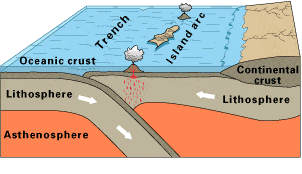
Which answer below correctly describes the formation of a volcanic island arc?
a)
Islands are created along the mid ocean ridge as new oceanic crust is formed.
b)
Islands are created one at a time as the plate moves across a hot spot in the mantle.
c)
Islands are created along a subduction zone as oceanic crust is forced back down in to the mantle.
d)
Islands are created as pressure is released when two tectonic plates are pulled apart.
37.

The movement of the tectonic plates is caused by

a)

the rotation of the Earth.

b)

convection currents in the Asthenosphere

c)

the gravity of the iron-nickel core.

d)

the Moho discontinuity.

38.

In some areas of the world, like California and Japan, earthquakes are a common occurrence. How can this best be explained?

a)

The strong ocean currents are undermining both areas causing earthquakes.

b)

Both areas are located near the edge of the Pacific Ocean, the unstable sand causes earthquakes.

c)

Both areas are subjected to strong ocean wind and waves that causes earthquakes.

d)

Both areas are on the boundary of active plates, the motion of the plates causes earthquakes.
39.
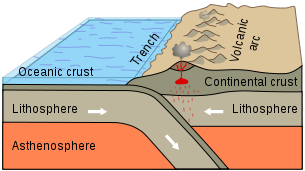
Subduction zones occur on Earth where dense oceanic crust dives under more buoyant continental crust. These boundaries are characterized by a deep ocean trench next to a high continental mountain range, large numbers of earthquakes and volcanoes. All of this is further evidence for the
a)
big bang theory.
b)
theory of plate tectonics.
c)
origin of the species.
d)
theory of natural selection.
40.
There are three types of plate boundaries. Which choice is NOT a type of plate boundary?
a)
convergent
b)
thrust
c)
divergent
d)
transform
41.

Observe this diagram of a plate boundary. One statement BEST describes what is happening. It is that

a)

the oceanic crust is melting.

b)

the denser ceanic crust is subducting under the less dense oceanic crust

c)

volcanic islands are forming.

d)

the tectonic plates are moving away from each other.
42.

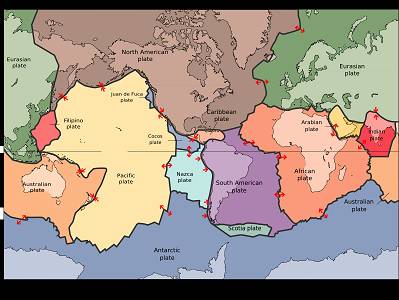
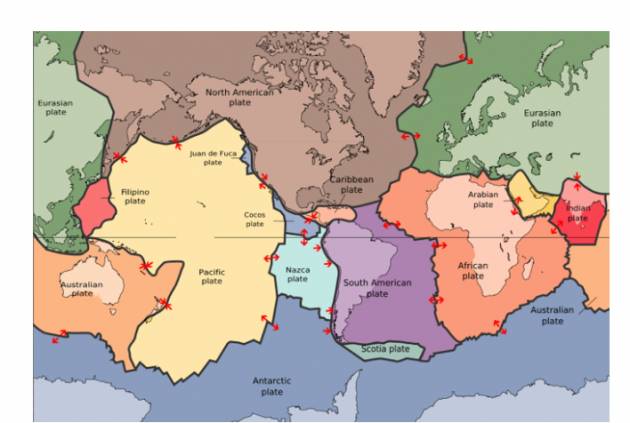
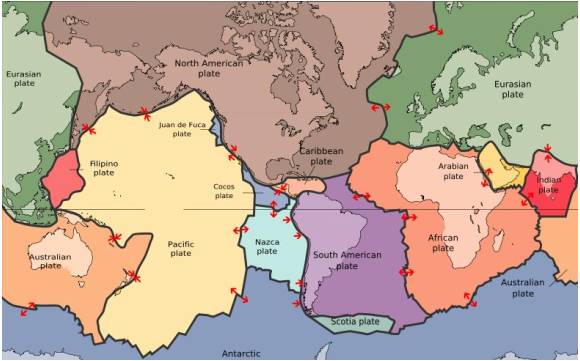
The map in the picture shows tectonic plate boundaries. This map would be useful in predicting the location of future

a)

droughts

b)

hurricanes

c)

earthquakes

d)

tornadoes

43.
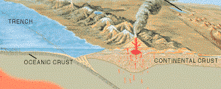
What geological forces might be responsible for this range of mountains?
a)
diverging tectonic plates
b)
erosion of the land by the ocean
c)
converging tectonic plates
d)
deposition of sediments by the ocean
44.

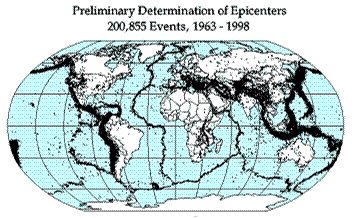
Earthquake epicenters (center of where the earthquakes started) were mapped for a 35 year period in the diagram above. The black dots indicate these epicenters. The black dots appear along what feature on Earth?

a)

hot spots

b)

plate boundaries

c)

rift zones

d)

sea floor spreading

45.
The Earth’s surface is not a solid surface but is divided into
a)
several oceanic plates.
b)
continental and crustal plates.
c)
seven continental plates.
d)
continental and oceanic plates.
46.
The Earth’s surface is not a solid surface but is divided into
a)
several oceanic plates.
b)
continental and crustal plates.
c)
seven continental plates.
d)
continental and oceanic plates.
47.
Geologists have long recognized that earthquakes are not randomly distributed on Earth but occur in concentrated areas that coincide with __________ and provide evidence for the theory of ___________ .
a)
mountain ranges; fault zones.
b)
continental borders; supercontinents.
c)
plate boundaries; plate tectonics
d)
areas of liquid magma; sea floor spreading.
48.
Which geological features MOST LIKELY prompted the development of the theory of plate tectonics?
a)
river deltas
b)
mountain ranges
c)
glacier fields
d)
tropical rainforests
49.

Where are earthquakes MOST LIKELY to occur?

a)

close to the equator

b)

close to the center of tectonic plates

c)

at divergent or convergent plate boundaries

d)

at transform plate boundaries

50.

The 2004 Indian Ocean tsunami was caused by a shift in two plates that pushed one section of the sea floor under another section of the sea floor by 5 meters. What type of boundary is this?

a)

divergent

b)

convergent

c)

transform

d)

metamorphic

51.
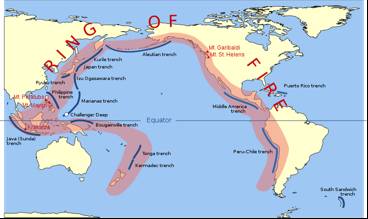
The image shows the Pacific Ring of Fire, a region of high tectonic activity. What evidence supports the theory that the tectonic activity of the region is due to the subduction of tectonic plates?
a)
The region is bound by many oceanic trenches.
b)
North America seems to be colliding with Asia at the north of the ring.
c)
The Asia-Pacific region is dotted by many small and large islands
d)
The landmasses look like they would fit together like the pieces of a jigsaw puzzle.
52.
The Atlantic Ocean gets about 3-5 ______ wider each year.
a)
centimeters
b)
kilometers
c)
miles
d)
meters
53.
According to the Law of Conservation of Energy, energy cannot be _________ or ____________. 
a)
destroyed, destroyed
b)
created, saved
c)
created, destroyed
d)
lost, found
54.
Energy transformations occur when...
a)
energy is created through conduction
b)
energy changes from one form to another
c)
two forces slide together that are touching
d)
a chemical reaction takes place
55.
Gravitational potential energy depends on the ________ and ________ of the object. 
a)
Height and mass
b)
Friction and movement
c)
Mass and Movement
d)
Height and Friction 
56.

The roller coaster cart has the most gravitational potential energy at position-

a)

W

b)

X

c)

Y

d)

Z

57.
Where is the potential energy the greatest?
a)
A
b)
B
c)
C
d)
D
58.

What is energy?

a)

The ability to do work

b)

A force

c)

Electricity

d)

The ability to transform work

59.
Energy of motion is which type of energy?
a)
Potential
b)
Kinetic
c)
Sound
d)
Gravitational
60.
On a roller coaster, where is maximum potential energy?
a)
At the bottom of a big hill
b)
When going around a corner
c)
When going upside down
d)
At the top of a big hill
61.
On a roller coaster, where is maximum kinetic energy?
a)
At the bottom of a big hill
b)
When going around a corner
c)
When going upside down
d)
At the top of a big hill
62.
Potential Energy is:
a)
The energy of motion
b)
always conserved
c)
The energy due to position
63.

Where is the potential energy the least?

a)

A

b)

B

c)

C

d)

D

64.

Where is the kinetic energy the least?

a)

A

b)

B

c)

C

d)

D

65.

Where is the kinetic energy the greatest?

a)

A

b)

B

c)

C

d)

D

66.

What would be the energy transformation from Position A to Position B

a)

Kinetic to Potential

b)

There is no energy transformation

c)

Gravitational Potential to Kinetic

d)

Potential Elastic to Gravitational Potential

67.

The fastest point of the roller coaster is__________ because____...

a)

B, all of the Gravitational Potential Energy has been transformed to Kinetic Energy

b)

D, it is at the end of the roller coaster

c)

C, all of the Gravitational Potential Energy has been transformed to Kinetic Energy

68.

What is the energy transformation that occurs in an electric pencil sharpener?

a)

mechanical energy to electrical energy

b)

electrical energy to mechanical energy

c)

radiant energy to sound energy

d)

chemical energy to mechanical energy

69.

Which object shows an energy transformation from electrical to mechanical?

a)
b)
c)
d)
70.

When a car burns gasoline it creates hot air to move the pistons in the engine, which causes the car to move. What energy transformation occur from the fuel to the movement of a car?

a)

thermal energy to mechanical energy

b)

thermal energy to chemical energy to mechanical energy

c)

chemical energy to thermal energy to mechanical energy

d)

chemical energy to electrical energy

71.
Which of the following energy transformations occur when a lamp that is plugged into a wall socket is functioning correctly?
a)
Chemical to light
b)
Electrical to chemical
c)
Electrical to light
d)
Chemical to electrical
72.

The roller coaster cart has the most kinetic energy at position-

a)

W

b)

X

c)

Y

d)

Z

73.

A hot air balloon rising is an example of ...

a)

conduction

b)

convection

c)

radiation

d)

connection

74.

A snowman melting in the sun

a)

convection

b)

conduction

c)

radiation

d)

connection

75.

Eggs cooking in a frying pan

a)

convection

b)

conduction

c)

radiation

d)

connection

76.

Heating a kettle on a hot stove (burner)

a)

convection

b)

conduction

c)

radiation

d)

connection

77.

A stove top will cook your food because of ___________.

a)

convection

b)

conduction

c)

radiation

d)

connection

78.

Thermal energy that is transferred from one substance to another.

a)

heat

b)

temperature

c)

thermal energy

d)

radiation

79.

A blow dryer uses __________ to dry your hair.

a)

convection

b)

conduction

c)

radiation

d)

connection

80.

At what point does the biker have the greatest Kinetic Energy?

a)

Point A

b)

Point B

c)

Point C

d)

Point D

81.

Which Apple has the greatest Gravitational Potential Energy?

a)

Apple A

b)

Apple B

c)

Apple C

d)

Apple D

82.

Which Apple has the greatest Gravitational Potential Energy?

a)

The object with a mass of 3kg because its mass is less.

b)

The object with a mass of 50kg because its mass is greater.

c)

Both objects because they are at the same height.

d)

Neither of the objects because they are at the same height.

83.

What type of energy is transformed in the Energy Conversion shown in the image below?

a)

Nuclear Energy

b)

Chemical Energy

c)

Thermal Energy

d)

Electrical Energy

84.

What is the Energy Conversion that is shown in the image?

a)

Radiant to Thermal

b)

Thermal to Chemical

c)

Chemical to Radiant

d)

Radiant to Chemical

85.

What is the Energy Conversion that is shown in the image?

a)

Chemical to Mechanical

b)

Thermal to Chemical

c)

Chemical to Thermal

d)

Mechanical to Chemical

86.
How many alleles (letters) does a child get from each parent for each trait?
a)
1
b)
2
c)
3
d)
4
87.
How many alleles (letters) do each person carry for a trait?
a)
1
b)
2
c)
3
d)
4
88.
Dominant alleles are represented by a:
a)
Male gene
b)
lowercase letter
c)
recessive trait
d)
capital letter
89.
Aa, DD, bB, yy are all examples of
a)
genotypes
b)
phenotypes
90.
In a heterozygous genotype, the ___________ allele takes over in the phenotype.
a)
recessive
b)
dominant
c)
lower case letter
d)
both 
91.
What you see, or the physical appearance.
a)
Genotype
b)
Phenotype
c)
Homozygous
d)
Heterozygous
92.
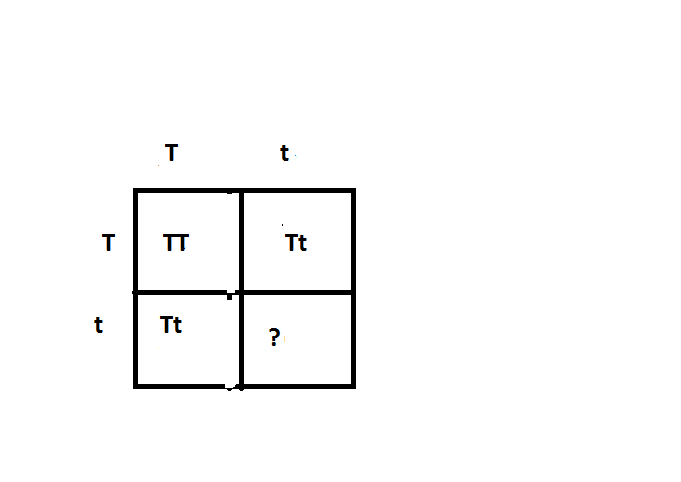
T - tall and t = short
In the punnett square below, what belongs in the missing square
a)
tt
b)
Tt
c)
Bb
d)
TT
93.
B = brown eyes
b = blue eyes
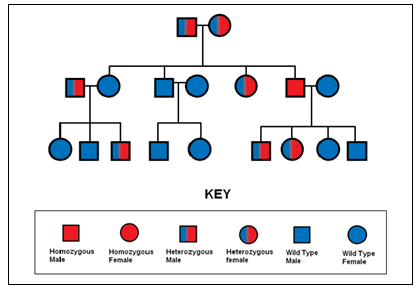
What is true about these two brothers that have brown eyes?
One has genotype BB the other Bb.
a)
they have same phenotype and genotype
b)
they have different genotypes and phenotypes
c)
they have same phenotype but different genotypes
d)
they have same genotype but different phenotypes
94.
Aa is
a)
homozygous
b)
heterozygous
95.
Which of the following is a phenotype?
a)
Aa
b)
red hair
c)
heterozygous
d)
DNA
96.
Which of the following genotypes is homozygous dominant?
a)
A
b)
Aa
c)
AA
d)
aa
97.
Which of the following genotypes is heterozygous?
a)
Bb
b)
BB
c)
bb
d)
B
98.
Which of the following is homozygous recessive?
a)
Tt
b)
tt
c)
TT
d)
T
99.
In a pedigree, what shape represents a male?
a)
circle
b)
square
c)
triangle
d)
diamond
100.
What gender has an X and a Y chromosome?
a)
male
b)
female
c)
transgender 
d)
all of the above
101.
The science of heredity
a)
heredity
b)
genetics
c)
trait
d)
gene
102.
The passing of traits from parents to offspring
a)
heredity
b)
genetics
c)
trait
d)
alleles
103.
Characteristics can also be called
a)
heredity
b)
traits
c)
gene 
d)
alleles
104.
The different forms of a gene
a)
heredity
b)
genetics
c)
gene
d)
alleles
105.
The factors that control a trait
a)
genetics
b)
trait
c)
gene
d)
alleles
106.
This trait always shows up in an organism when the allele is present
a)
dominant allele
b)
codominance
c)
probability
d)
recessive allele
107.
This trait is hidden whenever the dominant allele is present
a)
dominant allele
b)
codominance
c)
recessive allele
d)
Punnett Square
108.
This trait is hidden whenever the dominant allele is present
a)
dominant allele
b)
codominance
c)
recessive allele
d)
Punnett Square
109.
This trait is hidden whenever the dominant allele is present
a)
dominant allele
b)
codominance
c)
recessive allele
d)
Punnett Square
110.
A chart that shows all the possible combinations of alleles that can result from a genetic cross
a)
dominant allele
b)
codominance
c)
probability
d)
Punnett Square
111.
The mathematical chance that an event will occur
a)
dominant allele
b)
probability
c)
recessive allele
d)
Punnett Square
112.
The mathematical chance that an event will occur
a)
dominant allele
b)
probability
c)
recessive allele
d)
Punnett Square
113.
An organism's physical appearance or visible traits
a)
fertilization
b)
genotype
c)
phenotype
d)
homozygous
114.
An organism's genetic makeup, or allele combination
a)
fertilization
b)
genotype
c)
phenotype
d)
heterozygous
115.
An organism that has two different alleles for a trait (hybrid)
a)
fertilization
b)
genotype
c)
homozygous
d)
heterozygous
116.
A new organism begins to form when egg and sperm join in a process called
a)
fertilization
b)
phenotype
c)
homozygous
d)
heterozygous
117.
The science of heredity
a)
Physics
b)
Chemistry
c)
Genetics
d)
Ecology
118.

What do you call the cell that forms from fertilization?

a)

fertilized egg

b)

sperm cell

c)

zygote

d)

egg cell

119.

What do you call the type of reproduction in which the genetic materials from two different cells combine, producing an offspring?

a)

pollination

b)

sexual reproduction

c)

fertilization

d)

asexual reproduction

120.

What do you call the female sex cell?

a)

egg cell

b)

sperm cell

c)

diploid

d)

haploid

121.

What do you call the cells that have pairs of chromosomes?

a)

Diploid

b)

Haploid

c)

Sperm cell

d)

egg cell

122.

Which of the following is NOT a stage of meiosis?

a)

Prophase

b)

Metaphase

c)

Interphase

d)

Telophase

123.

Which of the following is an advantage of sexual reproduction?

a)

Genetic variation

b)

Down syndrome

c)

Mutation

d)

New trait formed

124.

All of the following statements are disadvantages of sexual reproduction except ______.

a)

Takes much time to process reproduction

b)

Hard t find a mate

c)

Limited to some factors like fertilization cannot take place during pregnancy

d)

Selective breeding

125.

All of the following statements are disadvantages of sexual reproduction except ______.

a)

Takes much time to process reproduction

b)

Hard t find a mate

c)

Limited to some factors like fertilization cannot take place during pregnancy

d)

Selective breeding

126.

All of the following statements are disadvantages of sexual reproduction except ______.

a)

Takes much time to process reproduction

b)

Hard t find a mate

c)

Limited to some factors like fertilization cannot take place during pregnancy

d)

Selective breeding

127.

What type of reproduction takes place when one parent organism produces offspring without meiosis and fertilization?

a)

pollination

b)

sexual reproduction

c)

asexual reproduction

d)

fertilization

128.

Cell division in prokaryotes that forms two genetically identical cells is known as ______

a)

fission

b)

bud

c)

regeneration

d)

cloning

129.

What type of asexual reproduction wherein it occurs when an offspring grows from a piece of its parent?

a)

budding

b)

fission

c)

regeneration

d)

vegetative reproduction

130.

What do you call the type of asexual reproduction performed in a laboratory that produces identical individuals from a cell or from a cluster of cells taken from a multi cellular organism?

a)

budding

b)

fission

c)

cloning

d)

regeneration

131.

Which is an example of asexual reproduction by regeneration?

a)

cloning sheep

b)

lizard regrowing a tail

c)

sea star arm producing a new organism

d)

strawberry plant producing stolons

132.

Which of the following is a disadvantage of asexual reproduction?

a)

All organisms have genetic variation

b)

Parents produces identical off spring which is not suitable for survival in a changing environment

c)

Finding a mate is not needed

d)

It can produce a lot of offspring

133.

Which of the following is a disadvantage of asexual reproduction?

a)

All organisms have genetic variation

b)

Parents produces identical off spring which is not suitable for survival in a changing environment

c)

Finding a mate is not needed

d)

It can produce a lot of offspring

134.
Change over time...
a)
Evolution
b)
Nucleotide 
135.
Charles Darwin came up with this theory 
a)
Natural Selection
b)
Mutation
136.
Darwin wrote that organisms with traits that are best suited to the environment will ________________
a)
increase in number
b)
become extinct
137.
Another word for adapt is ____________.
a)
change
b)
create
138.
Which of the following is NOT an example of natural selection? 
a)
People selectively breeding hamsters.
b)
Insect populations developing resistance to certain pesticides.
c)
Bacteria becoming resistant to antibiotics.
d)
Male birds of certain species developing colorful feathers to attract female mates.
139.
What characteristic did Darwin observe about the finches on the Galapagos Islands?
a)
Their feathers 
b)
Genotypes 
c)
Their beaks
d)
Their body sizes
140.
Which term refers to the process by which individuals that are better suited to the environment survive and reproduce therefore passing down their genes to their offspring? 
a)
Evolution 
b)
Variation 
c)
Adaptation
d)
Natural Selection 
141.
Which species’ DNA is most similar to the DNA of the toothed whale? 
a)
Hippopotamus 
b)
Baleen Whale
c)
Grazing Mammals
d)
Camels