
 Worksheets
Tri 3 Gauntlet
Total questions: 110
Worksheet time: 2hrs 50mins
The difference between attraction and repulsion is that to attract is to pull something closer and repel is to push something away.
True
False
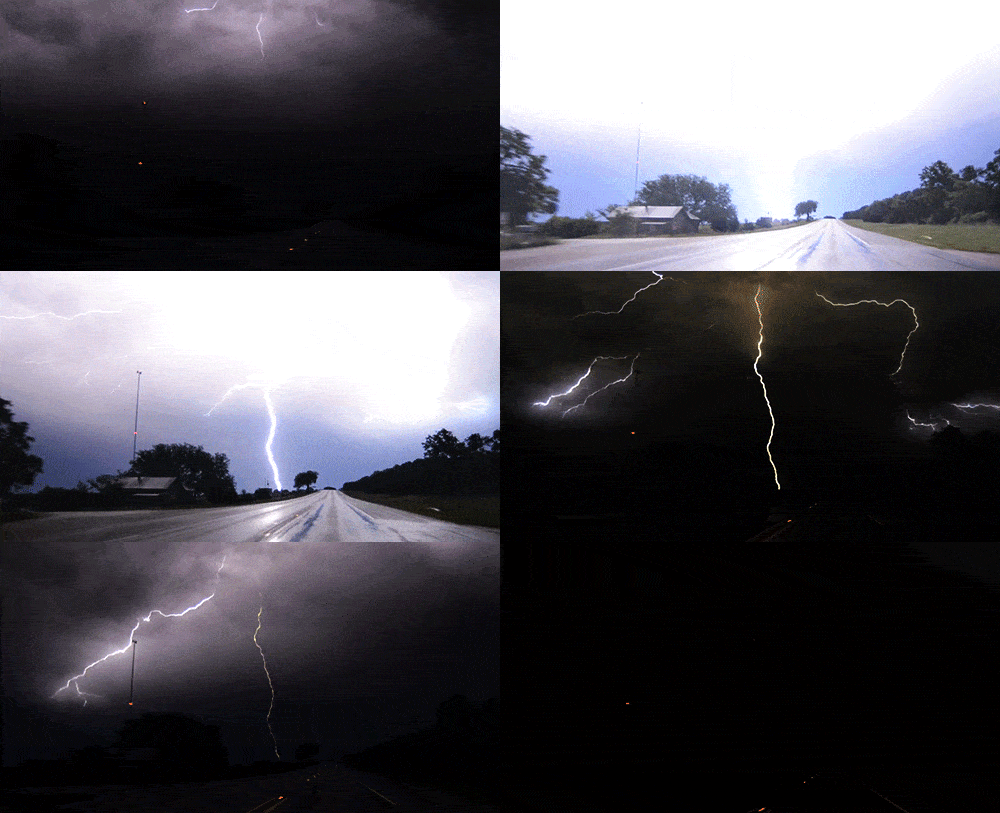
Lightning occurs because ___.
the negative charges at the bottom of clouds are attracted to the positive charges on the ground.
the positive charges at the bottom of clouds are attracted to the negative charges on the ground.
the positive and negative charges inside clouds are attracted to each other
All of these reasons are correct.
Like charges repel
A positively charged object has lost electrons


Do these magnets attract or repel?
Attract
Repel

This is the term that describes when a mechanical waves passes through matter.
Transmission
Reflection
Absorption
Diffraction
Which of the following is NOT a cause of a wave changing direction?
Reflection
Transmission
Radiation
Absorption
Sound travels faster in ________________ than in liquids
solids
gas
water
air
Movie theaters use sound proofing to reduce echoes. Soundproofing materials are designed to ________________ the sound.
Absorb
Transmit
Diffract
Reflect
Which of the following is NOT a way that waves interact with matter?
Waves can be reflected by matter.
Waves are affected by gravity.
Waves can transfer energy to the medium through which it travels.
As waves pass through matter, some of the energy they carry can be transferred to matter.

Which type of interaction is this?
diffraction
absorption
transmission
reflection

Which type of interaction is this?
absorption
transmission
reflection
diffraction
Sound travels FASTEST through which of these materials?
Air
Empty space
Solid
Water
Sound does not travel in space because
Space is too far away.
There is no matter in space.
The energy is too weak
The sound from our surrounding id too loud


The image represents which of the following wave interations?
Reflection
Absorption
Transmission
Diffraction

Which of the following describes this wave?
Longitudinal
Transverse
Light
Scattered

#3 refers to the
wavelength
amplitude
crest
trough
#1 refers to the
wavelength
amplitude
crest
trough
Transverse waves have:
crests and troughs
troughs and rarefactions
compressions and contractions
rarefactions and crests
Longitudinal waves have:
crests and troughs
crests and compressions
compressions and rarefactions
troughs and rarefactions
A wave that needs a medium to travel is called a(n)
electromagnetic wave
mechanical wave
light wave
any wave can do this
Which are properties of a mechanical wave?
can be longitudinal or transverse
can move through space
must have matter to move
carries energy

What kind of wave is this?
electromagnetic
longitudinal
transverse
The lowest point on a transverse wave is the
compression
crest
rest position
trough
The highest point on a transverse wave is the
compression
crest
rest position
trough
What is light?
a kind of heat
a kind of color
a kind of energy
a kind of reflection
Which of these describes how light travels through empty space?
it scatters widely in all directions
it travels straight but changes direction to go around objects
it travels in a straight line without stopping
it changes direction often even if there are no objects
What three things are needed to produce a shadow?
the sun, a mirror, and a surface
a light, some shade, and a dark object
a light source, a mirror, and an object
a light source, an object, and a surface

Which type of light has the largest/longest wavelength of this group?
X-rays
Microwave
Infrared
Ultraviolet

Increasing energy in an electromagnetic wave increases the ___________________ of the wave.
Amplitude
Frequency
Wavelength
Volume
The energy carried by an electromagnetic wave is called
A soundwave
Magnetic energy
Radiant energy
Radio Energy
The lowest frequency in visible light is______.
violet
red
blue
yellow
Increasing energy in a mechanical wave increases the ___________________ of the wave.
Amplitude
Frequency
Wavelength
Volume
Increasing brightness of visible light increases the ___________________ of the wave.
Amplitude
Frequency
Wavelength
Volume
Which type of wave travels at a faster speed?
A mechanical wave through air
A mechanical wave in a vacuum
An electromagnetic wave through air
An electromagnetic wave in a vacuum
In a vacuum/empty space, the speed of light...
can vary
is always 300,000 km/s
is slower than the speed of light through a medium
is slow
Material that allows light to pass through allowing you to see "clearly" to the other side.
opaque
translucent
transparent
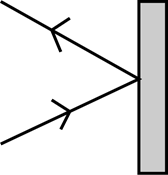
The light ray is-

Caleb is sitting near the window on a sunny day. When he closes the curtain, the room becomes darker. What property of the curtain allows it to make the room darker?
The curtain absorbs light.
The curtain is brightly colored.
The curtain folds easily.
The curtain is rectangular shape.
Which of the following is the best example of an object absorbing light?
A black sweater in the sun.
A clean window in the sun.
A curved mirror in the sun.
A long shadow in the sun.

Why does a banana look yellow?
it reflects yellow wavelengths of light and absorbs most other wavelengths
it absorbs yellow wavelengths of light and reflects most other wavelengths
Why does an apple look red?
because it absorbs red light and reflects white light
because it absorbs red light waves and reflects the others
because it absorbs all colors of light
because it reflects red light waves and absorbs the others
White light is made up of all of the colors of the rainbow
True
False
The color with the longest wavelength is...
Blue
Red
Green
Yellow
If you see a green leaf on a tree, that means...
Green is the color being reflected off the leaf.
Green is the color being absorbed by the leaf.
All the colors are being reflected off the leaf.
All the colors are being absorbed by the leaf.
The sky is blue because...
blue is the color most scattered or reflected by our atmosphere.
red is the color most scattered or reflected by our atmosphere.
blue is the color most absorbed by our atmosphere.
blue is complimentary to orange.


The model shows Earth in several positions relative to the sun.
In which position is it winter in North America?
Position 1, because North America receives the most direct sun
Position 2, because North America is tilted toward the sun
Position 3, because North America is parallel to the sun
Position 4, because North America is tilted away from the sun

In the summer many people enjoy going to the beach. The photograph shows a beach in Argentina, which is located in the Southern Hemisphere.
Which diagram shows the position of Earth when it is summer in Argentina?


The Seasons on earth are caused by:
The tilt of Earth's axis
The Earth getting closer and farther from the sun
The rotation of the earth
The moon

Which of the following best describes equinoxes?
The earth is tilted neither toward or away from the sun
The norther hemisphere is tilted toward the sun
The northern hemisphere is tilted away from the sun
The southern hemisphere is tilted toward the sun
Period of 24 hours, or the time it takes Earth to make one complete spin on its axis
Rotation
One Year
Revolution
A Season

What is the line running down the center of Earth called?
Equator
Axis
North Pole
South Pole
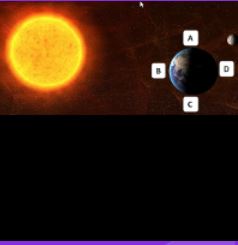

In this image, what season is it in the northern hemisphere?
Spring
Summer
Fall
Winter
When the Northern Hemisphere is tilting toward the sun, what is happening in the Southern Hemisphere?
It is summer in the Southern Hemisphere
The Southern Hemisphere is tilting toward the sun
The Southern Hemisphere is tilting away from the sun
They are both tilting the same direction

In the Southern Hemisphere, the summer solstice is in
March
June
September
December
When the Earth is between the Moon and the Sun, we will most likely see a:
Full Moon
Half Moon
3rd Quarter Moon
Crescent Moon

What phase of the moon is shown?
waning gibbous
1st quarter
waxing crescent
Waxing gibbous
How much of the Moon is always reflecting light from the Sun?
The entire moon is always illuminated
Half of the Moon is always illuminated; it's just not always facing Earth
Half of the Moon is illuminated only during the new moon
Half of the Moon is illuminated only during the full moon
How much of the Moon is always reflecting light from the Sun?
The entire moon is always illuminated
Half of the Moon is always illuminated; it's just not always facing Earth
Half of the Moon is illuminated only during the new moon
Half of the Moon is illuminated only during the full moon

What is the phase of the Moon at position #5?
New Moon
Third Quarter Moon
First Quarter Moon
Full Moon
What is the correct phases of the Moon at position 3?
Waning Crescent
First Quarter (or Waxing Half)
Third Quarter (or Waning Half)
Waxing Gibbous
The Moon gets its light from the
It reflects the Earth's light
It reflects the other stars' light
It reflects the Sun's light
It makes its own light


How long does it take the moon to make one complete rotation on its axis?
365.25 days
24 hours
27.3 days
90 days
How long does it take the moon to make one complete revolution around the earth?
365 days
24 hours
27.3 days
no one has ever measured it.

