Wayground logo

Free Printable Worksheets

Font size

S
M
L
XL
Worksheets

Disease Practice Test

Total questions: 65

Worksheet time: 1hrs 6mins

Name
Class
Date
1.
What sort of pathogen causes influenza (flu)?
a)
A bacterium
b)
A virus
c)
A fungus
d)
A protist
2.
Athlete's foot is which type?
a)
Virus
b)
Bacteria
c)
Fungi
d)
Protist
3.
A tiny, non-living particle that invades and then multiplies inside a living cell is called
a)
bacteria
b)
a virus
c)
a fungi
d)
a protist
4.
Viruses...
a)
use a host to reproduce
b)
breath oxygen
c)
grow
d)
eat food
5.
Which can be treated with antibiotics?
a)
Virus
b)
Bacteria
c)
Mutagen
d)
Parasite
6.
20 people became sick with the flu after a school dance. What is the best explanation for how they got sick?
a)
Contact with environmental source
b)
Contact with an infected animal
c)
contact with a contaminated object
d)
contact with an infected person
7.
Which of the following is a noninfectious disease that affects the respiratory system?
a)
Influenza
b)
Parkinson's disease
c)
Cold
d)
Asthma
8.
What is ring worm?
a)
Virus
b)
Bacteria
c)
Fungi
d)
Parasite
9.
Are viruses living?
a)
Yes
b)
No
10.
What is the cause of an infectious disease?
a)
inherited
b)
environmental factors
c)
pathogens
d)
lifestyle
11.
a single-celled organism that lacks a nucleus is called
a)
a bacteriophage
b)
a virus
c)
a protist
d)
bacteria
12.
A protein made by white blood cells to fight a specific pathogen.
a)
Antibody
b)
Antivirus
c)
Allegra
d)
Allotment
13.

the body's response to an infection by showing redness, swelling, & pain

a)

immunization

b)

mobilization (stage of infection)

c)

inflammation

14.

Antibodies are only effective against a specific pathogen because:

a)

The shape of the antibody is the same as the shape of the antigen on the pathogen

b)

The shape of the antibody is complementary to the shape of the antigen on the pathogen

c)

Antibodies cause a primary immune response

d)

Antibodies cause a secondary immune response

15.

Bacteria can come in a variety of shapes. Which of the following is NOT a shape of bacteria?

a)

Cocci

b)

Fusilli

c)

Spirilla

d)

Bacillus

16.
What body system protects animals against invaders such as bacteria and viruses?
a)
Immune System
b)
Integumentary System
c)
Mammary System
d)
Respiratory System
17.
Proteins produced by B cells and designed to mark antigens to be destroyed, specific to the antigen.
a)
Antigens
b)
Active Immunity
c)
Antibodies
d)
Antibiotics
18.
Proteins produced by B cells and designed to mark antigens to be destroyed, specific to the antigen.
a)
Antigens
b)
Active Immunity
c)
Antibodies
d)
Antibiotics
19.
First recognizes foreign body and eats it and displays it to the other cells
a)
Macrophage
b)
T Cells
c)
B Cells
20.
Which is an example of passive immunity?
a)
You have been infected
b)
You have been vaccinated
c)
You made antibodies
d)
You got your mother's antibodies
21.
What is the first barrier against disease?
a)
White blood cells
b)
Red blood cells
c)
the skin
d)
leucocytes 
22.
If you are feeling ill and the doctor prescribes you some antibiotics to help you feel better, you are infected with a _______
a)
Virus
b)
Bacteria
23.
The common cold can be spread many different ways. One such way is through coughing and sneezing. Is the common cold caused by bacteria or by viruses?
a)
Bacteria
b)
Virus
24.
How do human diseases caused by bacteria and diseases caused by viruses react to antibiotics? 
a)
Neither responds to antibiotics.
b)
Both respond to antibiotics.
c)
 Viral diseases respond to antibiotics; bacterial diseases do not.
d)
Bacterial diseases respond to antibiotics; viral diseases do not.
25.

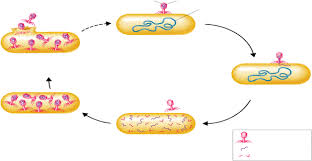
What is shown in this diagram?

a)

Lytic cycle

b)

binary fission

c)

lysogenic cycle

d)

mitosis

e)

meiosis

26.
A(n) _____ is a virus that enters a bacterial cell.
a)
endospore
b)
decomposer
c)
plasmid
d)
bacteriophage
27.

A virus may have DNA or RNA as its genetic material.

a)

True

b)

False

28.

What part of the phage is the nucleic acid (DNA or RNA)?

a)

A

b)

B

c)

C

d)

D

29.

The protein coat of a virus is known as the __________.

a)

capsid

b)

genome

c)

cell membrane

d)

envelope

30.

Which viral life cycle kills its host cell by breaking it open?

a)

lytic

b)

lysogenic

31.
What process is this?
a)
phagocytosis
b)
lytic cycle
c)
lysogenic cycle
d)
formation of antibodies
32.
Certain viruses only infect certain cells.
a)
true
b)
false
c)
depends upon the DNA in the virus
d)
depends upon the bacteriophage
33.
Immunity is
a)
an organism's ability to go through gene therapy
b)
the process of getting a vaccine
c)
the use of antibiotics to resist infection
d)
an organism's ability to resist infection using antibodies
34.
Chicken pox, SARS, Ebola, and AIDS are all types of 
a)
fungal diseases
b)
plant diseases
c)
bacterial diseases
d)
viral diseases
35.

Which viral life cycle kills its host cell by lysing (bursting)?

a)

Lysogenic Cycle

b)

Lytic Cycle

c)

Binary Fission

d)

Conjugation

36.

Viruses in the lysogenic cycle can be DORMANT. This means they....

a)

are resting and waiting to attack

b)

speed up reactions

c)

are infecting quickly

d)

catalyzing proteins

37.
What helps prevent viral diseases?
a)
Vaccines
b)
Antibiotics
c)
Herbal tea
d)
Gene Therapy
38.

What is the function of the flagellum?

a)

to sense surroundings

b)

movement; locomotion

c)

reproduction

39.

How are prokaryotes and eukaryotes different?

a)

Prokaryotes do not have a nucleus, but Eukaryotes do

b)

Prokaryotes are larger than Eukaryotes

c)

Prokaryotes are multicellular, and Eukaryotes are not

40.

Which cycle is represented by the image?

a)

Lytic

b)

Lysogenic

41.

Which cycle is the virus in?

a)

Lysogenic

b)

Lytic

42.

Which cycle is showing cell division in the image?

a)

Lytic

b)

Lysogenic

43.

Which of the following states describes how a virus and eukaryote reproduce?

a)

Viruses reproduce on their own, eukaryotes cannot

b)

Viruses use the host cells machinery, eukaryotes reproduce on their own.

c)

Viruses use spores, eukaryotes will bud

d)

Viruses reproduce asexually, eukaryotes do not

44.

Which of the following is the largest?

a)

Virus

b)

Eukaryotes

c)

Prokaryotes

45.

How do bacteria reproduce?

a)

Sexual Reproduction

b)

Division

c)

Binary Fission

d)

Pollination

46.
Are bacteria are good or bad?
a)
Good
b)
Bad
c)
Both
47.

What type of bacteria is pictured?

a)

coccus

b)

spirilium

c)

bacillus

48.
Another way in which bacteria are beneficial:
a)
they are decomposers
b)
they are the powerhouse of cells
c)
they contain special DNA
d)
they are used to make Diet Coke
49.
One way in which bacteria are beneficial:
a)
they make food
b)
they cause disease
c)
they cause food poisoning
d)
they create sugar
50.

Beneficial or Harmful?

bacteria absorbs nutrients from food for our digestion

a)

beneficial

b)

harmful

51.

Beneficial or Harmful?


bacteria used to make cheese and yogurt

a)

beneficial

b)

harmful

52.

Beneficial or Harmful?


fungus causes ringworm or athlete's foot on the skin

a)

beneficial

b)

harmful

53.

Beneficial or Harmful?


mold used to create the medicine Penicillin (antibiotic)

a)

beneficial

b)

harmful

54.
The bacteria seen in the picture is
a)
bacillus
b)
coccus
c)
spirilla
55.
Why are superbugs difficult to control?
a)
They are difficult to transmit from one person to another
b)
They have mild symptoms that often go unreported
c)
They occur in remote regions of the world
d)
They are resistant to antibiotics.
56.
The bacteria seen in the picture is
a)
cocci
b)
bacillus
c)
spirilla
57.

Binary fission results in

a)

2 genetically different cells

b)

4 genetically identical cells

c)

2 genetically identical cells

d)

4 genetically different cells

58.

Bacteria that can help clean up the environment are used for:

a)

bioremediation

b)

nitrogen fixation

c)

probiotics

d)

bioluminescence

59.

Bacteria that can make light are known as having this property:

a)

bioremediation

b)

nitrogen fixation

c)

probiotics

d)

bioluminescence

60.

Why was David Vetter in a bubble for so long? Why couldn't the doctors take him out?


What did David eventually die of?


Do you think what happened to David was ethical (right or fair)? Should the doctors have promised the family that they could treat him? What do you think the doctors should have done?


(5 minutes for this practice test)

4 lines
61.

First line defenses include

a)

skin

b)

hair

c)

mucus

d)

all of the above

62.

Select 3 ways that your digestive system works to protect you form pathogens that have entered your body on food?

a)

by using stomach acids to neutralize the pathogen

b)

causing you to vomit

c)

causing you to have diarrhea

d)

causing you to burp

63.

What is the best definition of antibodies?

a)

antibiotics that help you when you are sick

b)

organs that create pathogens

c)

pathogens that enter the bloodstream

d)

proteins that attach to antigens and make them useless

64.

Viruses include... (select all that apply)

a)

flu

b)

common cold

c)

measles

d)

chicken pox

e)

food poisoning

65.

A condition in which a person's immune system is overly sensitive to environmental substances that are normally harmless.

a)

Allergy

b)

Antigen

c)

Bacteria

d)

Virus