wayground logo

Free Printable Worksheets

NEW

Font size

S
M
L
XL
Worksheets

Chemistry Review 2nd Semester

Total questions: 62

Worksheet time: 1hrs 2mins

Name
Class
Date
1.

What is the conjugate base of HF?

a)

HF

b)

F+

c)

H+

d)

F-

2.

Which choice below is the definition of a Bronsted-Lowry Base?

a)

Hydrogen ion producer

b)

Electron pair donor

c)

Hydrogen ion acceptor

d)

Hydroxide ion

3.

What is the H+ concentration of a solution with a pH of 4.0

a)

4 x 10⁴

b)

1 x 10⁻⁴

c)

1 x 10⁴

d)

1 x 10⁻⁷

4.

"Tastes sour" is a property of

a)

an acid.

b)

a base.

c)

both and acid and a base.

d)

neither an acid nor a bas.

5.

"Feels slippery" is a property of

a)

an acid.

b)

a base.

c)

both and acid and a base.

d)

neither an acid nor a bas.

6.

"Tastes sweet" is a property of

a)

an acid.

b)

a base.

c)

both and acid and a base.

d)

neither an acid nor a bas.

7.

Which of the following is/are and electrolyte?

a)

an acid.

b)

a base.

c)

both and acid and a base.

d)

neither an acid nor a bas.

8.

A solution where [H+] = 1 x 10-11 is

a)

acidic

b)

basic

c)

neutral

d)

pentastic

9.

What is the conjugate acid of NH3?

a)

NH3

b)

F-

c)

NH4+

d)

NH2-

10.

If the pOH of a solution is 4.5, the pH is

a)

4.5

b)

-4.5

c)

9.5

d)

-9.5

11.

What is the pH of a [H+] = 1 x 10-11 solution?

a)

1

b)

3

c)

7

d)

11

12.

A solution where [H+] = 1 x 10-11 is

a)

acidic

b)

basic

c)

neutral

d)

pretty neat.

13.

What is the [H+] of a neutral solution?

a)

1 x 10⁷

b)

1 x 10⁻⁷

c)

1 x 10-14

d)

1 x 10¹⁴

14.

A solution that has a pH of 5.0 is

a)

acidic

b)

basic

c)

neutral

d)

pentastic

15.

What is the [H+] concentration of a 0.10 M HCl solution?

a)

0.10 M

b)

0.050 M

c)

0.20 M

d)

7.0 M

16.

What is the pH of 0.10 M HCl?

a)

0

b)

1

c)

2

d)

10

17.

Which below is a product of any acid-base neutralization reaction?

a)

NaCl

b)

HCl

c)

carbon dioxide

d)

salt

18.

In the equation below, identify the acid

HSO3- + H2PO4- --> H3PO4 + SO32-

a)

HSO3-

b)

H2PO4-

c)

H3PO4

d)

SO32-

19.

In the equation below, identify the conjugate acid.

HSO3- + H2PO4- --> H3PO4 + SO32-

a)

HSO3-

b)

H2PO4-

c)

H3PO4

d)

SO32-

20.

In the equation below, identify the base.

HSO3- + H2PO4- --> H3PO4 + SO32-

a)

HSO3-

b)

H2PO4-

c)

H3PO4

d)

SO32-

21.

How many mL of 0.10 M NaOH are needed to neutralize 25 mL of 0.10 M HCl?

a)

5.0 mL

b)

10. mL

c)

20. mL

d)

25 mL

22.

How many mL of 0.50 M NaOH are required to neutralize 25 mL of 0.10 M HCl?

a)

25 mL

b)

125 mL

c)

5 mL

d)

15 mL

23.

A student found that it took 20.0 mL of 0.10 M NaOH to titrate (neutralize) 10.0 mL of HNO3. What is the concentration of the HNO3?

a)

0.050 M

b)

0.10 M

c)

0.20 M

d)

0.40 M

24.
At a constant pressure, the volume decreases.  What happens to the temperature?
a)
increases
b)
decreases
c)
stays the same
25.
At a constant volume, the pressure increases.  What happens to the temperature?
a)
increases
b)
decreases
c)
stays the same
26.
At a constant temperature, the volume decreases.  What happens to the pressure?
a)
increases
b)
decreases
c)
stays the same
27.
At STP (Standard Temperature and Pressure), a gas has a volume of
3.0 L. What is the new volume if the pressure increases to 303.9 kPa? 
a)
9.0 L
b)
1.0 L
c)
9.0 kPa
d)
1.0 kPa
28.
Under which of the following conditions do REAL gases behave most like IDEAL gases?
a)
High pressure and high temperature
b)
High pressure and low temperature
c)
Low pressure and low temperature
d)
Low pressure and high temperature
29.
Which of the following is NOT a part of Kinetic Molecular Theory?
a)
Gas particles have mass and occupy space (the individual particles have volume)
b)
Gas particles do not have mass and occupy space (the individual particles have volume
c)
Gas particles move in straight lines
d)
The more heat energy the gas particles have, the faster they move
30.
At a constant temperature, pressure increases.  What happens to the volume?
a)
increases
b)
decreases
c)
stays the same
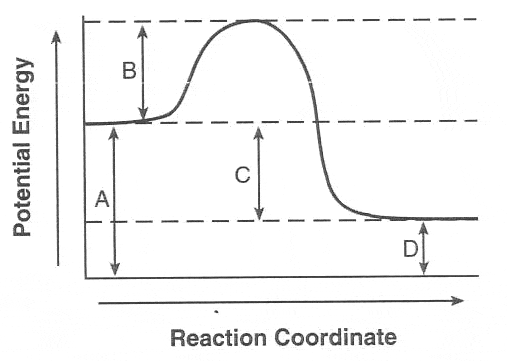
31.
What type of reaction is this?
a)
Endothermic
b)
Exothermic
32.
Grinding a seltzer tablet into powder increases the rate of reaction due to increased
a)
concentration
b)
surface area
c)
temperature
d)
reactants
33.
Which factors increase the rate of a reaction.
a)
increasing temperature
b)
increasing concentration
c)
increasing surface area
d)
all of these
34.
Why does a higher temperature increase the rate of a reaction?
a)
it increases both the frequency and energy of particle collisions
b)
it only increases the frequency of particle collisions
c)
it only increases the energy of particle collisions
d)
it reduces the activation energy of the reaction
35.
Why does a higher concentration increase the rate of reaction?
a)
it increases the amount of reactants
b)
it lowers the activation energy
c)
it increases the energy of particle collisions
d)
it increases the frequency of particle collisions because there are more collision sites
36.
A ______________ is a substance that increases the rate of a reaction without being used up during the reaction. 
a)
catalyst
b)
product
c)
reactant
d)
solute
37.
When the system X + 2 Y <=> Z has reached equilibrium, which of the following is TRUE?
a)
Forward reaction and Backward reaction stop.
b)
Forward reaction has sped up and backward reaction has slowed down.
c)
Forward and backward reactions occur at the same rate.
d)
Forward reaction has slowed down and backward reaction has sped up.
38.

Identify the incorrect statement about achieving equilibrium.

a)

achieved when product and reactant concentrations are equal

b)

achieved when forward and reverse reaction rates are same

c)

achieved when concentration of reactants is stable/constant

d)

achieved when concentration ratio of reactants to products becomes stable, thus fixing the equilibrium constant (equilibrium position)

39.
Which of the two graphs reaches equilibrium?
a)
The left one.
b)
The right one.
c)
Both of them.
d)
Neither.
40.
What is the activation energy?
a)
the quantity of heat absorbed in a reaction
b)
the minimum energy needed to begin a reaction
c)
the energy given off after reactants collide.
d)
both the energy and frequeny of collisions in increased
the energy difference between reactants and products
41.
2SO2(g)+O2(g)⇌2SO3(g)
Removing O2(g) will
a)
shift equilibrium right
b)
shift equilibrium left
c)
decrease temperature
d)
have no change
42.
2SO2(g)+O2(g)⇌2SO3(g)
Adding SO2(g) will
a)
shift equilibrium right
b)
shift equilibrium left
c)
increase rate of reaction
d)
have no change
43.

At elevated temperatures ammonium carbonate, NH2COONH4, is in equilibrium with NH3 and CO2 according to the equation;

NH2COONH4(s) ↔ 2 NH3(g) + CO2(g)

What is the equilibrium expression for this reaction?

a)

K = 2 [NH3][CO2]

[NH2COONH4]

b)

K = [NH3]2[CO2]

[NH2COONH4]

c)

K = 2 [NH3][CO2]

d)

K = [NH3]2[CO2]

44.
What is the equilibrium-constant expression for 
CO2(g) + H2(g) ↔ CO(g) + H2O(l)
a)
Kc= [CO][H2O] / [CO2][H2]  
b)
Kc= [CO2][H2] / [CO]
c)
Kc= [CO2][H2] / [CO][H2O]
d)
Kc= [CO] / [CO2][H2]  
45.
For the reaction...
heat  +  N2  +  O2  ↔  2NO
If the heat is added to the chemical system, the equilibrium will shift _______.
a)
left
b)
right
c)
left and right
d)
neither left nor right
46.
According to the Law of Conservation of Energy, the energy in the universe is 
a)
ever changing
b)
constant
c)
flowing
d)
decreasing
47.
Heat always flows from _____ to ________
a)
cold to hot
b)
hot to cold
c)
top to bottom
d)
bottom to top
48.
A metal cylinder at 95.6⁰C was placed in a cup of water at 22.0⁰C. After 3 minutes the final temperature was 26.8⁰C. How did heat energy flow?
a)
from the metal to the cup
b)
from the water to the metal
c)
from the metal to the water
d)
heat did not flow
49.
If a 40.0 g sample of metal cools from  80.0°C to 20.0°C and loses 1060 J of energy, what is the specific heat of the metal?   
C=q/mΔT
a)
-0.442 J/g°C
b)
 0.442 J/g°C
c)
0.00142 J/g°C
d)
0.000629 J/g°C 
50.
The specific heat of silver is 0.24 J/g·°C. How many joules of heat must be added to an  83.6 g silver block to raise its temperature by 9.0°C?
q=mCΔT
a)
0.00032 J
b)
0.45 J
c)
180 J
d)
39 J
51.
The phase change from water vapor to liquid water is known as...
a)
evaporation
b)
precipitation
c)
condensation
d)
sublimation
52.
2. A change of state from a liquid to a solid is called....
a)
Melting
b)
Freezing
c)
Evaporation
53.
4. What type of state of matter is a gas that has electrons flowing through it?
a)
Gas
b)
Liquid
c)
Plasma
d)
Solid
54.
5. What is it called when a solid turns directly into a gas?
a)
Sublimation
b)
Condensation
c)
Liquid
55.
Change from Liquid to Solid is call......
a)
fusion
b)
Freezing
c)
sublimation
d)
evaporation
56.
What is sublimation?
a)
phase change between solid and liquid
b)
pahse change from gas to solid
c)
phase change from solid to gas
d)
phase change from solid to solid
57.

When you make a dilution, which of these values remains constant?

a)

The molarity (M)

b)

The total moles of solute

c)

The volume (V)

d)

The concentration

58.

Molarity is ...

a)

grams of solute/deciliters of solvent.

b)

grams of solute/liters of solution.

c)

moles of solute/liters of solution.

d)

moles of solute/milliliters of solvent.

59.
What is the molarity of 1 mole of Ba+ in 2 L of water
a)
1 M
b)
2 M
c)
.5 M
d)
.25 M
60.
What is the molarity of 3 mole of hydrochloric acid in 3 L of water. 
a)
3
b)
1
c)
6
d)
9
61.
True or False? The higher the concentration of a solution the less solutes it has in it.
a)
True
b)
False
62.

What is the concentration of a solution prepared by dissolving 20.0 g of NaOH with water to a total volume of 100.0 mL? (molar mass of NaOH = 40.0 g/mol)

a)

1.00 M

b)

0.500 M

c)

0.250 M

d)

5.00 M