
 Worksheets
Gas Law Test!
Total questions: 46
Worksheet time: 1hrs 8mins
Which of the following do the units need to be converted to be used in all gas law equations?
Temperature (Celsius to Kelvin)
Volume (Liters to Kiloliters)
Pressure (atm to psi)
moles (grams to moles)
Which of the following would increase the (gas) pressure of a system?
Decreasing the kinetic energy
Increasing the Volume
Increasing the energy of the particles
Removing gas particles
TRUE or FALSE the properties of Gases (pressure, volume, temperature) are all directly proportional to each other?
TRUE
FALSE
The gas constant (R) value in the ideal gas law is dependent on the units of....
Temperature
Volume
Pressure
Moles
Boyle showed that Pressure and Volume have an inverse relationship. This means that as the pressure of a gas goes up...
the volume goes up as well
the volume goes down
the volume remains the same
the volume changes by 1/V
If you increase the pressure of a gas in a closed container the temperature will...
Not be affected
Increase
Decrease
You can't change the pressure

The image shows a relationship that is
directly proportional
inversely proportional
exponentialy proportional
explicitly descriptive

The image shows a relationship that is
directly proportional
inversely proportional
exponentially proportional
explicitly exquisite
According to the Kinetic Molecular Theory, the temperature of a gas relates to the...
size of the space the gas occupies
speed of the molecules as they move in a container
molecule type
partial pressure
What kind of relationship exists between volume and temperature for an ideal gas? (Charles' Law)
a directly proportional relationship
an inversely proportional relationship
an exponential relationship
an inverse exponential relationship
When the temperature of gas in a soda can becomes lower, the volume the gas occupies within that can...
becomes lower
becomes higher
stays the same
cannot be predicted
Which reasoning best explains why pressure increases if temperature increases?
As the number of molecules increase, the number of collisions increase
As the speed of the molecules increase, the force and frequency of their collisions increase
As the size of the molecules increase, the force of their collisions increase
As the type of the molecule changes, the types of collisions change
Pressure is
defined as the mass that an object exerts when at rest.
not a measurable in gases.
defined as the number of moles of substance divided by the mass of the substance.
created by the force of the gas particles impacting the walls of the container.
What describes the motion of a Gas Molecule?
Molecules are far apart
Move in constant, random motion
It will travel in a straight path
All of the above
If pressure goes down in a container, what happens to volume when the temperature is held constant.
Increase
Decrease
How would you convert 34oC to Kelvin?
K = oC + 273
oC = K + 273
K = oC - 273
oC = K + 273
What about gases can be measured?
Pressure and Volume
Temperature, Volume, and Pressure
Volume and Temperature
Pressure, Temperature, Volume, and amount in moles or grams
Which one of these is NOT an Ideal Gas Assumption?
Gas particles are hard, round spheres.
Gas particles are strongly attracted to one another.
Gas particles do not take up space.
Gas particles collide perfectly elastically.
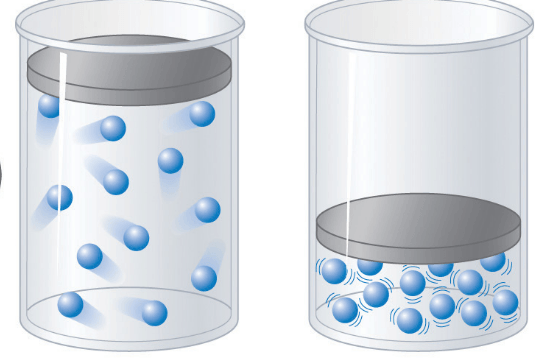
The energy of movement is ___.
potential energy
kinetic energy
mechanical energy
The more energy that particles have, the ___ they move.
slower
faster
What formula would you use to solve the following: A 0.562 L container of Helium has a pressure of 9.5 atm. What volume would be necessary to decrease the pressure to 2.4 atm?


What formula would you use to solve the following: A sample of nitrogen gas was collected over water at a temperature of 23.0°C. What is the partial pressure of nitrogen if the atmospheric pressure (total) was 785 mmHg and the vapor pressure of water was 21.1 mmHg?


What formula would you use to solve the following: A container of carbon monoxide gas is at a temperature of 65.0 °C and occupies a volume of 6.5L. At what temperature would it occupy a volume of 10.2L?


What formula would you use to solve the following: At high altitudes, pilots have to supplement their supply of oxygen. In this mixture, there are oxygen and nitrogen gases. If nitrogen’s partial pressure is 250mmHg, calculate the partial pressure of oxygen if the total pressure is 710mmHg.


What formula would you use to solve the following: 6.25L of nitrogen gas is known to contain 5.21 moles. If the amount of nitrogen is increased to 12.64 moles, what new volume will result (at unchanged temperature and pressure)?


What formula would you use to solve the following problem: 76 L of compressed oxygen is at a temperature of 330 K. If there are 7.3 moles of oxygen in the container, calculate the pressure (in atm) inside the container.


In the Question: A cylinder has a volume of 5.4 L of air at a pressure of 140 atm. If the volume is increased to 12.4L, what would the new pressure be? Which answer choice has the data correctly labeled?
P1=5.4L, V1=140atm; P2= 12.4L, V2= ?
P1=140atm, V1=5.4L ; P2= ?, V2=12.4L
T1=140atm, V1=5.4L ; T2= ?, V2=12.4L
There was no important data to label
A gas has a volume of 4 liters at 500K. What will its volume be (in liters) at 300K? (V1/T1 = V2/T2)
1.4L
1.8L
2.0L
2.4L
If I have 2.00 moles of a gas at a temperature of 250.K and a volume of 8.50 liters, what is the pressure? (PV = nRT where R = 0.0821)
0.673atm
1.41atm
2.91atm
4.83atm
If I have 1.00 moles of a gas at a pressure of 1.20 atm and a volume of 16.0 liters, what is the temperature? (PV = nRT where R = 0.0821)
128K
234K
341K
426K
A gas has a volume of 5 liters at 3 atm. To expand the volume to 6L, what the new pressure? (V1P1 = V2P2)
0.5atm
1.5atm
2.5atm
3.0atm
A sample of gas has a pressure of 2.5 atm. When its volume is changed to 10.0 L, the pressure becomes 1.0 atm. What was the original volume of gas? (V1P1 = V2P2)
25 L
0.25 L
0.4 L
4.0 L

Calculate the volume that a 0.323-mol sample of a gas will occupy at 265 K and a pressure of 0.900 atm (PV = nRT where R = 0.0821)
7.18 L
7.81 L
4.63 L
4.36 L
A student inflates a balloon with helium then places it in the freezer. The student should expect
the balloon's volume to increase
the balloon's volume to decrease
the balloon's moles to increase
the balloon's moles to decrease
A sample of a gas has a volume of 852 mL at 298 K. What temperature is necessary for the gas to have a volume of 945 mL? Which equation would you use?
Pt = P1 + P2 + P3 + ...
P1V1 = P2V2
V1/T1 = V2/T2
P1V1/T1 = P2V2/T2
A gas has a pressure of 1.50 atm at a temperature of 273 K. What will be the pressure at 410 K? (V1/T1 = V2/T2)
.99 atm
2.25 atm
.75 atm
2.5 atm
Dalton's law equation is used to find what?
the density of a pure gas
the total pressure of a pure gas
the total pressure of a gas mixture
the volume of a gas mixture

What is the total pressure of the heliox gas in the diagram?
300 kPa
100 kPa
400 kPa
500 kPa
In a mixture of gases, each gas contributes to the total pressure. The individual contribution of each gas is known as the _________________.
partial volume
partial pressure
molar mass
mole ratio


