
 Worksheets
Spring Final Exam Review
Total questions: 172
Worksheet time: 5hrs 34mins
How many moles of hydrogen are needed to react with 2 moles of nitrogen?
How many moles of water can be produced if 8 moles H2 are used?
12.00 moles of NaClO3 will produce how many grams of O2?
How many moles of oxygen are consumed if 8 moles H2 are used?
What coefficient would go in front of the O2?
How many grams are in 7.8 moles of NaCl?
476grams
460 grams
452 grams
462 grams

For the reaction 3Fe + 4H2O --> Fe3O4 + 4H2, how many moles of iron oxide are produced from 500 g of iron?
1
3
9
12
For the reaction 2Na + 2H2O --> 2NaOH + H2, how many grams of hydrogen gas are produced if 120. g of sodium and 80. g of water react?
4.5 g
44 g
80. g
200. g
A student measures the pressure and volume of an empty water bottle to be 1.4 atm and 2.3 L. She then decreases the pressure to 0.65 atm. What is the new volume?
2.1 L
5.0 L
8.2 L
3.9 L
A scientist needs to store 28.0 moles of xenon gas at STP in the lab. What size gas tank will he need?
628 L
473 L
219 L
376 L
A sample of gas containing 8.1 moles at STP would fill a container of what volume?
342 L
703 L
475 L
182 L
A water bottle at STP is cooled to -155°C. What is the new pressure?
3.2 atm
0.43 atm
1.8 atm
0.27 atm
A student inflates a balloon with helium then places it in the freezer. The student should expect
the balloon's volume to increase
the balloon's volume to decrease
the balloon's moles to increase
the balloon's moles to decrease
The pressure of a 6.5 L sample of oxygen gas is measured to be 3.8 atm. If the gas is transferred into a 12 L tank, what is the new pressure?
6.6 atm
3.9 atm
4.5 atm
2.1 atm
A student transfers a gas at STP from a 11.0 L tank to a 25.0 L tank. If the pressure remains constant, what is the new temperature?
620 K
393 K
254 K
530 K
What is the pressure of a car tire that had an initial pressure of 1.8 atm but was heated from 38°C to 123°C?
0.9 atm
2.1 atm
1.6 atm
3.4 atm
A sample of gas containing 9.2 moles is transferred from an 13 L tank to a 23 L tank. What is the new number of moles that can be stored in the tank?
10.2 mol
13.7 mol
19.1 mol
16.3 mol
Three gases are mixed together in a container with a total pressure of 4.8 atm. If two of the gases have pressures of 1.2 atm and 1.5 atm, what is the pressure of the third gas?
2.5 atm
1.8 atm
2.1 atm
1.3 atm
When a piston compresses in a chamber the volume of the gas inside decreases. What happens to the pressure and which gas law is this representing?
The pressure decreases - Charles'
The pressure increases - Charles'
The pressure decreases - Boyle's
The pressure increases - Boyle's
What is the volume of a balloon that contains 3.7 moles of helium at 75°C and 5.1 atm?
37 L
13 L
45 L
21 L
Avogadro's Law explains the relationship between
Pressure and Volume
Pressure and Temperature
Volume and Temperature
Volume and Moles
A student places four gases into a container. The pressures of the gases are: N2=2.1 atm, H2=1.3 atm, He=1.9 atm & Ar=3.4 atm. What is the total pressure?
5.1 atm
8.7 atm
7.4 atm
6.9 atm
If a hairspray can is heated, what can be expected of the pressure of the gas inside the can?
The pressure will increase
The pressure will decrease
The pressure will remain constant
The pressure will equalize
A mole of potassium chloride, an ionic compound, contains 6.02 x 10²³ _____.
atoms
formula units
ions
molecules
How many molecules are in 2.00 moles of H2O?
124x1024 molecules of H2O
1.20x10²³ molecules of H2O
12.04 x10²³ molecules H2O
124
Which one has the most molecules or formula units?
1 mole H2O
1 mole Al(OH)3
1 mole NaCl
They are all the same
The sum of the percent by mass of each element in a compound must equal 100%.
True
False
Which of the following sets of empirical formula, molar mass, and molecular formula is correct?
CH, 78 g/mol, C13H13
CH4N, 90 g/mol, C3H12N3
CaO, 56 g/mol, Ca2O2
C3H8O, 120 g/mol, C3H8O2
The empirical formula for a compound is CH2O, and the molar mass is 180.2 g/mol. Which is the molecular formula for this compound?
C6H12O6
C7H16O5
C8H20O4
C3H6O3
How many formula units are in 3.6 grams of NaCl?
0.06
1.0x10²¹
1.3x1026
3.7x10²²

Which is the correct empirical formula for this substance?
CH4O
CHO
C3H12O3
C3H4O

Which substances have the same empirical formula?
Samples 1, 2, and 4
Samples 1 and 4
Samples 1 and 3
Samples 2 and 3
The molecular formula for a compound is the formula with the smallest whole-number mole ratio of the elements.
True
False
88.0 grams of CO2 is about _____________. [Select 2 answers.]
1 mole of CO2
2 moles of CO2
6.02 x 10²³ molecules of CO2
two times 6.02 x 1023 molecules of CO2
To find the percent by mass of a compound if you are given the formula, divide the molar mass of that element in one mole of the compound by the total molar mass of the compound.
True
False
For the reaction 2Na + 2H2O --> 2NaOH + H2, how many grams of hydrogen gas are produced if 120. g of sodium and 80. g of water react?
4.5 g
44 g
80. g
200. g


A solid acid HX is mixed with water. Two possible solutions can be obtained. Which of the following is true?
In case I, HX is acting like a weak acid, and in case II, HX is acting like a strong acid.
In case I, HX is acting like a strong acid, and in case II, HX is acting like a weak acid.
In both cases, HX is acting like a strong acid.
In both cases, HX is acting like a weak acid.
Which of the following is NOT a strong base?
KOH
Ca(OH)2
LiOH
Al(OH)3
All of the following are weak acids except
HCNO
HBr
HF
HCN
Which of the following is a strong acid?
HF
KOH
HClO4
HClO
Aqueous solutions of sodium sulfide and copper(II) chloride are mixed together. Which statement is correct?
Both NaCl and CuS precipitate from solution
No reaction will occur
CuS will precipitate from solution.
NaCl will precipitate from solution.
Aqueous solutions of potassium sulfate and ammonium nitrate are mixed together. Which statement is correct?
Both KNO3 and (NH4)2SO4 precipitate from solution
A gas is released.
KNO3 will precipitate from solution
No reaction will occur
Which of the following salts is insoluble in water?
Na2S
K2CO3
Pb(NO3)2
All of these are soluble in water.
Which of the following ions is most likely to form an insoluble sulfate?
K1+
Li1+
S2-
Ca2+
Which pair of ions would not be expected to form a precipitate when dilute solutions of each are mixed?
Al3+, S2–
Pb2+, Cl–
Mg2+, SO42–
Ba2+, PO43–
Aqueous solutions of barium chloride and silver nitrate are mixed to form solid silver chloride and aqueous barium nitrate. The balanced molecular equation contains which one of the following terms?
AgCl (s)
2AgCl (s)
2Ba(NO3)2 (aq)
BaNO3 (aq)
Aqueous solutions of barium chloride and silver nitrate are mixed to form solid silver chloride and aqueous barium nitrate. The balanced complete ionic equation contains which of the following terms?
2Ba2+(aq)
Cl–(aq)
2Ag+(aq)
AgCl(aq)
When sodium chloride and lead(II) nitrate react in an aqueous solution, which of the following terms will be present in the balanced molecular equation?
PbCl(s)
Pb2Cl(s)
NaNO3(aq)
2NaNO3(aq)
N2 + O2 > N2O
What should be done to balance the following equation?
N2 + O2 > N2O
Put a 2 in front of O2 and a 2 in front of N2O
Put 3 in front of N2O
put a 2 in front of N2 and a 2 in front of N2O
put a 2 in front of N2
How many hydrogen atoms are on the product side of the following chemical equation?
N2 + 3H2 > 2 NH3
3
5
2
6
Na + I2 > NaI
When the equation Fe3O4 + Al --> Fe + Al2O3 is correctly balanced, what is the coefficient of Al?
3
4
6
8
Sb + O2 --> Sb4O6
Consider an aqueous solution of calcium nitrate added to an aqueous solution of sodium phosphate. What is the formula of the solid formed in the reaction?
Ca(PO4)2
CaPO4
Ca3(PO4)2
Ca3(PO3)2
Aqueous solutions of barium chloride and silver nitrate are mixed to form solid silver chloride and aqueous barium nitrate. The balanced complete ionic equation contains which of the following terms?
2Ba2+(aq)
Cl–(aq)
2Ag+(aq)
NO3– (aq)
The net ionic equation for the reaction of calcium bromide and sodium phosphate contains which of the following species?
2Br–(aq)
PO43–(aq)
2Ca3(PO4)2(s)
3Ca2+(aq)
The net ionic equation for the reaction of aluminum sulfate and sodium hydroxide contains which of the following species?
3Al3+(aq)
OH–(aq)
3OH–(aq)
2Al(OH)3(s)
A double-replacement reaction takes place when aqueous cobalt(III) chloride reacts with aqueous lithium hydroxide. One of the products of this reaction is
Co(OH)3.
Co(OH)2.
LiCo3.
LiCl3.
6.02 x 10²³ _____.
How many molecules are in 2.00 moles of H2O?
124x1024 molecules of H2O
1.20x10²³ molecules of H2O
12.04 x10²³ molecules H2O
124
88.0 grams of CO2 is about _____________. [Select 2 answers.]
1 mole of CO2
2 moles of CO2
6.02 x 10²³ molecules of CO2
two times 6.02 x 1023 molecules of CO2
What is the molar mass of NaCl?
58 g/mol
28 g/mol
12 g/mol
6.02 x 10²³
The sum of the percent by mass of each element in a compound must equal 100%.
True
False
To find the percent by mass of a compound if you are given the formula, divide the molar mass of that element in one mole of the compound by the total molar mass of the compound.
True
False
Which element has a molar mass of 30.974 g/mol?
potassium
phosphorus
gallium
palladium
Which is the correct molar mass for the compound FeSO4?
103.85 g/mol
151.85 g/mol
415.4 g/mol
247.85 g/mol
How many formula units are in 3.6 grams of NaCl?
0.06
1.0x10²¹
1.3x1026
3.7x10²²
The phase of matter in which the atoms are moving freely and are very far apart
solid
liquid
gas
Removing energy (cooling) causes the atoms to
spread apart
move closer together
get larger
get smaller
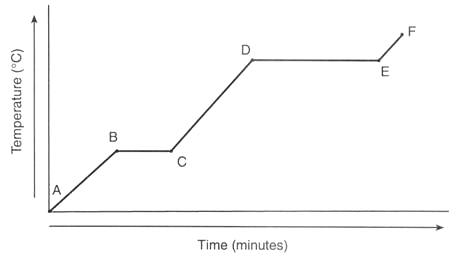
What state/phase is the object likely from points A to B?
Solid
Liquid
Gas
Plasma

Is the substance gaining or losing energy?
Gaining
Losing

Use the graph below to answer this question. What state of matter would the substance be at point F?
solid
liquid
gas

Are the particles moving faster or slower as time goes on?
Faster
Slower

On which parts of the graph does the temperature remain the same?
Between C and D
Between D and E
At C, D, or E
On both flat sections

What phase change is happening? (hint: solid to liquid)
freezing
condensation
melting
sublimation

What phase change happens when dew forms on leaves? (hint: gas to liquid)
freezing
melting
deposition
condensation

The phase change from liquid to gas is _________
Melting
Evaporation
Deposition
Condensation

Phase change from liquid to solid is ___________.
Freezing
Melting
Sublimation
Condensation
All phase changes need energy added or taken away.
True
False

At what point is the substance liquid?
B
A
C
D

Which point shows evaporation or condensation driving a phase change?
B
E
D
A
Sulfur has a melting point of 215 oC. This means that if Sulfur has a temperateure of 215 oC, what phase(s) of matter can it be in?
Sulfur has a melting point of 215 oC. This means that if Sulfur has a temperature of 220 oC, what phase(s) of matter can it be in?

What letter on the diagram represents the substance only in the gas phase?
A
B
C
D
What letter on the diagram represents a substance only in the liquid?
A
B
C
D
What letter on the diagram represents a substance only in the solid phase?
A
B
C
D
What letter on the diagram represents the triple point?
A
B
C
D
What is the melting point of this substance at 1 ATM of pressure?
40
60
100
110
What is the boiling point of this substance at 1 ATM of pressure?
40
60
100
110
What would the state of this substance be at 0.5 ATM of pressure at a 100 degrees Celsius?
Solid
Liquid
Gas
Michigan
What would the state of this substance be at 1 ATM of pressure at a 80 degrees Celsius?
Solid
Liquid
Gas
Michigan
Based on what you have learned... Is this substance likely water?
Yes
No

What happens along the AC line?
Melting/Freezing
Boiling/Condensing
Boiling/melting
freezing/condensing
What happens along the BC line?
Melting/Freezing
Boiling/Condensing
Boiling/melting
freezing/condensing

The critical point is found at point.....
A
B
C
D
What is being measured on the y axis?
Pressure
Temperature
Energy
Mass
What is being measured on the x axis?
Pressure
Temperature
Energy
Mass


What will occur when the substance changes from 1 atm to 30 at a constant temperature of -15oC? (Diagram A)
condensation
deposition
melting
sublimation
What will occur when the substance changes from 0o C to 100oC at a constant pressure of 30 atm? (Diagram A)
condensation
evaporation
melting
freezing

What is the normal boiling point of this substance? (Diagram C)
150 °C
100 °C
-50 °C
0 °C

What phase change occurs at letter E?
Freezing
Deposition
Condensation
Melting

What phases of water are present at a temperature of 0.01°C and 0.006 atm of pressure?
solid and liquid
solid and gas
solid, liquid, and gas

WHAT IS THE PHASE CHANGE FROM C TO B?
MELTING
FREEZING
VAPORIZATION
CONDENSATION


