
 Worksheets
Spring Final Review
Total questions: 75
Worksheet time: 3610secs
Sustainability is making sure that the planet and its resources can continue to provide life.
True
False
An accurate definition of Sustainability is
meeting population needs
meeting the needs of the present without compromising the ability of future generations to survive
meeting the needs of the future without worrying about todays
meeting the food needs of animals
TRUE or FALSE? Invasive species grow quickly due to the lack of predators. This leads to a decline or extinction of the native population.
True
False
A species that is not native to an area is called a ---
Native Species.
Natural Species.
Invasive Species.
Symbiotic Species.
Why do the populations of invasive species grow so quickly?
Invasive Species are native to an area.
Invasive species are prey to many animals.
Invasive species have no predators.
Invasive species keep the ecosystems in equilibrium.
The primary cause of the introduction of invasive species introduction is ---
too much food.
human action.
weather events.
asteroids.

Click on the map to help answer this question. What can we predict about the population of Feral Swine for the year 2016?
There will be less feral swine in 2016 than there were in 1982.
There will be more feral swine in 2016 than there were in 2010
There were fewer feral swine in 2004 than 1982.
There will be no change in feral swine population.
A native species is
a species that lives in the region where it evolved.
a species that came from ancient ecosystems
a species that can out produce other species
a species that was brought to a region by people
Who is at the most risk of going extinct?
large population
genetically diverse population
few harmful mutations
small population
A species form that supports an entire ecosystem.
Keystone Species
Herbivores
Umbrella Species
Predators
Why are bees considered a keystone species?
The honey they make supports the bear population
They pollinate flowers that produce fruit which supports the ecosystem
They sting when threatened
They live in hives
Species that are clearly critical to the functioning of an ecosystem are known as
biodiversity
keystone species
main species
native species
Succession that occurs in areas that previously didn't support life, such as on rocks or ice
tangential succession
primary succession
secondary succession
quaternary succession
A common type of succession that occurs where an event such as a forest fire has occurred, or a farmer's field has been abandoned is called
common succession
primary succession
secondary succession
Quaternary succession

Which of the following forms of biodiversity describes all of the different types of biotic factors in an ecosystem?
Species Diversity
Habitat Diversity
Genetic Diversity
None of the Above
Which of the following forms of biodiversity describes the differences between individuals within the same species?
Species Diversity
Habitat Diversity
Genetic Diversity
None of the Above

Why is biodiversity in an ecosystem so important?
Because it can help humans where to determine good places to develop farm land.
Because places that have a healthy biodiversity are unaffected by major disturbances.
Because having a high biodiversity allows ecosystems to withstand major changes.
Because having a high biodiversity allows for fewer opportunities of competition for similar resources.

The largest number of individuals that an environment can support long term is...
carrying capacity
emigration
immigration
population density

What happens if a population grows past its carrying capacity?
The population keeps growing
The population starts to die off
The entire species will go extinct
The carrying capacity just increases
This may cause a population to increase
increase of food supply
removal of predators
removal of disease
all of these

Something that regulates the size of a population is called...
a limiting measure
a limiting factor
carrying capacity
biodiversity

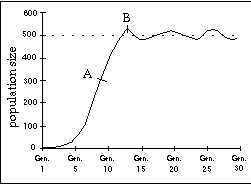
What is the carrying capacity of the graph?
1000
8000
800
600
Which of the following is a density-dependent limiting factor?
human activities
unusual weather
competition
natural disaster
Which of the following would NOT be an example of a density dependent limiting factor?
fire
disease
lack of food
space
Which of the following would NOT be an example of a density independent factor?
predation
tornado
hurricane
fire
Long life span
K-selected
r-selected
many offspring
K-selected
r-selected
substantial parental care is given
K-selected
r-selected
population growth rate is fast
K-selected
r-selected
short life span
K-selected
r-selected
few offspring
K-selected
r-selected
short time to reach reproductive maturity
K-selected
r-selected
many years to reach reproductive maturity
K-selected
r-selected


Primary succession occurs in areas with:
very little soil
lots of soil
no soil
soil that has been disturbed
What best describes the term succession?
rapid changes that create an ecosystem overnight
gradual changes over time to fully create or restore and ecosystem
forest with the tallest trees
the rate species produce offspring
The succession of an ecosystem that was destroyed by a wild fire is an example of ...
positive feedback
negative feedback
The predator/prey interactions in an ecosystem show equilibrium and balance in the environment. This is an example of a ....
positive feedback loop
negative feedback loop
During a temperature inversion.....,
the air gets cooler as you go up
There is a layer of warm air above cooler air
there air is dryer
the air is wetter
Temperature inversions can _________ air pollution
trap
move
eliminate

Temperature inversion is represented in the picture. Which picture is correct?
left
right

Pollution that comes from MANY different places and is hard to identify its source.
Point
Non-Point

Pollution that comes from a single source
Point
Non-Point

A ship carrying gasoline runs into shore and spills large amount of gasoline.
Point
Non-Point

Containers at a food processing plant leaking fat and animal juices
Point
Non-Point

Disposing of paint and other household hazardous materials down the drain
Point
Non-Point

Acid Rain
Point
Non-Point

Cattle ranches allow livestock to feed along streams
Point
Non-Point

Construction sites sediments wash away into a stream.
Point
Non-Point

What 2 things cause upper level ozone destruction?
agriculture and evaporation from the ocean
algal blooms
hydrocarbons and aircraft emissions
automotive exhaust

325 thousand years ago, what was the concentration of carbon dioxide (CO2) in the atmosphere?
0 ppm
300 ppm
180 ppm
400 ppm
an agreement that attempted to regulate greenhouse gas emissions
Kyoto Protocol
Nature Conservancy
CITES
sustainability
What is the name of the international agreement committing parties to phasing out ozone depleting substances and phasing down hydrofluorocarbons (HFCs)?
Vienna Protocol
Paris Agreement
Montreal Protocol
Antarctic Convention
The Clean Air Act...
sets limits on illegal dumping of pollution in our waterways
cleans the air with scrubbers
sets limits on certain air pollutants & how much can be emitted by companies & industries
helps farmers use less pesticides & fertilizers on their crops
Natural causes of air pollution can be caused by...
volcanic eruptions
forest fires
dust storms
all of the above!

