wayground logo

Free Printable Worksheets

Font size

S
M
L
XL
Worksheets

Bio 2 Review SEEd Utah

Total questions: 77

Worksheet time: 3hrs 34mins

Name
Class
Date
1.

TISSUE . . .

a)

specialized structure within a cell that performs specific cellular functions.

b)

basic unit of life

c)

group of same cells.

d)

structure consisting of several different tissues to perform a specific function

2.

Organ . . .

a)

specialized structure within a cell that performs specific cellular functions.

b)

basic unit of life

c)

group of same cells.

d)

structure consisting of several different tissues to perform a specific function

3.

Organ system . . .

a)

specialized structure within a cell that performs specific cellular functions.

b)

group of organs working together to perform a vital body function.

c)

group of same cells.

d)

structure consisting of several different tissues to perform a specific function

4.

organism

a)

a group of organs working together to perform a vital body function.

b)

a living thing

c)

same species interacting with each other

d)

all living things in a particular area.

5.

What organelle is associated with the production of proteins during protein synthesis?

a)

nucleus

b)

ribosome

c)

mitochondria

d)

cell membrane

6.

What organelle determines what comes into and out of the cell?

a)

nucleus

b)

mitochondria

c)

ribosome

d)

cell membrane

7.

Which of these do plant cells have that animal cells do NOT have?

a)

cell wall

b)

chlorophyll

c)

chloroplasts

d)

all of these

8.

The cell membrane is selectively permeable. What does "selectively permeable" mean?

a)

Anything can enter.

b)

Nothing can enter.

c)

Some things can enter, while other things can't enter.

9.

A/an _____________________ is a specialized proteins that helps with many chemical reactions in the body.

a)

enzyme

b)

DNA

c)

sugar

d)

alcohol

10.

Mitochondria convert what substance into energy?

a)

glucose

b)

sucrose

c)

fructose

d)

lactose

11.
Chloroplasts in plant cells are where this process takes place.
a)
cellular respiration
b)
photosynthesis
c)
protein production
d)
glycolysis 
12.

What organelle contains the DNA and is the "brain, or control center" of the cell?

a)

mitochondria

b)

nucleus

c)

ribosome

d)

cell membrane

13.

Which of the following statements about chromosomes is correct?

a)

Chromosomes are long, thread-like structures

b)

Chromosomes are found in the nucleus of all cells in the human body

c)

Chromosomes contain DNA

d)

All of the above

14.

What is the function of the STOMATA in plants?

a)

Allows water to enter the plant

b)

Provides food to enter the plant

c)

Allows for gas exchange

d)

Site of photosynthesis

15.

What is the function of GUARD cells in plants?

a)

Allow gas exchange

b)

Control the opening & closing of the stomata

c)

Contain DNA

d)

Nucleus

16.

What is a STEM CELL?

a)

Cells found in the stems of plants.

b)

Cells that can differentiate into specialized cells.

c)

Cells that control your genes to be expressed.

d)

Cells that provide nutrients to your blood.

17.

What is the function of red blood cells?

a)

Help to digest your food.

b)

Help you breathe.

c)

Provide nutrients to your organs.

d)

Carry oxygen throughout your body.

18.

What does cell differentiation mean?

a)

Process by which a cell absorbs nutrients.

b)

Process by which a less specialized cell becomes a more specialized cell.

c)

Process by which a specialized cell becomes a less specialized cell.

d)

Process by which cells enter the cell cycle.

19.

What is the function of nerve cells?

a)

Allow for gas exchange to happen.

b)

Transport oxygen throughout the body.

c)

Control DNA expression.

d)

Transmit electrical signals to different parts of the body.

20.

Which cell is specialized by having lots of mitochondria for energy and protein fibers for movement?

a)

skin cell

b)

nerve cell

c)

blood cell

d)

muscle cell

21.
This type of cell fights infection.
a)
red blood cell
b)
platelet
c)
white blood cell
d)
antibacterial cell
22.

Which process releases energy?

a)

cellular respiration

b)

photosynthesis

23.

Which process absorbs energy?

a)

Photosynthesis

b)

Cellular Respiration

24.

Oxygen (O2) is a product during which reaction?

a)

Photosynthesis

b)

Cellular Respiration

25.

Carbon dioxide (CO2) is a raw material in which process?

a)

Photosynthesis

b)

Cellular Respiration

26.

Which organelle is responsible for releasing energy in eukaryotic cells?

a)

Lysosomes

b)

Mitochondria

c)

Golgi Bodies

d)

Vacuoles

27.
Cellular respiration is a cellular process that occurs in the cells of –
a)
plants
b)
Plants and Animals
c)
Animals
d)
None
28.
The diagram below shows the relationship between photosynthesis and cellular respiration and the organelles in which they occur.Which statement describes how photosynthesis and cellular respiration are interrelated?
a)
 Oxygen is produced during cellular respiration and stored during photosynthesis.
b)
Carbon dioxide and water released by cellular respiration are used in photosynthesis.
c)
Photosynthesis releases the energy that is stored during the process of cellular respiration.
d)
 Glucose is used during cellular respiration to produce food that is broken down during photosynthesis.
29.
Cellular Respiration's goal is to
a)
make water
b)
make ATP
c)
make glucose
d)
make  oxygen
30.
In photosynthesis ...
a)
water is chloronated
b)
light energy is changed to glucose
c)
osmosis happens
d)
ATP is made
31.
What is cellular respiration?
a)
the breakdown of glucose  to release ATP
b)
the breakdown of glucose to release NADH
c)
the breakdown of glucose to release FADH
d)
the breakdown of glucose to release carbon
32.
What is the correct equation for cellular respiration?
a)
6O2 + C6H12O6 -> 6CO2 + 6H2O + Energy
b)
6O2 + C6H12O6 + Energy -> 6CO2 + 6H2O
c)
6CO2 + 6H2O -> 6O2 + C6H12O6 + Energy
d)
6CO2 + 6H2O + Energy -> 6O2 + C6H12O6
33.
Aerobic respiration is different from anaerobic respiration in that aerobic respiration needs...
a)
chlorophyll
b)
carbon dioxide
c)
glucose
d)
oxygen
34.
Which statement about photosynthesis is correct?
a)
Plants get the energy they need for photosynthesis from water.
b)
Plants get the energy they need for photosynthesis from soil.
c)
Plants get the energy they need for photosynthesis from sunlight.
d)
Plants do not require energy to perform photosynthesis.
35.
Which gas is removed from the atmosphere during photosynthesis?
a)
hydrogen
b)
oxygen
c)
nitrogen
d)
carbon dioxide
36.
The energy carrier that the cell uses to power its day to day activities is 
a)
ATP
b)
NADH
c)
FADH2
d)
glucose
37.
What green pigment is used to trap light energy from the Sun to be used for photosynthesis?
a)
Chlorophyll
b)
Xanthophyll
c)
Carotene
d)
Chloroplast
38.
What would happen if a plant didn't have stomates?
a)
It wouldn't be able to regulate the loss of glucose
b)
It wouldn't be able to regulate the loss of water vapor
c)
It wouldn't be able to store carbohydrates
d)
It wouldn't be able to trap sunlight
39.
The maintenance of homeostasis in animals is MOST directly related to which?
a)
recombination of chromosomes during meiosis
b)
percentage of protein molecules in the organism
c)
growth and development of the organism
d)
use and production of energy
40.
What structure is labeled G?
a)
Channel Protein
b)
Phospholipid
c)
Marker Protein
d)
Phosphate head
41.
The space from H-I represents the?
a)
Phospholipid bilayer
b)
Marker protein
c)
Lipid tail
d)
Channel protein
42.
What type of solution is this?
a)
Isotonic
b)
Hypotonic
c)
Hypertonic
d)
Adcockotonic
43.
What will happen to this cell?
a)
It will shrink and shrivel up
b)
It will swell and get bigger
c)
Nothing will happen
44.
Water will move?
a)
Into the cell
b)
Out of the cell
c)
Neither into or out of the cell
45.
What process is C referring to?
a)
Passive Transport
b)
Diffusion
c)
Osmosis
d)
Active Transport
46.

All of the following are examples of passive transport except....

a)

osmosis

b)

diffusion

c)

facilitated diffusion

d)

endocytosis

47.

Active transport is when molecules move from....

a)

high concentration to low concentration with NO energy

b)

low concentration to high concentration with NO energy

c)

high concentration to low concentration with energy

d)

low concentration to high concentration with energy

48.

What are the "X" shaped things in the drawing.

a)

PMATs

b)

Chromosomes

c)

Ribosomes

d)

Telophase

49.

During what phase of Mitosis do the chromosomes line up in the Middle

a)

Metaphase

b)

Prophase

c)

Telophase

d)

Anaphase

50.

PMAT helps us remember the correct order of the phases of Mitosis. Which of the following has the phases of Mitosis in the correct Order

a)

Interphase, Mitosis, Cytokinesis

b)

Prophase, Metaphase, Anaphase, Prophase

c)

Anaphase, Telophase, Prophase, Telophase

d)

Prophase, Metaphase, Anaphase, Telophase

51.

In which phase of Mitosis do the Chromosomes pull Apart

a)

Metaphase

b)

Prophase

c)

Anaphase

d)

Telophase

52.

What is the purpose of Mitosis?

a)

Growth of an organism and Repair of damaged tissue

b)

To help the body get rid of extra cells

c)

To increase the amount of classwork you have to do

d)

To get rid of the nucleus

53.
DNA is replicated during the ______ phase of the cell cycle.
a)
G1
b)
Synthesis
c)
G2
d)
G0
54.
Cells spend 90% of their time in this stage of the cell cycle. This is the reason you would see most cells in this stage if viewed under a microscope.
a)
Prophase
b)
Metaphase
c)
Anaphase
d)
Interphase
55.
What do the cells look like at the end of mitosis?
a)
different from original cell
b)
similar to the original cell
c)
identical to the original cell
d)
none of these
56.
Before cells can divide, what must be copied?
a)
mitochondria
b)
cytoplasm
c)
DNA
d)
Cell Wall
57.

What is the correct order of the cell cycle?

a)

Interphase, Cytokinesis, Mitosis

b)

Interphase, Mitosis, Cytokinesis

c)

Cytokinesis, Mitosis, Interphase

d)

Anaphase, Telophase, Cytokinesis

58.
 What might the immune system protect our body from?
a)
sugars, fats, and carbs.
b)
viruses, bacteria, fungi, other parasites
c)
viruses, bacteria, fungi, other parasites, carbs, sugars
d)
Cold & Flu
59.
... network organs containing cells that recognize foreign substances in the body and destroy them
a)
Pathogen System
b)
Digestive System
c)
Immune System
d)
Lympathic System
60.
Organs of this system include the kidneys and bladder
a)
Digestive
b)
Excretory
c)
Immune
d)
Skeletal
61.
Which human body systems interact to produce movement of the body?
a)
Nervous and endocrine
b)
Skeletal and muscular
c)
Circulatory and digestive
d)
Excretory and nervous
62.
The two body systems that work together to protect you from foreign pathogens are...
a)
Integumentary and immune
b)
Reproductive and muscular
c)
Endocrine and digestive
d)
Respiratory and circulatory
63.
The circulatory system interacts with the ______ system to remove waste from our blood and produce urine.  
a)
nervous
b)
endocrine
c)
excretory
d)
digestive
64.
The circulatory system interacts with the ____ system when as it surrounds the small intestine. Broken down food (nutrients) is delivered in the blood to all the cells.  
a)
digestive
b)
excretory
c)
nervous
d)
skeletal
65.
The immune system interacts with the _____ system because most of the immune cells travel in the blood.  
a)
muscular
b)
circulatory
c)
digestive
d)
respiratory
66.
The nervous system interacts with the ____ system when it send a message to the adrenal glands to release the hormone "adrenaline" into our blood.  
a)
endocrine
b)
skeletal
c)
muscular
d)
digestive
67.

In humans, the gases oxygen and carbon dioxide must be exchanged between the environment and cells. During this exchange, oxygen is delivered to the red blood cells so that they can function properly in the blood stream. Which two body systems are working together to achieve this goal?

a)

Endocrine and Reproductive

b)

Skeletal and Muscular

c)

Respiratory and Circulatory

d)

Digestive and Excretory

68.

When your body comes in contact with a sharp object, an impulse sent you your brain triggers a reflex that causes you to move away from the object. What body systems are interacting to cause this response?

a)

Nervous, Respiratory,

b)

Nervous, Muscular

c)

Nervous, Skeletal

d)

Nervous, Digestive

69.
What is another word that can be used to describe "homeostasis"?
a)
STABLE
b)
EQUAL
c)
COMPLETE
d)
CORRECT
70.
If the environment gets cold, we will often shiver in order to:
a)
keep body temperature the same as the external temperature
b)
decrease body temperature
c)
increase body temperature
d)
regulate blood pressure
71.

When you get cut, your skin cells release hormones that signal platelets to come and stop the bleeding. Platelets then release more hormones that signal even more platelets to help stop bleeding. The hormone signals continue growing until the cut is closed.

a)

Positive Feedback Response

b)

Negative Feedback Loop

72.
When glucose levels in the blood rise, your brain sends a signal to your pancreas. The pancreas releases insulin, which opens channels in cell membranes to allow glucose to enter the cell, lowering blood sugar levels. 
a)
Positive Feedback Response
b)
Negative Feedback Loop 
73.
Rapid growth during puberty causes your body to release more and more growth hormones. As you grow, more and more growth hormones are released until puberty is reached, and then the hormones stop.
a)
Positive Feedback Response
b)
Negative Feedback Loop 
74.
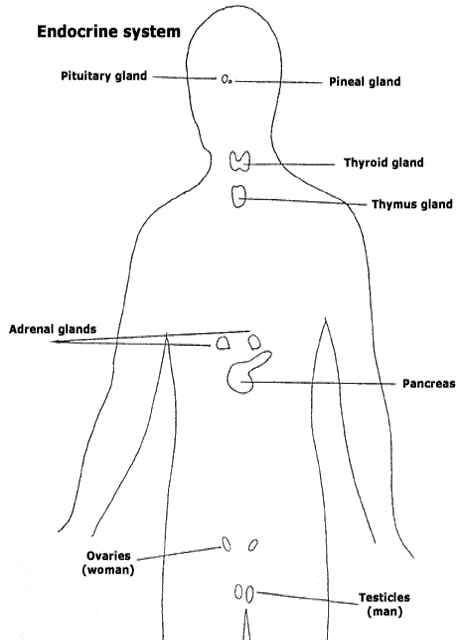
a body system that controls growth and homeostasis by secreting hormones from glands.
a)
skeletal system
b)
nervous system
c)
endocrine sytem
d)
integumentary system
75.

What is an example of a positive feedback mechanism?

a)
b)
76.

What is an example of a negative feedback mechanism?

a)
b)
77.
The main purpose of the ____________ system is to break food particles into pieces that can be used.
a)
circulatory
b)
respiratory
c)
digestive
d)
skeletal