Wayground logo

Free Printable Worksheets

Font size

S
M
L
XL
Worksheets

Chemistry 2021 Practice Final Exam

Total questions: 83

Worksheet time: 2hrs 35mins

Name
Class
Date
1.

the basic structural unit of matter

a)

atom

b)

matter

c)

element

d)

nucleus

2.
What is an ion?
a)
A Charged Atom
b)
A Large Atom
c)
A Small Atom
d)
A Cute Atom
3.
Barium atoms want to form...
a)
an anion
b)
a cation
c)
an onion
d)
a cuddly kitten friend
4.
An Arsenic atom wants to form...
a)
An anion
b)
A cation
c)
An onion
d)
A cuddly kitten friend
5.
Valence electrons are: 
a)
Electrons farthest away from the nucleus
b)
Electrons closest to the nucleus
c)
Electrons that just come and go - they don't stay with the atom
6.
Ions are: 
a)
atoms with a positive or negative charge
b)
atoms with no charge
c)
atoms with ONLY a positive charge
d)
atoms with ONLY a negative charge
7.

Na (sodium) forms an ion with a charge of _______

a)

+1

b)

+2

c)

-1

d)

-2

8.

Be (beryllium) forms an ion with a charge of ________.

a)

+1

b)

+2

c)

-1

d)

-2

9.

Sr (strontium) forms an ion with a charge of _________.

a)

+1

b)

+2

c)

-1

d)

-2

10.

P (phosphorus) ionizes to a charge of _______.

a)

+3

b)

-3

c)

+2

d)

-2

11.

O (oxygen) ionizes to a charge of ________.

a)

+1

b)

+2

c)

-1

d)

-2

12.

Se (selenium) ionizes to a charge of _____.

a)

-2

b)

-1

c)

+1

d)

+2

13.
Cations are
a)
positive
b)
negative
c)
on the right side of the periodic table.
d)
nonmetals
14.

What is an anion's charge?

a)

positive

b)

negative

c)

neutral

d)

depends on the element's charge

15.

Which of these is a calcium ion?


Use all the information in the Bohr model to help you! (Protons, total electrons, valence electrons)

a)
b)
c)
d)
16.

Which of these is an nitrogen ion?


Use all the information in the Bohr model to help you! (Protons, total electrons, valence electrons)

a)
b)
c)
d)
17.
Where are metals located on the periodic table?
a)
Blue
b)
Green
c)
Red
18.
Where are the nonmetals located on the periodic table? 
a)
Blue
b)
Red
c)
Green
19.

the positively charged subatomic particle contained in the nucleus of an atom

a)

proton

b)

neutron

c)

electron

d)

matter

20.

a subatomic particle, contained in the nucleus of an atom, having the same mass as a proton but no electrical charge

a)

proton

b)

neutron

c)

electron

d)

matter

21.

a negatively charged subatomic particle that orbits the nucleus of an atom

a)

proton

b)

neutron

c)

electron

d)

matter

22.
How many different elements are in this chemical formula: C2H2ClK3
a)
6
b)
8
c)
2
d)
4
23.
Which of the following atomic symbols for bromine is written correctly?
a)
bR
b)
BR
c)
Br
d)
br
24.
A neutron has a charge of
a)
+2
b)
No charge
c)
-1
d)
+1
25.
A proton is....
a)
A negatively charged subatomic particle
b)
A positively charged subatomic particle
c)
A neutrally charged subatomic particle
d)
The only subatomic particle located in the nucleus
26.

A subatomic particle that has a negative charge

a)

nobles gases

b)

protons

c)

electrons

d)

neutrons

27.

The periodic table is mostly comprised of what type of element?

a)

Metals

b)

Nonmetals

c)

Metalloids

28.

a negatively charged subatomic particle that orbits the nucleus of an atom

a)

proton

b)

neutron

c)

electron

d)

matter

29.
Which of the following has a full valence shell?
a)
Oxygen
b)
Neon
c)
Barium
d)
Carbon
30.
Which of the following has a full valence shell?
a)
Oxygen
b)
Neon
c)
Barium
d)
Carbon
31.
Which type of bond has an equal sharing of electrons?
a)
Polar Covalent 
b)
Non Polar Covalent
c)
Ionic
d)
Metallic
32.
An ionic bond forms when atoms ___________ electrons.
a)
gain
b)
share
c)
increase
d)
transfer
33.
Which type of bond has an unequal sharing of electrons?
a)
Polar Covalent 
b)
Non Polar Covalent
c)
Ionic
d)
Metallic
34.
Which type of bond has a transfer of an electron from on atom to another?
a)
Polar Covalent 
b)
Non Polar Covalent
c)
Ionic
d)
Metallic
35.
Chemical bonds form when atoms
a)
combined nuclei
b)
give up neutrons
c)
gain protons
d)
share or transfer electrons
36.
If an atom loses two electrons what charge will it have?
a)
+ 2
b)
 - 2
c)
+1
d)
-1
37.
If an atom gains one electron what charge will it have?
a)
-2
b)
-1
c)
+1
38.
Covalent compounds
a)
Share electrons
b)
transfer electrons
c)
contain a sea of electrons
d)
conduct electricity
39.
What is the number of valence electrons for Oxygen?
a)
8
b)
6
c)
2
d)
1
40.
How many valence electrons in this structure?
a)
6
b)
5
c)
4
d)
7
41.
H2O
a)
Ionic Bond
b)
Covalent Bond
c)
Both bonds
d)
Neither bond
42.
NaCl
a)
Ionic Bond
b)
Covalent Bond
c)
Both bonds
d)
Neither bond
43.
CO2
a)
Ionic Bond
b)
Covalent Bond
c)
Both bonds
d)
Neither bond
44.
This picture shows a...
a)
Ionic Bond
b)
Covalent Bond
c)
Both bonds
d)
Neither bond
45.
This picture shows a...
a)
Ionic Bond
b)
Covalent Bond
c)
Both bonds
d)
Neither bond
46.
Atoms want
a)
A full outer shell of electrons
b)
One electron short of a full shell
c)
kit kats
47.
The compound formed between lithium and chlorine is _________.
a)
ionic
b)
covalent
48.
Which of the following has a full valence shell?
a)
Oxygen
b)
Neon
c)
Barium
d)
Carbon
49.
What is the term for the → sign in a reaction?
a)
makes
b)
produces
c)
yields
d)
all are correct
50.
What reaction type is characterized by the reactant breaking down as the reaction progresses?
a)
Synthesis
b)
Decomposition
c)
Combustion
d)
Double Replacement
51.
The Law of Conservation of Mass states
a)
that matter exists in all states and reacts the same
b)
that matter can only be changed into new substances by introducing a catalyst
c)
that matter exists in the same state throughout any chemical change
d)
that matter cannot be created or destroyed and that the mass of the products must equal the mass of the reactants
52.
___________________ are the elements/compounds formed in a chemical reaction (on the right)
a)
Polymers
b)
Bonds
c)
Reactants
d)
Products
53.
What are the reactants in the chemical equation pictured?
a)
CH4 and CO2
b)
CH4 and O2
c)
CO2 and H2O
d)
O2 and H2O
54.
Is this balanced?...
Al + O2 --> 2Al2O3
a)
Yes!
b)
NO!
55.
Is this balanced?...
Fe + S --> FeS
a)
YES!
b)
NO!
56.
The red numbers in the image below represent ________
a)
subscripts
b)
coefficients
c)
I don't know, and don't want to try
d)
None of the answers are correct
57.
How many Al atoms are in this compound?         4Al2O3
a)
2
b)
8
c)
6
d)
4
58.
How many F atoms are in this compound?
6MgF2 
a)
2
b)
6
c)
8
d)
12
59.
In the equation,          2Mg + O2 ---> 2MgO, which are the reactants?
a)
Mg and O
b)
MgO
c)
Mg and MgO
d)
O and MgO
60.
What is the arrow in a chemical equation...
H2 + O --> H2O
a)
Reactants
b)
Products 
c)
Yields 
d)
Chemical Equation 
61.
The substances at the beginning of a chemical equation are called the ____
a)
product
b)
yield
c)
chemical symbol
d)
reactants
62.
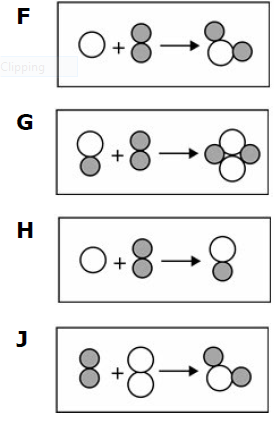
Which of the following models best demonstrates a balanced chemical equation?
a)
F
b)
G
c)
H
d)
J
63.
What are Chemical Reactions?
a)
It's when you mix substances.
b)
a process in which atoms rearrange to form new substances
c)
When something bubbles.
d)
letter and numbers showing the types and number of atoms
64.
True or False
In a chemical reaction, no new atoms are created, and no atoms are destroyed. 
a)
true
b)
false
65.
The left side of the equation below is called
a)
Products
b)
Reactants
66.
The right side of the equation below is called the
a)
products
b)
reactants
67.
A number in front of a chemical formula in an equation that indicates how many molecules or atoms of each reactant and product are involved in a reaction.
a)
Coefficient
b)
reactant
c)
subscript
d)
product 
68.
What type of reaction is illustrated below?
2HI --> H2  +  I2
a)
synthesis
b)
decomposition
c)
single replacement
d)
double replacement
69.

What type of reaction is illustrated below?

Zn + H2S --> ZnS + H2

a)

synthesis

b)

decomposition

c)

single replacement

d)

double replacement

70.
What type of reaction is illustrated below?
FeS + Hal --> H2S + FeCl
a)
synthesis
b)
decomposition
c)
single replacement
d)
double replacement
71.

This is a correct dot diagram for neon (Ne)

a)

true

b)

false

72.
This is the correct dot diagram for nitrogen, group 15.
a)
true
b)
false
73.

How many valence electrons does Aluminum Have?

a)

1 Valence electron

b)

2 Valence electron

c)

3 Valence electron

d)

4 Valence electron

e)

5 Valence electron

74.

How would you draw a Lewis dot diagram for Magnesium?

a)
b)
c)
d)
75.

This is a correct dot diagram for nitrogen (N)

a)

true

b)

false

76.

This is a correct dot diagram for carbon (C)

a)

true

b)

false

77.

Which of these is correct?

a)
b)
78.
This is a correct dot diagram for oxygen (O)
a)
true
b)
false
79.
Which of the following is the correct Lewis dot structure for the molecule fluorine (F2)?
a)
A
b)
B
c)
C
d)
D
80.
What is the correct formula for this molecule?
a)
NH
b)
N3H
c)
NH3
d)
NH4
81.

Which is the correct molecular structure for carbon dioxide CO2?

a)
b)
c)
d)
82.

What is the correct Lewis Dot Structure for ammonia NH3

a)
b)
c)
d)
83.
Which of the following is the correct Lewis structure for water?
a)
A
b)
B
c)
C