
 Worksheets
Science Chapter 3
Total questions: 180
Worksheet time: 3hrs 1mins
A (a) shows us what each animal sets.


*Remember Humans are on the top of all food chains because we do not get hunted.
What is a food chain?
The flow of energy from one thing to another
The way animals eat each other
The way the sun makes everything
How the plants grow
*Remember Humans are on the top of all food chains because we do not get hunted.
What do plants need to make their own food?
Sun, Water, and Animals
Sun, Coke, and Soil
Sun, Water, and Soil
Nothing at all
An example of a predator:
shark
mouse
rabbit
An example of prey:
lion
mouse
shark

What is a decomposer?


Food webs show you everything an animal eats. Food chains show you one thing.

The main source of energy for all of earth's food chains is the...
sun
water
nutrients
producers
Plants produce their own food through...
symbiosis
photosynthesis
genetics
magic
All food chains begin with a...
grass
producer
consumer
decomposer
The second link in a food chain is a...
consumer
producer
herbivore
carnivore
A herbivore is a...
consumer that eats both plants and other animals
consumer that only eats other animals
consumer that only eats plants
A herbivore is also known as...
primary consumer
secondary consumer
tertiary consumer
The second consumer in the food chain is called...
primary consumer
secondary consumer
tertiary consumer
The secondary consumer is a carnivore which means...
a consumer that eats both plants and other animals
a consumer that eats only plants
a consumer that eats only other animals
The third consumer in the food chain is called...
primary consumer
secondary consumer
tertiary consumer
An omnivore is a...
consumer that eats both plants and other animals
consumer that eats only other animals
consumer that eats only plants
Animals that are not hunted and eaten by any animals are called...
herbivores
carnivores
omnivores
apex predators
The level of apex predators in the food chain is...
first
second
tertiary
top
Apex predators contribute to the food chain by...
being eaten by other animals
decomposers breaking down their bodies when they die
producing their own food
Examples of decomposers are...
plants
animals
bacteria and fungi
The level of humans in the food chain is...
first
second
tertiary
top
Where do all life forms get their energy?
Food
Water
Plants
The Sun
An organism that lives by breaking apart dead animal and plants into simpler parts is...
scavenger
consumer
decomposer
carnivore
Recently, a family of bobcats(predator) moved into an area with a large rabbit(prey) population. What changes may occur in the food chain?
The rabbit population may increase
The rabbit population may decrease
The rabbit population may increase first, then decrease
The rabbit population will remain the same
A food chain is:
an animal that eats only plants.
a diagram that shows how energy moves from one organism to another. (Grass>Mouse>Owl)
An animal that is hunted and eaten by another animal.
An animal that hunts and eats other animals.
Pick 3 answers.
herbivore
carnivore
predator
prey
consumer
which one is a Producer?




Why do people say adult lions are at the top of the food chain?
Adult lions have no predators in the wild.
Adult lions are prey for many different kinds of animals.
Adult lions are producers and can make food on their own.
Adult lions help other animals get food by hunting for them.


How are the living creatures in an ecosystem linked?
By what they eat
By how they breathe
By their size
By their species`
What can you infer from the fact that the disappearance of just one species can disrupt an entire food chain?
Every food chain depends entirely on a single species
Food chains are extremely fragile
Food chains can regenerate on their own
Food chains would not exist without humans
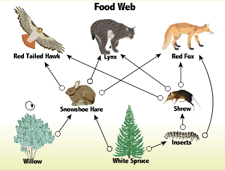
How is a food web different from a food chain?
Food webs contain only producers, not consumers.
Food webs do not include decomposers.
Food webs contain many different, linked food chains.
Food webs exist in aquatic environments; food chains exist in terrestrial environments.
Which of the following is a producer?


Through what process do producers make their own food?
Parthenogenesis
Photosynthesis
Meiosis
Mitosis
What role do you play in the food web?
Producer
Consumer
Decomposer
Human
How might a lack of sunlight disrupt the food web?
It would cause consumers to consume less.
It would prevent decomposers from decomposing matter
It would prevent producers from producing nutrients.
It would not disrupt the food web at all.
How are primary consumers different from secondary consumers?
Primary consumers eat only plants; secondary consumers eat other consumers.
Primary consumers eat other consumers; secondary consumers eat only plants.
Primary consumers eat plants and other consumers; secondary consumers eat plants and decompose matter.
Primary consumers eat plants and decompose matter; secondary consumers eat plants and other consumers.

This organism is most likely
A primary consumer
A secondary consumer
A decomposer
A producer
Sheep are herbivorous. What can you infer from this?
They are primary consumers.
They are producers.
They are secondary consumers.
They are decomposers.
Producers are:
animals
rocks
plants
Plants are called producers because they can produce their own:
music
food
air
Animals that eat only plants are called:
herbivores
omnivores
carnivores
Animals that eat only meat are called:
herbivores
carnivores
omnivores
Animals that eat both plants and animals are called:
herbivores
carnivores
omnivores
A food chain is:
an animal that eats only plants.
a diagram that shows how energy moves from one organism to another. (Grass>Mouse>Owl)
An animal that is hunted and eaten by another animal.
A living thing that breaks down dead plants and animals - such as, fungi, worms, bacteria, is:
decomposer
food web
omnivore
A system of many food chains that interact with each other:
predator
consumer
food web
An animal that hunts and eats other animals:
producer
plants
predator
A living thing that needs to eat other living things for food:
consumer
producer
desk chair
A living thing:
organism
rock
weather
An animal that is hunted and eaten by another animal:
predator
prey
scavenger
An animal that searches for and eats dead animals:
scavenger
scavenger
scavenger
An example of a herbivore:
cow
lion
wolf
An example of a carnivore:
giraffe
eagle
cow
An example of a producer:
apple tree
cat
dog
An example of a consumer:
grass
roses
dog
An example of an omnivore:
raccoon
oak tree
water
An example of a predator:
shark
mouse
rabbit
An example of prey:
lion
mouse
shark
Animals eat plants and other animals and the way this happens shown in a (a) .
We use (a) - to give information about the feeding relationship.
Food chain are useful because they show how plants and animals need food to ___________________.
arrows
pictures
live
relationships
We can use words or ____________ to create food chain.
arrows
pictures
live
relationships
We use ___________ to show us feeding relationship.
arrows
pictures
live
relationships
Arrows are used to show feeding ___________________.
arrows
pictures
live
relationships
Food webs give us more information about (a) .
A food web shows all the different things that animals eat in a (a) .
Food webs and food chains give information about feeding relationships.
True
False
We use arrows to show us what each animals eat.
True
False
Food webs give information than food chains.
True
False
Food chains always start with (a) -.
They are called producers because they can make their own food using __________ from the ____________.
(a)
A healthy plant needs sunlight, water, _______ and a suitable place to ______________.
(a)
We describe green plant as (a) plant.
They all start with green plants called (a) .
Animals cannot make their own (a) .
They have to eat something to get the (a) they need.
Some of the energy is used by the (a) .
The rest of the energy is passed along the food ___________ and ______________________.
(a)
We use (a) of numbers to help us.
When green plants make food using ____________ energy from the _______________it is called ________________________.
(a)
Green plants use _________________ from the air and ___________from the soil to make ________________.
(a)
(a) is the name of the food the plant needs so that it can grow.
(a) is the name of the food the plant needs so that it can grow.
Humans and other animals use (a) when they breathe.
The (a) provides food for animals and insects.
We call animals and insects (a) -because they consume plants.
Insect
Primary Consumer
Secondary Consumer
Tertiary Consumer
Snake
Primary Consumer
Secondary Consumer
Tertiary Consumer
Lizard
Primary Consumer
Secondary Consumer
Tertiary Consumer
Animals that hunt other animals for food are called (a) -.
(a) kill other animals.
These animals are called (a) .
The (a) is the fastest animal on the Earth.
It can run as fast as (a) -.
Cheetah are found in (a) .
They are (a) .
The __________ can be found in Africa and ___________.
(a)
Some animals hunt for their food are called (a) .
The animals that are hunted and killed by predators are called (a) -.
Predators and prey are both _________ because they cannot produce their own _____________.
(a)
___________ is the producer in a ________- habitat.
(a)
Food chains can also include information about (a) - and prey in a different habitats.
Some (a) -- can be predators and prey.
How are the living creatures in an ecosystem linked?
By what they eat
By how they breathe
By their size
By their species`

What is a predator?
An animal that eats plants
An animal that naturally preys on (eats) other animals

Are predators important to an ecosystem?
Yes
No

The way energy is passed from one organism to another
food chain
energy
extinct

Which best describes what a food chain shows you?
Energy flow through an ecosystem
The life cycle of animals

An organism that gets energy from eating other organisms is a ______________
producer
consumer
decomposer

What is a producer?
an organism that gets energy from EATING other organisms
an organisms that uses sunlight to MAKE its own food

In this image, the cheetah is the
prey
energy
herbivore
predator

What is this model called?
Food Chain
Habitat
Herbivore

How is the sun a part of a food chain?
it is bright
it is the energy source
it is hot

