Wayground logo

Free Printable Worksheets

Font size

S
M
L
XL
Worksheets

NCHSE Anatomy & Physiology & Pathology

Total questions: 74

Worksheet time: 2hrs 30mins

Name
Class
Date
1.
The large intestine is responsible for?
a)
absorption of water
b)
absorption of food
c)
making chyme
2.
What type of acid is in the stomach?
a)
HCl (Hydrochloric acid)
b)
NaCl (Table salt)
c)
NaOH (Sodium Hydroxide)
3.
The Pancreas is responsible for?
a)
Creating enzymes for digestion
b)
Regulating the sugar levels in your body
c)
Both A & B
d)
Neither A & B
4.
The Liver is responsible for?
a)
Store bile
b)
Produce bile
c)
creates enzymes
5.
The Gallbladder is an organ that?
a)
Stores bile
b)
Produce bile
c)
Creates enzymes
6.
Carbohydrates are broken down into?
a)
sugar
b)
protein
c)
amino acids
d)
lipids
7.

Oxygenated blood from the lungs re-enters this chamber:

a)

Right atrium

b)

Right ventricle

c)

Left atrium

d)

Left ventricle

8.

This artery is the only artery in the body to carry deoxygenated blood:

a)

Aorta

b)

Pulmonary Artery

c)

Coronary Arteries

d)

Hepatic Arteries

9.

Deoxygenated blood travels from the right atrium to the right ventricle through this valve:

a)

Mitral Valve

b)

Aortic Valve

c)

Pulmonary Valve

d)

Tricuspid Valve

10.

This valve allows the passage of blood from the right ventricle to the pulmonary artery:

a)

Tricuspid Valve

b)

Mitral Valve

c)

Aortic Valve

d)

Pulmonary Valve

11.

This structure prevents the backwards movement of blood:

a)

Ventricle

b)

Valve

c)

Atrium

d)

Vein

12.

The chordae tendineae prevent the prolapse of:

a)

The aortic valve

b)

The pulmonary valve

c)

The atrioventricular valves

d)

The semi-lunar valves

13.

The largest artery in the body is the:

a)

Aorta

b)

Pulmonary Artery

c)

Carotid Artery

d)

Brachiocephalic Artery

14.

Blood from the Inferior and Superior Vena Cava empties into the:

a)

Right ventricle

b)

Right atrium

c)

Left ventricle

d)

Left atrium

15.

Which term refers to the lungs?

a)

Hepatic

b)

Coronary

c)

Pulmonary

d)

Thoracic

16.

Blood leaving the Pulmonary arteries and travelling to the lungs is:

a)

Oxygenated

b)

Deoxygenated

17.

During systole, the AV (atrioventricular valves) are:

a)

Open

b)

Closed

18.

Blood is example of __ tissue.

a)

Nervous

b)

muscle

c)

epithelial

d)

connective

19.

Most of your respiratory tract is lined with ___ tissue.

a)

hyaline cartilage

b)

ciliated pseudostratied columnar epithelium

c)

stratified squamous epithelium

d)

transitional epithelium

20.

This type of tissue makes up glands like your salivary glands.

a)

Epithelial

b)

Nervous

c)

Connective

d)

Muscle

21.

What is the basic unit of structure and function of all LIVING organisms?

a)

organism

b)

species

c)

cell

d)

tissue

e)

organ system

22.

The sum of all chemical reactions in the body is called

a)

metabolism

b)

assimilation

c)

growth

d)

digestion

23.

Which of the following is the most complex level of organization?

a)

cell

b)

organ

c)

organ system

d)

organelle

24.
What is the name given to the protective coating on the end of a bone?
a)
Cartilage 
b)
Ligament
c)
Tendon
d)
Periosteum
25.
Which of the following is the name given to the connective tissue which connects ‘Bone to Bone’?
a)
Tendon
b)
Ligament
c)
Aponeurosis
d)
Muscle fascia
26.
The Hip and shoulder are both what type of synovial joint?
a)
Ball and socket
b)
Condyloid
c)
Hinge
d)
Gliding
27.
The Atlas and Axis bone found in the top section of the vertebrate form what type of joint?
a)
Condyloid
b)
Gliding
c)
Pivot
d)
Saddle
28.
What is the movement known as when the arms are taken away from the bodies midline in a lateral motion?
a)
Abduction
b)
Protraction
c)
Adduction
d)
Retraction
29.
Which movement is occurring when the shoulder blade are draw backwards? 
a)
Abduction
b)
Protraction
c)
Adduction
d)
Retraction
30.
What is the name given to the connective tissue that attaches muscle to bone?
a)
Ligament
b)
Tendon
c)
Patella
d)
Perimysium
31.
Which of the following movements can occur at the Elbow joint?  
a)
Abduction and Adduction 
b)
Rotation and Circumduction
c)
Flexion and Extension 
d)
Protraction and Retraction
32.
What is the name given to the shoulder joint where the humerus meets the Glenoid fossa?
a)
Glenohumeral joint
b)
Acetabulum 
c)
Talus joint
d)
Condyloid joint
33.
Which structure within a synovial joint aids friction free movement? 
a)
Joint capsule
b)
Synovial cavity
c)
Synovial membrane
d)
Articular cartilage
34.
The elbows, knees, ankles and phalanges are examples of which type of synovial joint?
a)
Ball and socket
b)
Condyloid
c)
Gliding
d)
Hinge
35.
Rotation of the forearm until the palm faces upwards is called is known as?
a)
Supination
b)
External rotation
c)
Plantar flexion
d)
Pronation
36.

What primary gas product is removed from your system during Exhalation?

a)

Air

b)

Oxygen

c)

Carbon Dioxide

d)

Carbon Monoxide

37.

The two main branches extending from the trachea to the lungs

a)

Bronchi

b)

Alveoli

c)

Capillaries

d)

Bronchioles

38.

Where the exchange of gases actually occur?

a)

Bronchi

b)

Trachea

c)

Oxygen

d)

Alveoli

39.

The tube that conveys air to and from the lungs; the windpipe

a)

Esophagus

b)

Bronchi

c)

Trachea

d)

Alveoli

40.

The "gate" that prevents food or fluid from entering the trachea.

a)

Pharynx

b)

Larynx

c)

Esophagus

d)

Epiglottis

41.

The thin skeletal muscle that sits at the base of the chest and separates the abdomen from the chest. It contracts and flattens when you inhale.

a)

Intercostal

b)

Diaphragm

c)

Epiglottis

d)

Larynx

42.

Pair of serous membranes lining the thorax and enveloping the lungs

a)

Alveoli

b)

Pericardium

c)

Pleura

d)

Bronchi

43.

The Primary to drive to breath

a)

Decrease Potassium in the arterial blood

b)

Increase Nitrogen in the arterial blood

c)

Decrease Oxygen in the arterial blood

d)

Increase Carbon Dioxide levels in the arterial blood

44.

The central control of breathing

a)

Epiglottis

b)

Medulla

c)

Vocal Chords

d)

Pleura

45.

Involved in controlling attention, spatial perception and sensory information, for example: touch, pressure and pain.

a)

Occipital lobe

b)

Parietal lobe

c)

Frontal lobe

d)

Temporal lobe

46.
The part of the brain that controls higher mental activities such as learning, perception, memory  and making decisions.
a)
cerebellum
b)
cerebrum
c)
thalamus
d)
midbrain
47.
The part of the brain that controls coordination, balance, and equilibrium
a)
cerebrum
b)
thalamus
c)
cerebellum
d)
medulla oblongata
48.
Lobe involved with making decisions, planning, reasoning, and carring out voluntary body movements.
a)
Frontal Lobe
b)
Parietal Lobe
c)
Occipital Lobe
d)
Temporal Lobe
49.

Groove that separates the two hemispheres

a)

longitudinal fissure

b)

transvere fissure

c)

corpus callosum

d)

hippocampus

50.
Receives and processes  auditory information and involved in language comprehension?
a)
Frontal Lobe
b)
Temporal Lobe
c)
Occipital Lobe
d)
Parietal Lobe
51.
Alicia suffered a brain disease that destroyed major portions of her temporal lobes. Alicia is most likely to suffer some loss of:

a)
AUDITORY PERCEPTION
b)
THIRST AND HUNGER
c)
PAIN SENSATIONS
d)
MUSCULAR COORDINATION
52.
Seeing is to hearing as the ________ lobes are to the _______ lobes. 
a)
FRONTAL , TEMPORAL
b)
OCCIPITAL, PARIETAL
c)
FRONTAL, PARIETAL
d)
OCCIPITAL, TEMPORAL
53.
A loss of physical coordination and balance is most likely to result from damage to the:

a)
HYPOTHALAMUS
b)
CEREBELLUM
c)
CORPUS CALLOSUM
d)
PONS
54.

A young man was referred to a neurosurgeon after his frequent bouts of aggression could not be controlled. Diagnostic tests found an inoperable tumor in which location?

a)

PONS

b)

AMYGDALA

c)

PITUITARY GLAND

d)

BROCA'S AREA

55.

THE PARIETAL LOBES ARE TO THE_________ AS THE OCCIPITAL LOBES ARE TO:

a)

HEARING AND SPEAKING

b)

SENSING TOUCH AND SEEING

c)

TASTING AND SMELLING

d)

SPEAKING AND SEEING

56.

THE BRAIN AND THE SPINAL CORD MAKE UP THE __________NERVOUS SYSTEM

a)

CENTRAL

b)

PERIPHERAL

c)

AUTONOMIC

d)

SOMATIC

57.

A person has a stroke on her occipital lobe. What might happen to her?

a)

inability to speak

b)

deafness

c)

coma

d)

blindness

58.

Controls heartbeat and breathing

a)

hypothalamus

b)

medulla oblongata

c)

Cerebellum

d)

Thalamus

59.
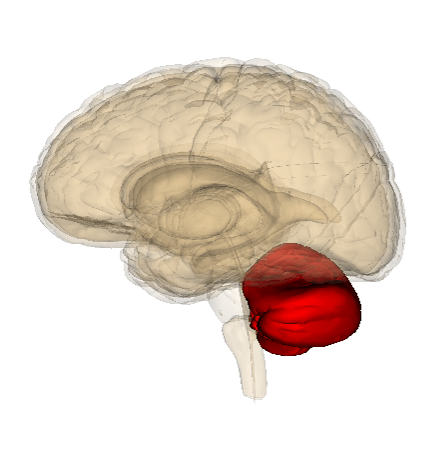
The red portion is the ________
a)
Cerebrum
b)
Cerebellum
c)
Brain Stem
d)
Diencephalon
60.
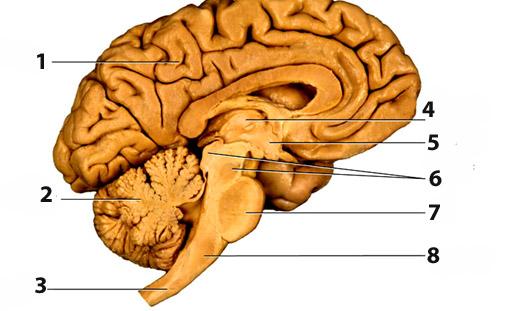
Label number 1
a)
Medulla Oblongata
b)
Pons
c)
Cerebellum
d)
Cerebrum
61.
Label number 3
a)
Mesencephalon
b)
Thalamus
c)
Hypothalamus
d)
Spinal Cord
62.

Which of the following are fragments that help stop bleeding when a blood vessel is damaged?

a)

Leukocytes

b)

Platelets

c)

Erythrocytes

d)

Mast Cells

63.

When you damage a blood vessel what is the first thing that happens?

a)

Vasoconstriction

b)

Platelet plug formation

c)

Coagulation

d)

Release of extra Leukocytes

64.

Which anemia is due to the destruction or inhibition of red bone marrow?

a)

Aplastic Anemia

b)

Pernicious Anemia

c)

Hemorrhagic Anemia

d)

Sickle-cell Anemia

65.

Which one is NOT an anticoagulant/blood thinner that helps to prevent undesirable clots?

a)

Asprin

b)

Heparin

c)

Warfarin

d)

Vit B

66.

Which Leucocyte is the body's bacteria slayers?

a)

Neutrophils

b)

Eosinophils

c)

Basophils

d)

Mast Cells

67.

Which cell type will make Antibodies?

a)

B Cells

b)

T Cells

c)

Monocytes

d)

RBC's

68.

Which blood type has both A and B antibodies?

a)

A

b)

B

c)

AB

d)

O

69.

What do you call a freely floating clot in the blood stream

a)

Thrombus

b)

Embolus

c)

Hemorragh

d)

Punk

70.
The brain's "sensory switchboard":  directs sensory messages to proper area of the brain
a)
thalamus
b)
hypothalamus
c)
hippocampus
d)
reticular formation
71.
The brain's "sensory switchboard":  directs sensory messages to proper area of the brain
a)
thalamus
b)
hypothalamus
c)
hippocampus
d)
reticular formation
72.
Which letter on the illustration represents the frontal lobe? 
a)
A
b)
B
c)
C
d)
D
73.
Which letter on the illustration represents the temporal lobe? 
a)
A
b)
B
c)
C
d)
D
74.
Controls motivational behaviors, including: feeding, fight-flight response
a)
Hippocampus
b)
Amygdala
c)
Reticular Formation
d)
Hypothalamus