wayground logo

Free Printable Worksheets

Font size

S
M
L
XL
Worksheets

2nd semester final 2022

Total questions: 90

Worksheet time: 2hrs 29mins

Name
Class
Date
1.
If the number of moles of gas inside of a container increases, what will happen to the volume of the container if both temperature and pressure are kept constant?
a)
The volume will increase.
b)
The volume will decrease
c)
The volume will remain constant.
d)
None of the above.
2.
At which of the following temperatures would the motion of all of an objects particles come to a complete stop?
a)
0 K
b)
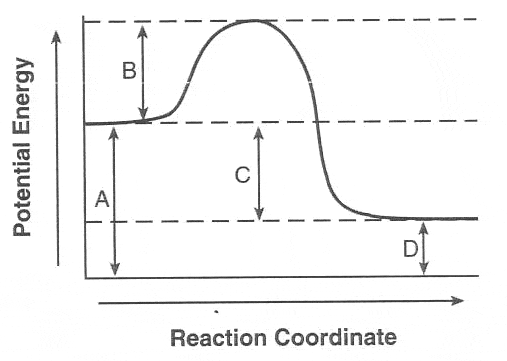
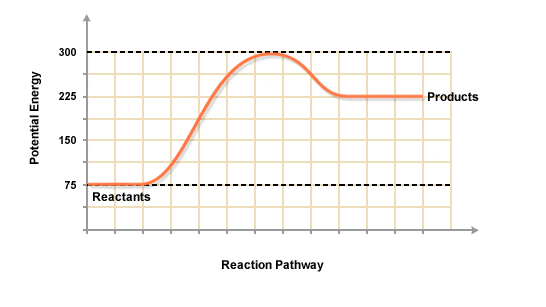
0oC
c)
373 K
d)
-100oC
3.
Which of the following is not a point made by the kinetic molecular theory of gases?
a)
Gases are composed of tiny particles.
b)
The speed of gas particles is related to the temperature of the system.
c)
Gas particles are always moving with high speed random motion.
d)
Gas particles do not have mass or take up any space.
4.
Charles’ Law states that if a given quantity of gas is held at a constant pressure, then its volume is directly proportional to the absolute temperature. This law explains why —
a)
the pressure of a gas increases when volume decreases
b)
a gas-filled balloon expands when it is heated 
c)
solids require heat in order to change into gases
d)
some gases only react with each other at high temperatures
5.
Two Reactants and One Product
a)
Decomposition
b)
Synthesis
c)
Combustion
d)
Single Replacement
6.
Always starts with a Hydrocarbon that reacts with oxygen and produces carbon dioxide and water. 
a)
Decomposition
b)
Synthesis
c)
Combustion
d)
Single Replacement
7.
One reactant into several products.
a)
Decomposition
b)
Synthesis
c)
Combustion
d)
Single Replacement
8.
One element replaces another in a compound.
a)
Synthesis
b)
Combustion
c)
Single Replacement
d)
Double Replacement
9.
Ions in two compounds switch. 
a)
Synthesis
b)
Combustion
c)
Single Replacement
d)
Double Replacement
10.
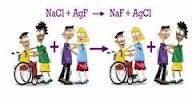
What is the type of reaction shown at the top?
a)
Synthesis
b)
Decomposition
c)
Single Replacement
d)
Double Replacement
11.
This pictures simulates what type of reaction?
a)
Synthesis
b)
Decomposition
c)
Single Replacement
d)
Double Replacement
12.
H2O + C yields H2 + CO2
1. Balance the equation,
2. what type reaction is this
a)
4:2:4:2
Decomposition
b)
1:1:1:2
Single Replacement
c)
2:1:2:1
Double Replacement
d)
2:1:2:1
Single Replacement
13.
H2O + C yields H2 + CO2
1. Balance the equation,
2. what type reaction is this
a)
4:2:4:2
Decomposition
b)
1:1:1:2
Single Replacement
c)
2:1:2:1
Double Replacement
d)
2:1:2:1
Single Replacement
14.
Ca(OH)2 yields CaO + H2O
1. Balance the equation
2. What type reaction is this?
a)
1:1:1
Synthesis
b)
1:1:1 
Double Replacement
c)
1:1:1
Decomposition
d)
1:2:1
Decomposition
15.
What symbol is used to indicate a heated reaction?
a)
Triangle
b)
Square
c)
Circle
d)
fire
16.
3KOH + H3PO4 --> K3PO4 + 3H2O
a)
Synthesis 
b)
Decomposition
c)
Single displacement
d)
Double displacement
17.
2Pb(NO3)2 --> 2PbO + 4NO2 + O2
a)
Synthesis 
b)
Decomposition
c)
Single displacement
d)
Combustion
18.
Fe + H2SO4 --> Fe2(SO4)3 + H2
a)
Synthesis (combination)
b)
Decomposition
c)
Single replacement
d)
Combustion
19.
What coefficient should be used to make the following equation balanced?
N2+O2--> _NO 
a)
1
b)
2
c)
3
d)
4
20.
Which compound has the smallest molar mass?
a)
CO
b)
CO2
c)
H2O
d)
H2O2
21.
Which has a greater mass: 1 mole of scandium or 2 moles of boron?
a)
scandium
b)
boron
c)
neither
d)
more information is needed.
22.
What is the mass in grams of 6.25 mol of copper (II) nitrate?
a)
126 g
b)
785 g
c)
625 g
d)
1172 g
23.
Avogadro's number of representative particles is equal to one_____.
a)
kilogram
b)
gram
c)
kelvin
d)
mole
24.
What do we call the SI unit for amount of a substance?
a)
Avogadros number
b)
kilogram
c)
mole
d)
liter
25.
What is the molar mass of AuCl3?
a)
96 g
b)
130 g
c)
232.5 g
d)
303.3 g
26.
How many atoms of carbon are in five molecules of propane, C3H8?
a)
40
b)
3
c)
15
d)
8
27.
Balance the following reaction:
Mg(s)   +   HCl(aq)  -->   MgCl₂(aq)   +   H₂(g)
a)
1,2,1,2
b)
2,1,1,2
c)
1,2,1,1
d)
1,2,2,2
28.
What is the molar mass of NaOH?
a)
39.997 g/mol
b)
38.989 g/mol
c)
23.998 g/mol
d)
57.004 g/mol
29.
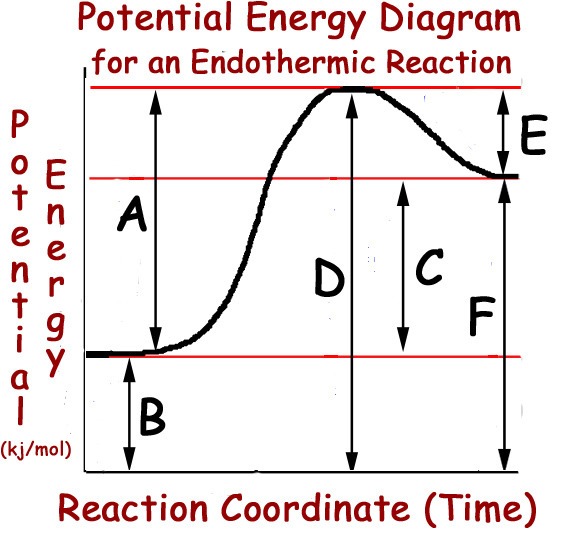
What type of reaction is this?
a)
Endothermic
b)
Exothermic
30.
What letter represents the activation energy?
a)
A
b)
B
c)
C
d)
D
31.
What is the energy of the activated complex?
a)
75 kJ
b)
225 kJ
c)
300 kJ
d)
225 kJ
32.
Increase in temperature of the reactants can do one of the following
a)
Slow collision frequency
b)
Allow less effective collision between the particles
c)
Cause particles to lose speed
d)
Increase collision between the particles thus increasing the rate.
33.
What is the activation energy of the reverse reaction?
a)
75 kJ
b)
300 kJ
c)
150 kJ
d)
225 kJ
34.
A ______________ is a substance that increases the rate of a reaction without being used up during the reaction. 
a)
catalyst
b)
product
c)
reactant
d)
solute
35.
Exothermic reactions release heat to the surroundings.
a)
true
b)
false
36.
Increasing the concentration of the reactants will slow down the reaction.
a)
false 
b)
true
37.
In an exothermic reaction the products have
a)
more energy than the reactants
b)
the same energy as the reactants
c)
less energy than the reactants
d)
no energy
38.
C represents
a)
energy absorbed
b)
energy released
c)
activation energy
39.
Why does a higher temperature increase the rate of a reaction?
a)
it increases both the frequency and energy of particle collisions
b)
it only increases the frequency of particle collisions
c)
it only increases the energy of particle collisions
d)
it reduces the activation energy of the reaction
40.
Why does a higher concentration increase the rate of reaction?
a)
it increases the amount of reactants
b)
it lowers the activation energy
c)
it increases the energy of particle collisions
d)
it increases the frequency of particle collisions because there are more collision sites
41.
Which of these will NOT speed up the rate of reaction between a strip of magnesium and hydrochloric acid?
a)
tightly coil up the strip of magnesium
b)
cut up the strip of magnesium
c)
increase the concentration of the hydrocholoric acid
d)
increase the temperature of the hydrocholoric acid
42.
What is the formula for Boyle's Law?
a)
P1V1=P2V2
b)
P1V1/P2V2
c)
P1V2=P2V1
d)
P1/V1=P2/V2
43.
A gas at a volume of 4 liters is at a pressure of 2 atm. The volume is changed to 16 Liters, what must the new pressure be?
a)
2 atm
b)
12 atm
c)
10 atm
d)
0.5 atm
44.
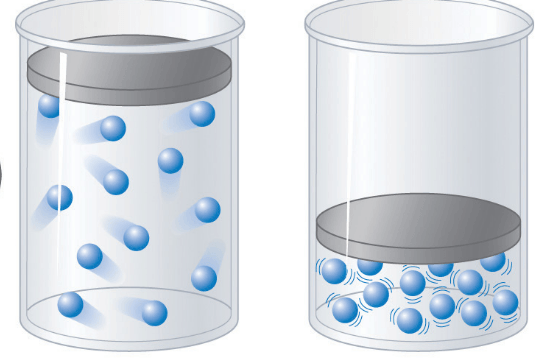
Which container will have a lower pressure?
a)
left
b)
right
c)
they both have the same pressure
d)
I don't know
45.
The relationship of which two variables are compared in Boyle's Law?
a)
pressure & volume
b)
volume & temperature
c)
temperature & pressure
d)
volume & moles (amount of gas)
46.

Zevan Crockett decides to go scuba diving while on vacation in Mexico. As he swims deeper into the ocean, the pressure pushing on him increases. Based on the relationship in Boyle’s law, what would happen to the volume of a Zevans’s lungs with this increase in pressure?

a)

volume of the lungs would increase

b)

volume of the lungs would have no change

c)

volume of the lungs would double

d)

volume of the lungs would decrease

47.
What is the formula Charles' Law?
a)
V = T
b)
VT = VT
c)
T1 / V1 = T2 / V2
d)
V1 / T1 = V2 / T2
48.
What is 50 C in Kelvin?
a)
223
b)
323
c)
100
d)
50
49.

(Charles Law) There are 65 liters of helium in a balloon at 35 K. If the temperature of the balloon is increased to 40 K, what will the new volume of the balloon be?

a)

40 L

b)

70 L

c)

74.3 L

d)

75.9 L

50.
The volume of a sample of a gas at 273 oC is 200 liters. If the volume is decreased to 100 liters at constant pressure, what will be the new temperature of the gas?
a)
0 K
b)
546 K
c)
273 K
d)
100 K
51.
The volume of a gas at 25ο C is 3.8 L.  What will be the volume of that gas at 57 ο C if the pressure is held constant?
a)
8.66 L
b)
4.21 L
c)
6.34 L
d)
3.46 L
52.

If 2.6L of a gas at 3.1 atm is compressed to 1.3L, what would the new pressure be?

a)

1.55 atm

b)

2.6 atm

c)

6.2 atm

d)

The pressure stays the same

53.
What is 50 C in Kelvin?
a)
223
b)
323
c)
100
d)
50
54.
Determine the Celsius temperature of 2.49 moles of gas contained in a 1.00-L vessel at a pressure of 143 kPa. 
a)
-266 degrees C
b)
-622 degrees C
c)
622 degrees C 
d)
266 degrees C
55.
At 249 kPa sample of nitrogen is heated from 86 degrees Celsius to 107 degrees Celsius.  What pressure will the sample have at the higher temperature?
a)
264 kPa
b)
266 kPa
c)
842 kPa
d)
824 kPa
56.

A container holds 50.0 mL of nitrogen at 25° C and a pressure of 736 mm Hg. What will be its volume if the temperature increases by 35° C?

a)

0.16 L

b)

51.7 L

c)

1835 L

57.

The term we use when all particle motion stops is known as:

a)

Absolute Zero

b)

Standard Temperature and Pressure

c)

Atmospheric Pressure

58.
A model submarine has a volume of 120L at 1.0 atm and 288K. During a test dive, pressure drops to 276K and pressure increases to 150 atm. What is the new volume of gas inside the submarine?
a)
0.80 L
b)
4.42 L
c)
7.67 L
d)
0.23 L
59.

What conversion factor would you use to convert 56 atm to mmHg?

a)

760 mmHg / 101.3 kPa

b)

101.3 kPa / 1 atm

c)

1 atm / 760

d)

760 mmHg / 1 atm

60.
When Pressure increases then the Volume must...
a)
Increase
b)
decrease
61.

What does R stand for

a)

Ideal gas constant

b)

Real gas constant

c)

Temperature constant

d)

Ideal gas law

62.
What is the variable for this number 1.5 mol
a)
P
b)
T
c)
n
d)
V
63.

Bases have a pH of

a)

7

b)

Less than 7

c)

More than 7

64.

What is the formula for nitrous acid?

a)

HNO2

b)

H3N

c)

HNO3

d)

HNO

65.

What is the formula for hydrosulfuric acid

a)

H2S

b)

H2SO2

c)

H2SO3

d)

H2SO4

66.

An arrhenius acid

a)

produces hydroxide ions in a solution

b)

is a proton donor

c)

produces hydrogen ions in a solution

d)

is a proton acceptor

67.

An arrhenius base

a)

produces hydroxide ions in a solution

b)

is a proton donor

c)

produces hydrogen ions in a solution

d)

is a proton acceptor

68.

A bronsted lowry base

a)

produces hydroxide ions in a solution

b)

is a proton donor

c)

produces hydrogen ions in a solution

d)

is a proton acceptor

69.

Water can act as both an acid and a base according to the bronsted lowry model. This means water is

a)

neutral

b)

conjugate

c)

ionic

d)

amphoteric

70.

Predict the products of this reaction.

a)
b)
c)
d)
71.

How can you identify an acid when analyzing a chemical equation?

a)

acid formulas have OH

b)

acid formulas begin with H cations

c)

acid formulas contain at least 1 hydrogen

d)

acid formulas end with OH

72.

How can you identify a base when looking at the chemical formula?

a)

bases contain hydroxide ions

b)

bases contain hydrogen ions

c)

bases do not have ammonia

d)

bases have oxygen in their formula

73.

How can you identify a salt when analyzing a chemical reaction?

a)

a salt only contains cations

b)

It always contains Na+ and Cl- ions

c)

any metal cation combined with a nonmetal anion

d)

a salt always has OH- ions

74.

Where does the water come from in a neutralization reaction?

a)

the H+ from the acid plus the OH- from the base

b)

the solution

c)

the formation of the salt

d)

the solvent

75.

What is a cation?

a)

the negative ion in a formula

b)

the neutral ion

c)

the positive ion in a formula

d)

the salt substance

76.

What information does a balanced chemical equation provide?

a)

the pH of the acid and the base

b)

the strength of the acid

c)

the correct ratio of acid to base

d)

the number of cations

77.

What are the products of this reaction?

a)

hydroxide and hydrogen

b)

Mg and OH

c)

water and hydroxide

d)

water and magnesium chloride

78.

The amount of solute that can be dissolved in a specific amount of solvent at a given temperature is its

a)

concentration.

b)

density.

c)

dilution.

d)

solubility.

79.

The solubility graph below shows the amounts of four substances that will dissolve in 100 grams of water at various water temperatures.


Which substance has 80 grams of solute dissolved in 100 grams of water at 50 C?

a)

Potassium Bromide

b)

Ammonium Chloride

c)

Potassium Chloride

d)

Lithium Hydroxide

80.

A solution that is able to dissolve additional solute is best described as

a)

supersaturated.

b)

concentrated.

c)

saturated

d)

unsaturated.

81.
When 50 grams of potassium chloride, KCl, is dissolved in 100 grams of water at 50 ºC, the solution can be correctly described as:
a)
supersaturated
b)
unsaturated
c)
saturated
82.
Which salt is LEAST soluble at 0 ºC?
a)
K2Cr2O7
b)
KNO3
c)
 KClO3
d)
Ce2(SO4)3
83.
How many grams of NaNOare soluble in 100 g of water at 10 ºC?
a)
80 grams
b)
100 grams
c)
40 grams
d)
10 grams
84.

If a solution has a [H+] of 9.3x10⁻¹¹, what is the pH?

a)

10.0

b)

4.0

c)

3.5

d)

8.2

85.
If the pH of a solution is 5.6 the pOH is
a)
6.5
b)
12.4
c)
8.4
d)
5.6
86.
A  pH and a pOH will add up to:
a)
0
b)
7
c)
14
d)
1.0 x 10⁻¹⁴
87.

What is the equation for calculating pH?

a)

pH = [H+]

b)

pH = log [H+]

c)

pH = -log[OH-]

d)

pH = -log [H+]

88.

How much Ce2(SO4)3 solute is saturated at 80 degrees?

a)

20

b)

15

c)

30

d)

2

89.

Which solute is MOST likely a gas?

a)

KNO3

b)

NaNO3

c)

KCl

d)

Ce2(SO4)3

90.

At what temperature can you fully dissolve 140g of NaNO3?

a)

62

b)

73

c)

81

d)

You cannot determine this