
 Worksheets
Chemical Boning
Total questions: 100
Worksheet time: 33mins

1. Are the atoms more stable when they are bonded together or when they are apart?
Bonded Together
Apart
3. What do atoms that form positive ions tend to do?
Tend to lose electrons
Tend to lose protons
Tend to gain electrons
Tend to gain protons
4. What usually forms the positive ion?
Metal
Nonmetals
None
5. What happens when the sodium atom loses an electron?
It become negatively charged
It become positively charged
none
8. What happens when an atom loses an electron?
Neutral (no charge)
Positive Charge
Negative Charge
12. What elements generally make an ionic bond?
metal and nonmetal
2 or more nonmetals
metal
none of the above
13. What elements generally make a covalent bond?
metal and nonmetal
2 or more nonmetals
metal
none of the above
15. What is a valence electron?
an electron that is found in the outermost shell of an atom.
an electron found in the innermost shell of an atom.
an electron found in the middle shell.
16. What is the number of valence electrons for Calcium (Group 2)?
1
2
3
4
17. What is the number of valence electrons for Carbon (Group 14)?
1
2
3
4
18. What is the number of valence electrons for Neon and the other Noble Gases?
5
6
7
8
Why do atoms bond?
They typically don't bond
To add or take away energy levels
To have a full valence shell.
To have a full inner shell
CaCl2 is an example of what type of bond?
Covalent
Metallic
Ionic
Predict the bond between Mg and Cl
covalent
ionic
metallic
none of the above


What charge would a potassium (K) ion have?
+1
-1
+2
-2
______ molecules are found in nature as pairs of two atoms of the same type covalently bonded together.
Diatomic
Monatomic
Polyatomic
Network
Which of the following types of elements can exist in monatomic form?
alkali metals
transition metals
halogens
noble gases

A mixture of two or elements at least one of which is a metal is called
an ion
an alloy
steel
a crystal
A compound that is a poor conductor and has low melting and boiling points is most likely
ionic
metallic
covalent
Which compound is held together by electrostatic forces?
NO2
CaSO4
Aluminum
P4O10
Which compound would have a very low melting point?
sodium chloride
copper (II) sulfate
sulfur dioxide
aluminum
Which solid would be a good conductor?
sodium chloride
copper (II) sulfate
glucose
aluminum
Which compound would be a good conductor when in solution?
aluminum
sulfur dioxide
ammonia
sodium nitrate
Which of the following can exist in monatomic form?
Oxygen
Copepr
Sodium
Argon
Number of hybrid orbitals formed will be equal to number of orbitals involved in hybridisation
Correct
wrong
Not related
Hybridisation of C - atoms in benzene is
sp
sp2
sp3d2
Hybridisation in SF4 is
sp3
sp3d
sp3d2
sp
What is a valence electron?
an electron that is found in the outermost shell of an atom.
an electron found in the innermost shell of an atom.
an electron found in the middle shell.
SHAPE OF BeCl2 MOLECULE IS
Trigonal
Tetrahedral
Linear
Octahedral
Shape of SF6 is------
(a)
Shape of ammonia molecule is----
(a)
Shape of H3O+ ion is -----
Linear
V shaped
Trigonal
Distorted tetrahedral
The most electronegative element is
Chlorine
Fluorine
Iodine
Sodium
The most electronegative element is
Chlorine
Fluorine
Iodine
Sodium
Ammonium ion (NH4+) is an example for
Covalent compound
Ionic compound
Coordinate compound
Metallic compound
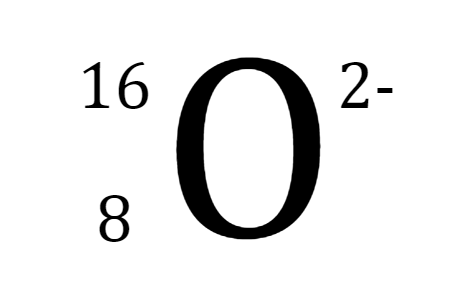
Which is the correct Lewis Structure for oxygen?

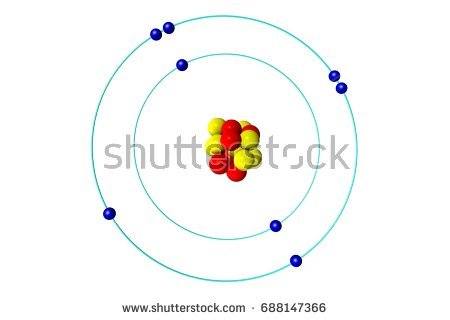
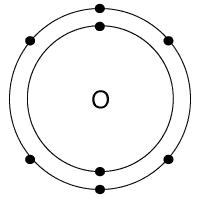

Is this molecule polar or nonpolar?
polar
nonpolar
What is the correct Lewis Dot Structure for ammonia NH3


13. What elements generally make a covalent bond?
metal and nonmetal
2 or more nonmetals
metal
none of the above
Which one of the following chloro-compounds is non-polar?
HCl
CCl4
CH3Cl
CHCl3
What charge would a potassium (K) ion have?
+1
-1
+2
-2
Which food is rich in iodine?


every cell requires Zinc to multiply
true
false
iron is a very important component in hemoglobin
false
true
you need ____milligrams of sodium per day
6,200
2
2,300
1,000,000,000
you need _____milligrams of calcium per day
2,000
1,500
1,000
none of the above
which food is high in potassium
potato
bread
chicken
possum
a deficiency in potassium could lead to what condition?
Hypolealemia
an ice cream headache
xevophthalmia
rickeets
what mineral do you get most from yoghurt
potassium
calcium
sodium
zinc
which of these 4 are all minerals?
iron Zinc sodium b6
fibre vitamin c vitamin D vitamin A
b2 b6 sodium potassium
iron, zinc, sodium, potassium

What is the atomic number for Hydrogen (H)?
1
2
3
4

What is the atomic symbol of the given element?
(a)
Vertical columns on the periodic table are called ___?
groups
periods
rows
families

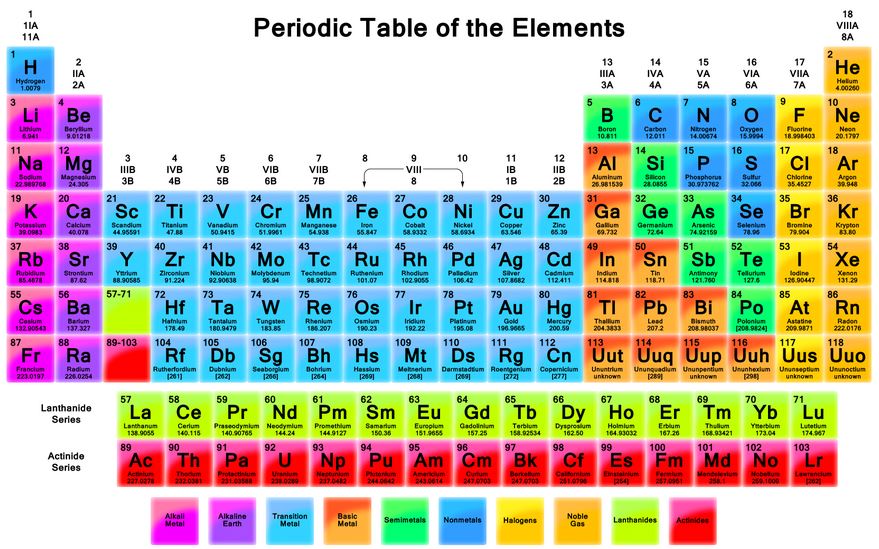
Which color on the image of the periodic table corresponds with the halogens.
red
black
blue
orange
Which color on the image of the periodic table corresponds with the noble gases.
red
black
blue
orange
the name of this compaund C4H10
METHANE
HEXENE
BUTANOIC ACID
BUTANE
What functional group is -OH
Hydroxyl
Carboxyl
Amino
Carbonyl Ketone

Classify the compound based on the functional group present.
aldehyde
ketone
alcohol
carboxyl
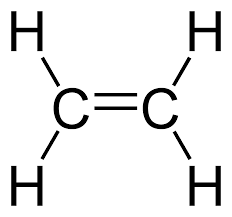

Classify the compound based on the functional group present.
alkane
alkene
alkyne
aromatic

Identify the functional groups present in this compound.
amine
amide
ether
ester

-COO is the functional group for...
alcohols
esters
carboxylic acids
amides

What is the name of this compound?
propan-2-al
propanane
propanone
propanal

What is the name of this compound?
ethanol
ethanal
ethanone
methanal
Carbon has 4 valence electrons. What is the valence configuration?
1s2 p2
2s2 p2
3s2 p2
4s2 p2

What is the IUPAC name of the product from the reaction of butanol and methanol?
methoxy butane
butanoic acid + H2O
1,5-pentanodiol
water
What is the "ending" used in alcohols?
al
ol
oilo
alco
If you have a carbon chain of 7 carbons, What is the name?
eptano
hexano
heptano
hebtano
The following functional group correspond to :
R - O - R'
Ester
aldehido
éter
cetona

