
 Worksheets
Collision Theory & Reaction Rates 2526
Total questions: 97
Worksheet time: 2hrs 37mins
What criteria must be met for reactant collisions to result in a successful product?
The reactants must collide with each other
The reactants must collide with enough energy and be in the right positions
The reactants must have enough energy to form the activated complex
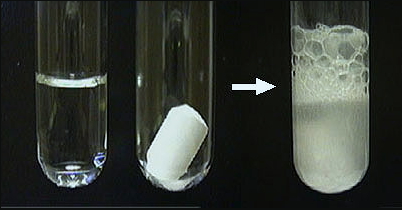
How could we make this reaction happen more quickly?
Decrease the concentration of the acid
crush the chalk to increase the surface area
Put the test tube in an ice bath
When surface area is decreased the rate of reaction...
Decreases, because there are LESS possible sites for correct collisions
Increases, because there are LESS possible sites for correct collisions
Decreases, because there are MORE possible sites for correct collisions
Increases, because there are MORE possible sites for correct collisions
Which has more surface area?
Large chunks of chalk
Cube of sugar
Powdered sugar
Small chunks of sugar
A temperature increase causes the particles ......
to slow down
move faster
collide higher
in the right order
How does a catalyst work in speeding up a reaction?
By lowering the activation energy of reaction
by giving them more energy
by making them more available
What is the rate of reaction?
How much energy is needed for a reaction to occur.
The energy required to break a bond.
The time it takes for a reaction to occur.
Collision Theory
Which of the following increase the reaction rate?
less surface area
lower temperature
increased concentration

Suppose you held a lighted match to a solid hunk of wood and another match to a pile of wood shavings. Which form of wood will catch fire more easily?
Wood shavings because of larger surface area.
Wood chunk because of smaller surface area
Wood chunk because of larger surface area.
Wood shavings because of smaller surface area.
What is the rate of reaction?
The time it takes for a reaction to occur.
How much energy is needed for a reaction to occur.
The energy required to break a bond.
Collision Theory

What factors affect rate of reaction?
Temperature, Pressure, Concentration and Surface area
Temperature, Concentration, Pressure and Energy
Surface Area, Concentration, Energy and Pressure
Pressure, Surface area, Density and Energy

The minimum amount of energy that reacting (colliding) particles need to react is called_________ _________.
activation energy
colliding energy
kinetic energy
maximum energy

As a reaction proceeds, the concentration of reactants will _______ and the concentration of products will ________.
decrease, increase
increase, decrease
increase, increase
decrease, decrease
A reactants temperature is increased. What happens?
more collisions occur
the same number of collisions occur
greater collision energy
less collision energy
the same collision energy
A reactants concentration is increased. What happens?
more collisions occur
the same number of collisions occur
greater collision energy
less collision energy
the same collision energy
What happens to reaction rate when temperature is decreased?
it increases
it decreases
it stays the same.
The higher the temperature a substance has the
more energy it has
less energy it has
A log is burning in a campfire. If the concentration of oxygen reaching the log is increased, what will happen to the reaction rate?
reaction rate decreases
reaction rate increases
reaction rate remains the same
What happens to reaction rate when a reactants concentration is increased?
it increases
it decreases
it remains the same
A substance that increases the rate of a chemical reaction without itself undergoing any permanent chemical change.
catalyst
products
reactants
chemical reaction
The minimum quantity of energy which the reacting species must possess in order to undergo a specific reaction.
collision theory
activation energy
reaction rate
chemical reaction
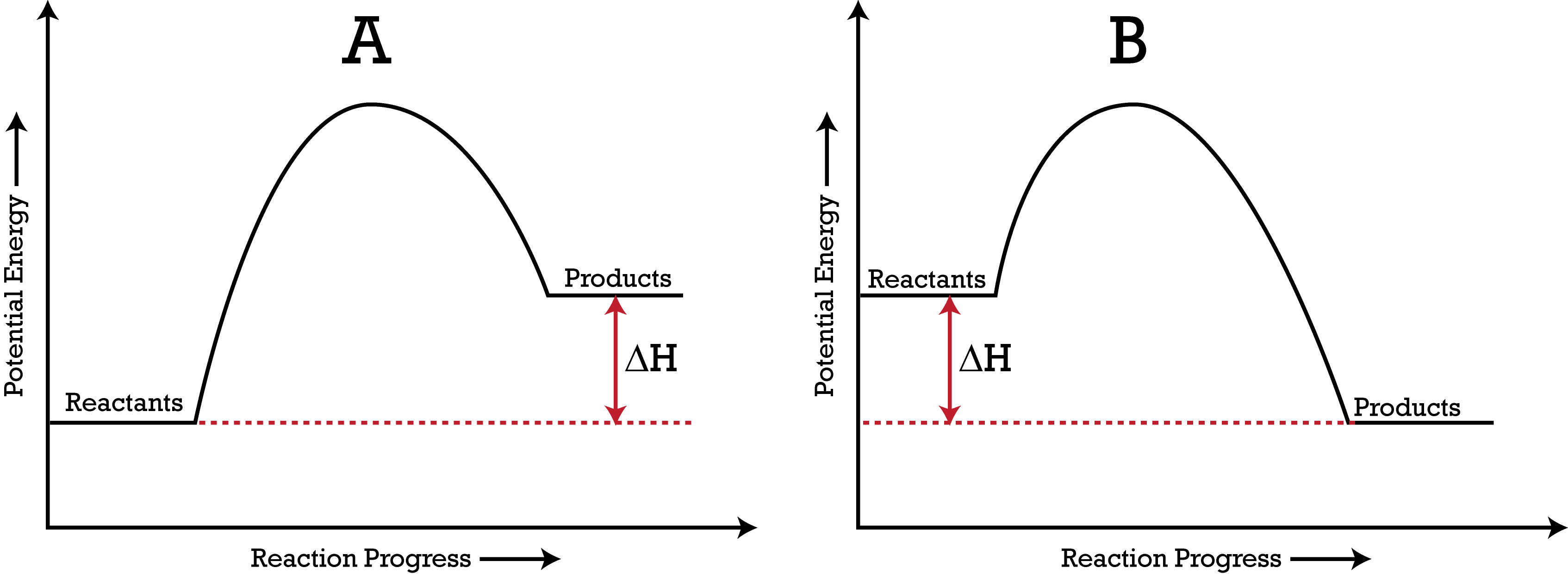
Which PE Diagram represents an endothermic reaction?
A
B
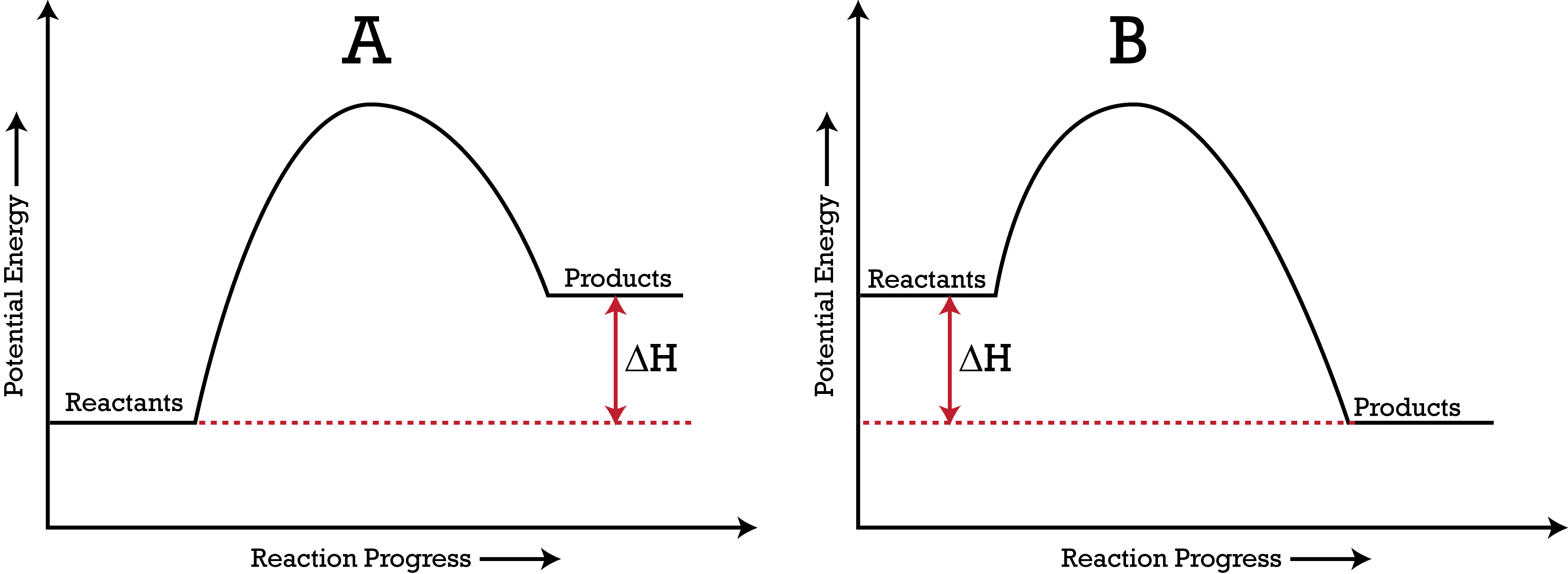
Which PE Diagram represents an exothermic reaction?
A
B
What is the purpose of a catalyst?
Helps to slow down a reaction
Raises the activation energy
Lowers the activation energy
Is consumed by the reaction
Increasing the temperature of your solution will.......
Not affect the rate of reaction.
Speed up the rate of reaction
Slow down the rate of reaction
Decreasing the concentration of a substance will usually........
Slow down the reaction
Speed up the reaction
Have no affect on the reaction
If you shrink the container size that your gas substance is in what will happen?
The reaction rate will stay the same
The reaction rate will speed up
The reaction rate will slow down
What instrument would you use to detect an endothermic or exothermic reaction?
triple beam balance
ruler
thermometer
Exo means out or ________.
absorbed
released
Endo means in or _______.
absorbed
released
As the frequency of ______________ increases, the rate of reaction increases.
Time
Reactions
Collisions
Reactants
Increasing the temperature gives particles more __________.
Time
Energy
Space
Frequency
Grinding a effervescent tablet into powder increases the rate of reaction due to increased
concentration
surface area
temperature
reactants
Suppose you held a lighted match to a solid hunk of wood and another match to a pile of wood shavings. Which form of wood will catch fire more easily?
Wood shavings because of larger surface area.
Wood chunk because of smaller surface area
Wood chunk because of larger surface area.
Wood shavings because of smaller surface area.

What is collision theory?
Molecules must collide in the correct orientation with enough energy to bond.
Molecules need enough energy to collide and react.
Atoms constantly collide and react.
The minimum energy needed for atoms to react
What is the rate of reaction?
The time it takes for a reaction to occur.
How much energy is needed for a reaction to occur.
The energy required to break a bond.
Collision Theory
What factors affect rate of reaction?
Temperature, Pressure, Concentration and Surface area
Temperature, Concentration, Pressure and Energy
Surface Area, Concentration, Energy and Pressure
Pressure, Surface area, Density and Energy
The minimum amount of energy that reacting (colliding) particles need to react is called_________ _________.
activation energy
colliding energy
kinetic energy
maximum energy
As a reaction proceeds, the concentration of reactants will _______ and the concentration of products will ________.
decrease, increase
increase, decrease
increase, increase
decrease, decrease
A reactants temperature is increased. What happens?
more collisions occur
the same number of collisions occur
greater collision energy
less collision energy
the same collision energy
A reactants concentration is increased. What happens?
more collisions occur
the same number of collisions occur
greater collision energy
less collision energy
the same collision energy
What happens to reaction rate when temperature is decreased?
it increases
it decreases
it stays the same.
The higher the temperature a substance has the
more energy it has
less energy it has
How does a catalyst work in speeding up a reaction?
By lowering the activation energy of reaction
by giving them more energy
by making them more available
A log is burning in a campfire. If the concentration of oxygen reaching the log is increased, what will happen to the reaction rate?
reaction rate decreases
reaction rate increases
reaction rate remains the same
What happens to reaction rate when a reactants concentration is increased?
it increases
it decreases
it remains the same
A substance that increases the rate of a chemical reaction without itself undergoing any permanent chemical change.
catalyst
products
reactants
chemical reaction
The minimum quantity of energy which the reacting species must possess in order to undergo a specific reaction.
collision theory
activation energy
reaction rate
chemical reaction
What criteria must be met for reactant collisions to result in a successful product?
The reactants must collide with each other
The reactants must collide with enough energy and be in the right positions
The reactants must have enough energy to form the activated complex
How could we make this reaction happen more quickly?
Decrease the concentration of the acid
crush the chalk to increase the surface area
Put the test tube in an ice bath
When surface area is decreased the rate of reaction...
Decreases, because there are LESS possible sites for correct collisions
Increases, because there are LESS possible sites for correct collisions
Decreases, because there are MORE possible sites for correct collisions
Increases, because there are MORE possible sites for correct collisions
Which has more surface area?
Large chunks of chalk
Cube of sugar
Powdered sugar
Small chunks of sugar
A temperature increase causes the particles ......
to slow down
move faster
collide higher
in the right order
How does a catalyst work in speeding up a reaction?
By lowering the activation energy of reaction
by giving them more energy
by making them more available
What is the rate of reaction?
How much energy is needed for a reaction to occur.
The energy required to break a bond.
The time it takes for a reaction to occur.
Collision Theory
Which of the following increase the reaction rate?
less surface area
lower temperature
increased concentration
As a reaction proceeds, the concentration of reactants will _______ and the concentration of products will ________.
increase, decrease
increase, increase
decrease, decrease
decrease, increase
What effect does chopping vegetables have on their cooking time and why? (using principles of collision theory)
Chopped vegetables are at a higher temperature and therefore take less time to cook
Chopped vegetables have catalysts and therefore take less time to cook
Chopped vegetables have increased surface area and therefore take less time to cook
Chopped vegetables are more concentrated and therefore take more time to cook
Which has more surface area?
Large chunks of chalk
Cube of sugar
Powdered sugar
Small chunks of sugar
A temperature increase causes the particles ......
to slow down
move faster
collide higher
in the right order
Catalysts permit reactions to proceed along a ___________energy path.
lower
higher
magnetic
psycho's
Smaller particle size allows for a _________ surface area to be exposed for the reaction.
larger
smaller
rectangular
spherical
Increasing the ____ causes the particles (atoms
or molecules) of the reactants to move more quickly so that
they collide with each other more frequently and with more
energy.
Catalyst
Surface Area
Temperature
Concentration
________ is the measure of how much area of an
object is exposed.
Surface Area
Catalyst
Temperature
Concentration
Grains of sugar have a greater _______ than a solid cube of
sugar of the same mass, and therefore will dissolve quicker in water.
Surface Area
Catalyst
Temperature
Concentratrion
Pick the TWO (2) options that will INCREASE the rate of a reaction.
Reducing Heat
Adding Catalyst
Adding Heat
Removing Catalyst
Which of the following will lower the rate
of reaction?
adding an enzyme to the reaction
decreasing the temperature from 40°C to
10°C
breaking a chunk of calcium up into
smaller pieces
increasing the amount of solute
dissolved in a solution

