wayground logo

Free Printable Worksheets

Font size

S
M
L
XL
Worksheets

Final Review

Total questions: 65

Worksheet time: 1hrs 5mins

Name
Class
Date
1.
Matter is anything that takes up space
a)
True
b)
False
2.
Some changes of matter from one state to another are:
a)
Solid and liquid
b)
Gas and solid
c)
solid, liquid and gas
d)
Solid
3.
Iron + oxygen = rust is an example of a ___________.
a)
physical property/change
b)
chemical property/change
c)
mass
d)
volume
4.
Look at this image.  Which object has the LOWEST density in water? How
a)
The Ping Pong Ball because it floats to the top 
b)
The bolt because it has sunk to the bottom
c)
The soda cap because it is not just full of air like the Ping Pong ball
5.
Jack has a rock. The rock has a mass of 14g and a volume of 2cm3. What is the density of the rock?
a)
7 mL
b)
7 g/cm3
c)
28 g/cm3
d)
1/7 g/cm3
6.

All matter is made of what...

a)

energy

b)

atoms

c)

electrons

d)

compounds

7.

The positive particles of an atom are

a)

electrons

b)

positrons

c)

neutrons

d)

protons

8.

The central region of an atom where its neutrons and protons are is its

a)

nucleus

b)

electron cloud

c)

core

d)

center

9.

What does the 1.00794 stand for?

a)

Hydrogen

b)

atomic number

c)

atomic mass

d)

atomic explosion

10.

In the modern periodic table, elements are arranged by:

a)

atomic mass

b)

atomic number

c)

valence electrons

d)

number of isotopes

11.

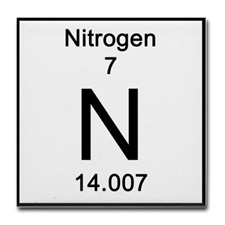
What is the number of protons that the element in this image contain?

a)

14

b)

7

c)

15

d)

18

12.
What is the atomic mass of "F"
a)
9
b)
18
c)
17
d)
19
13.

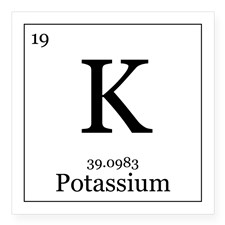
How many neutrons are in the atom "K"?

a)

7

b)

2

c)

39

d)

20

14.
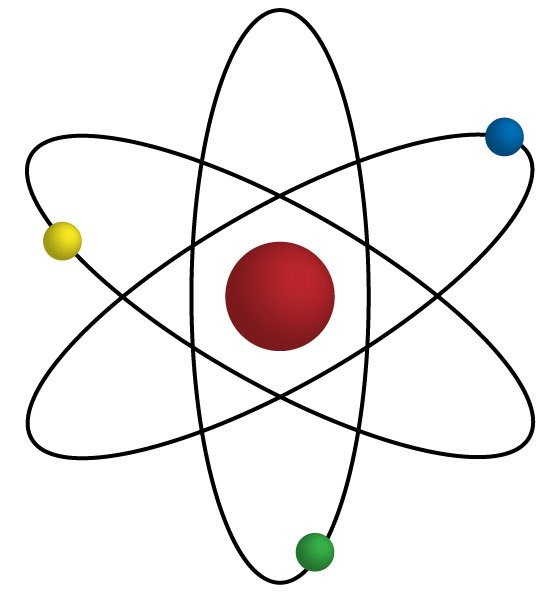
What are the 3 particles that make-up the atom?
a)
protons, neutrons, and isotopes
b)
neutrons, isotopes, and electrons
c)
positives, negatives, and electrons
d)
protons, neutrons, and electrons
15.

Ionic bonds form between ---

a)

nonmetals.

b)

metals and nonmetals.

16.

Covalent bonds form between ---

a)

nonmetals.

b)

metals and metals

c)

metals and nonmetals

17.

What are valence electrons?

a)

sum of the protons and neutrons

b)

protons minus electrons

c)

electrons in the inner shells

d)

electrons in the outer shell

18.

Atoms that gain an electron have an electric charge of ---

a)

-1.

b)

-2.

c)

+1.

d)

+2.

19.

Which of the following is NOT a covalent bond?

a)

K2S

b)

H2O

c)

I2

d)

CO2

20.

Which of the following is NOT an ionic bond?

a)

NH3

b)

KCl

c)

K3N

d)

NaCl

21.

A proton has a ___ charge.

a)

positive

b)

negative

c)

no charge

d)

it depends

22.

According to the Octet Rule, atoms of elements react with each other in order to attain ____ electrons in their outermost energy level or shell.

a)

2

b)

4

c)

8

d)

10

23.

An atom of Neon complies with the Octet Rule because it has ___ electrons in its outer shell.

a)

10

b)

8

c)

2

d)

7

24.

A substance that is formed as the result of a chemical reaction is a __________________

a)

Product

b)

Reactant

c)

Starters

d)

Enders

25.

Which of the following is an example of a chemical change?

a)

water freezes to form ice

b)

sugar dissolves in water

c)

gasoline burns in a car engine

d)

a piece of metal expands when it is heated

26.

A change in the shape of an object is an example of _________________.

a)

a chemical change

b)

energy

c)

an endothermic change

d)

a physical change

27.
a copper penny turning greenish after a few years.
a)
Chemical Change
b)
Physical Change
28.
How many Al atoms are in this compound?         4Al2O3
a)
2
b)
8
c)
6
d)
4
29.
How many F atoms are in this compound?
6MgF2 
a)
2
b)
6
c)
8
d)
12
30.
Balance this equation:
MgCl2 --> Mg4+ Cl2
a)
It's already balanced.
b)
4MgCl2 --> Mg4+ 4Cl2
c)
4MgCl2 --> Mg4+ 5Cl2
31.
Balance this equation:
 2Li + Cl2 -> LiCl
a)
2Li + Cl2 -> 4LiCl2
b)
2Li + Cl2 -> LiCl2
c)
2Li + Cl2 -> 2LiCl
32.
Name the part in red:

H2 + O2 -> H2O
a)
Coefficient
b)
Product
c)
Yield
d)
Subscript
33.
Name the part in red:

H+ O2 -> H2O
a)
Coefficient
b)
Product
c)
Reactant
d)
Subscript
34.
Name the part in red:

H+ O-> H2O
a)
Coefficient
b)
Product
c)
Reactant
d)
Subscript
35.

Which type of reaction is:

2 NaBr + Ca(OH)2 → CaBr2 + 2 NaOH

a)
Synthesis
b)
Single Displacement
c)
Double Displacement
d)
Combustion
36.
Which type of reaction is: C2H4 + 3 O2 → 2 CO2 + 2 H2O
a)
Synthesis
b)
Decomposition
c)
Single Displacement
d)
Combustion
37.

Which type of reaction is:

2 NH3 + H2SO4 → (NH4)2SO4
a)
Synthesis
b)
Decomposition
c)
Single Displacement
d)
Double Displacement
38.
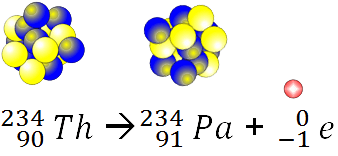
Which type of nuclear radiation is being emitted here?
a)
Alpha
b)
beta
c)
gamma 
d)
none
39.
Has the symbol
a)
Alpha
b)
Beta 
c)
Gamma
40.

Which of these is a property of acidic solutions?

a)

they taste sour

b)

they feel slippery

c)

they are in many cleaning products

d)

they taste bitter

41.

pH 3

a)

Weak

b)

Strong

c)

Acid

d)

Base

42.

pH 14

a)

Weak

b)

Strong

c)

Acid

d)

Base

43.

What are the products of a neutralization reactions

a)

water

b)

salt

c)

acid

d)

base

44.
A car is driven for 3 hours. What else do you need to know to describe this car’s speed?
a)
the road the car in driven on
b)
the time of day
c)
the distance the car is driven
d)
the number of passengers in the car
45.
What is a force?
a)
a push or pull
b)
speed or acceleration 
c)
potential or kinetic energy
d)
balanced or unbalanced force
46.
When objects remain in the same place, it is called...
a)
gravity
b)
friction
c)
balanced force
d)
unbalanced force
47.
What is the force that causes everything to be pulled down to the Earth?
a)
friction
b)
gravity
c)
balanced
d)
unbalanced
48.

The formula to determine speed is

a)

change in velocity/change in time

b)

change in distance/change in time

c)

time/distance

d)

distance/time

49.

__________________ changes when the speed or the direction of the motion of the object changes.

a)

distance

b)

reference point

c)

acceleration

d)

velocity

50.

The distance between your final position and your starting position is displacement.

a)

true

b)

false

51.
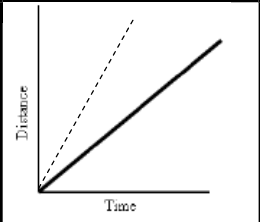
What does this graph represent?
a)
Constant Speed
b)
Acceleration
c)
Not moving
52.
How long did it take this object to travel 10 m?
a)
0 s
b)
10 s
c)
15 s
d)
20 s
53.
What does this graph represent?
a)
Constant speed
b)
Acceleration
c)
Not moving
54.

The graph shows

a)

positive velocity that's getting faster

b)

negative velocity that's getting faster

c)

negative velocity that's getting slower

d)

positive velocity that's getting slower

55.
When two objects rub together, what force do they produce
a)
Gravity
b)
Air resistance
c)
Friction
d)
Water resistance
56.
What does the strength of gravity between two objects depend upon?
a)
Mass & distance
b)
Mass & weight
c)
Gravity & inertia
d)
Inertia & mass
57.
If a 10 kilogram object accelerates suddenly at 15 m/s^2, how much force was applied to the object?
a)
150 Newtons
b)
15 Newtons
c)
150 kilograms
d)
100 kilograms
58.
If a force of 50 Newton's was applied to an object with a mass of 500 grams, what will the object's acceleration be?
a)
10 m/s^2
b)
.1 m/s^2
c)
100 m/s^2
d)
1 m/s^2
59.
Rockets are launched into space using jet propulsion where exhaust accelerates out from the rocket and the rocket accelerates in an opposite direction.
a)
Newton's 1st Law
b)
Newton's 2nd Law
c)
Newton's 3rd Law
d)
None of them
60.
A picture is hanging on a wall and does not move.
a)
Newton's 1st Law
b)
Newton's 2nd Law
c)
Newton's 3rd Law
d)
None of them
61.
Pushing a child on a swing is easier than pushing an adult on the same swing, because the adult has more inertia.
a)
Newton's 1st Law
b)
Newton's 2nd Law
c)
Newton's 3rd Law
d)
None of them
62.

Which of the following is a diatomic molecule?

a)

N

b)

S

c)

P

d)

C

63.
Electrical power can be calculated using
a)
Resistance x Voltage
b)
Voltage x Current 
c)
Voltage ÷ Current
64.
The voltage supplied to a circuit is 17 V and the current running through is 10 A. What is the power generated?
a)
170 W
b)
170 A
c)
1.7 V
d)
1.7 W
65.
Calculate the electric power of an electrical appliance in which 10 A of current is flowing through a resistor of 2 ohms.
 
Remember: V=IR and P=VI
a)
80 W
b)
200 W
c)
2.5 A
d)
22.5 KJ