
Font size
 Worksheets
Astronomy Unit Review
Total questions: 76
Worksheet time: 13hrs 40mins
The sun is an example of a _________.
planet
meteorite
star
comet
Get out your ESRT. Use the Characteristics of Stars Chart at the top of pg. 15 for questions 2-5. What color stars are the hottest?
red
yellow
white
blue
Which star is about 3000 degrees Kelvin and 100,000 times brighter than the Sun. *You must spell it correctly!
(a)
Which star has a higher luminosity and a lower surface temperature than the Sun?
Rigel
Barnard’s Star
Alpha Centauri
Aldebaran
Which table below correctly contrasts the temperature and luminosity of each star with our Sun?


Which of the following is the correct order from smallest to the largest?
universe, solar system, galaxy
galaxy, solar system, universe
solar system, universe, galaxy
solar system, galaxy, universe
What is the correct placement of the objects in our solar system?
The sun revolves around the planets and the moons rotate around the sun
The planets revolve around the sun and the moons revolve around the planets.
The object at the center of our solar system.
Sun
moon
orbit
axis
A galaxy is a collection of
planets
moons
millions or billions of stars
The galaxy we are a part of is called:
Milky Way
Andromeda
Whirlpool
Sombrero
Which group of planets are referred to as "terrestrial"?
Mercury, Venus, Earth, Mars
Jupiter, Saturn, Uranus, Neptune
Which group of planets are referred to as "jovian"?
Mercury, Venus, Earth, Mars
Jupiter, Saturn, Uranus, Neptune
Which group of planets are closer to the Sun, smaller, and have higher densities?
Terrestrial
Jovian
Which planets are larger, have a longer periods of revolution, and are gaseous?
Terrestrial
Jovian
As distance from the Sun increases, period of revolution___________________
increases.
decreases.
remains the same.
What motion causes us to experience day and night?
Rotation
Revolution
Which planet has a mass approximately 17 times the mass of Earth?
Jupiter
Saturn
Uranus
Neptune
Where is our solar system located in the Milky Way galaxy?
Right in the exact center
just outside
on an arm- the orion arm (orion spur)
Which of the following objects is the biggest?
Galaxy
Star
Planet
Solar system
Which of the following objects is the biggest?
Star
Solar system
Planet
moon
Use the ESRT Electromagnetic Spectrum table at the bottom of pg. 14 for questions 22-26 Which electromagnetic wave has the shortest wavelength and the highest frequency?
Gamma Rays
Ultraviolet Rays
Radio Waves
X Rays
Which electromagnetic wave has the longest wavelength and lowest frequency?
Microwaves
Ultraviolet Rays
Infrared Waves
Radio Waves
What happens to wavelength as the frequency of a wave increases?
increase
stays the same
decreases
becomes faster
X-rays have a _____wavelength than gamma rays.
longer
shorter
Ultraviolet has a _____wavelength than infrared.
longer
shorter

What does the Big Bang theory suggest?
The universe was accidently dropped by a stork, burst open, and released all the matter of the universe.
the universe only exists because it's observed
The universe is expanding
The universe is collapsing
Which statement is true?
Galaxies are moving toward us.
Galaxies are moving away from us.
The universe is stationary.
None of the above

Is the object moving toward or away from Observer A
toward
away
Is the object moving toward or away from Observer B
toward
away
A shift to the red end of the visible spectrum from an object emitting light means the object is
moving toward Earth
moving away from Earth
not moving
RED shifted light has a
shorter wavelengths
longer wavelengths
BLUE shifted light has a
shorter wavelengths
longer wavelengths
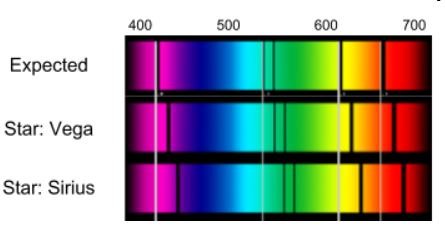
Study the spectrum in the picture. "Expected" is the spectrum here on Earth. The stars Vega and Sirius are.....
both moving away from us.
both moving towards us.
Vega is moving toward Earth and Sirius is moving away from Earth
Vega is moving away from Earth and Sirius is moving toward Earth.

Study the picture and look at the North Pole axis. What season is it in the Northern Hemisphere?
Summer
Winter
Spring
Fall

Study the picture. Look at the tilt of the North Pole axis. What season is it in the Northern Hemisphere?
Winter
Spring
Summer
Fall


The motion of a planet spinning (producing day and night) is called....
orbit
rotation
revolution
tide
The motion of a planet around the Sun (producing seasons)...
Revolution
Rotation
Period of Revolution
Period of Rotation

At which location is the planet traveling fastest?
A
B
At which location is the planet traveling slowest?
A
B
Which location shows perihelion?
A
B
Which location shows aphelion?
A
B
At which location will the Sun appear slightly smaller?
A
B
At which location will the Sun appear slightly larger?
A
B
As the distance of a planet from the Sun increases, it's orbital velocity____.
increases (travels faster)
decreases (travels slower)

The time it takes Earth to travel from C to D is___________ the time it takes Earth to travel from A to B.
shorter than
longer than
equal to

Indicate which of Kepler's Three Laws of Planetary Motion is shown.
Orbits are elliptical and the Sun is located at one focus.
An object orbiting another object sweeps over equal areas of an ellipse in equal amounts of time.
There is a proportional relation between a planet's period of revolution and its distance from the Sun.

Indicate which of Kepler's Three Laws of Planetary Motion is shown.
Orbits are elliptical and the Sun is located at one focus.
An object orbiting another object sweeps over equal areas of an ellipse in equal amounts of time.
There is a proportional relation between a planet's period of revolution and its distance from the Sun.
A planet's orbit is always elliptical. Calculate the eccentricity for the following planet's orbit. Given: Distance between F1 and F2 is 4.5 and the length of the major axis is 12 No units, no rounding!
(a)

Indicate which of Kepler's Three Laws of Planetary Motion is shown.
Orbits are elliptical and the Sun is located at one focus.
An object orbiting another object sweeps over equal areas of an ellipse in equal amounts of time.
There is a proportional relation between a planet's period of revolution and its distance from the Sun.
The moon ____________ around the Earth.
revolves
rotates
up
down
At any given time, how much of the moon's total surface is illuminated by the Sun?
half
a quarter
an eighth
full
Why does the moon shine?
it has its own light
it reflects Earth's light
it reflects the Sun's light
Which NASA missions brought humans to the moon?
Hubble
Mercury
Apollo
Voyager

What would we see from Earth when the moon is in position 1 ?


What would we see from Earth when the moon is in position 2 ?
What would we see from Earth when the moon is in position 3 ?
What would we see from Earth when the moon is in position 4 ?


What would we see from Earth when the moon is in position 5 ?
What would we see from Earth when the moon is in position 6 ?


What would we see from Earth when the moon is in position 7 ?
What would we see from Earth when the moon is in position 8 ?


In which TWO positions do Neap Tides occur? Hint: Neap tides do not have as dramatic a change High and Low tide. The pull of gravity is weaker.
1
3
5
7
In which TWO positions do Spring Tides occur? Hint: Spring tides have a very dramatic change in High and Low tide. The pull of gravity is strong.
1
3
5
7


Rochester, NY will be in the zone for a Total Solar Eclipse on
June 16, 2022
April 8, 2024
August 3, 2023
September 9, 2021
Eclipses do not occur every month because the Moon's
orbit is inclined to Earth's orbit
period of revolution is 27.3 days
period of rotation and period of revolution are the same
rate of rotation is 15º each hour

What type of eclipse is shown?
Lunar Eclipse
Solar Eclipse

What type of eclipse is shown?
Lunar Eclipse
Solar Eclipse

