
 Worksheets
Unit 6 Test Review Practice
Total questions: 78
Worksheet time: 58mins
Put the following actions in order: DNA replicates, cell grows, cell divides, cell prepares for mitosis.
DNA replicates, cell grows, cell prepares for mitosis, cell divides
cell grows, cell prepares for mitosis, DNA replicates, cell divides
cell grows, DNA replicates, cell prepares for mitosis, cell divides
DNA replicates, cell prepares for mitosis, cell grows, cell divides
Which statement below desribes the events during G2 of Interphase?
The cell grows, develops, and makes new proteins
The DNA replicates to form a new set of identical chromosomes
The cell grows, makes new organelles, and prepares for mitosis
the nucleolus disappears and the nuclear envelope disintegrates
In which part of Interphase are the chromosomes replicated?
G0
G1
S
G2
During which stage of the cell cycle does the nucleus divide?
interphase
mitosis
endocytosis
cytokinesis
Which is not a phase of the cell cycle?
Interphase
Mitosis
Cytokinesis
Duplication
Spinal cord injuries are difficult to treat because damaged nerce cells do not regenerate. Which of the following most accurately explains why damaged nerve cells no longer regenerate?
Mature nerve cells are in a resting state; the no longer divide during mitosis
Nerve damage disrupts the cell cycle at the G1 phase
Nerve damage disrupts the cell cycle at the S phase
Nerve damage prevents centrioles from being synthesized
Which stage of the cell cycle is MOST critical for ensuring that daughter cells are identical?
G1
S
Prophase
G2
Select all stages of interphase?
G1
S
G2
Mitosis
What best explains the role of cellular division?
to grow, develop, and repair tissue
to eliminate unneeded cells
to produce egg and sperm cells
to eliminate waste from your body
In which stage of the cell cycle does the cell split into two?
Mitosis
G1
Cytokinesis
S
_____ is the uncontrolled growth of cells, often resulting in a tumor or mass of abnormal cells
Cancer
Apoptosis
Radiation
Apoptosis is
programmed cell death
mysterious cell death
programmed cellular mutation
mysterious cellular mutation
If you look at a cell under a microscope, which phase is it MOST likely to be in?
Cytokinesis
M phase
Interphase
G1 Phase
The correct sequence of mitosis:
metaphase, anaphase, telophase, prophase
prophase, metaphase, anaphase, telophase
prophase, anaphase, metaphase, telophase
telophase, metaphase, prophase, anaphase
What is cell differentiation?
Process by which cells produce more cells
Process by which cells become specialized
Process by which cells become unspecialized
Process by which cells die
What is one goal of cellular differentiation/specialization?
To create specialized cells to help organism maintain homeostasis.
To many cells.
To make stem cells
to make single celled organisms
Stem cells are
cells that grow uncontrollably
undifferentiated and can be any type of cell
never go through cell division
only found in embryos

what is the role of stem cells in the body
fight against infection
provide specialized roles in the body
used for fertility treatment
they produce new specialized cells in the body to replace old cells that are used up
Name the cellular process responsible for repair, growth, and development in living organisms.
meiosis
mitosis
transcription
translation
Stem cell research is controversial because in involves?
social issues
ethical issues
educational issues
economical issues
What is the difference between embryonic stem cells and adult stem cells?
Embryonic stem cells can differentiate into more cell types than adult stem cells
Adult stem cells are pluripotent, just like embryonic stem cells
Adult stem cells can differentiate into more cell types than embryonic stem cells
Adult stem cells grow bigger than embryonic stem cells
Why are scientists interested in studying stem cells?
They never die.
They come from the brain stem.
They can be transplanted into monkeys.
They can become any type of cell.
What is the importance of apoptosis?
To eliminate damaged or unnecessary cells
To create specialized cells
To produce two identical cells
To cause uncontrolled cell growth
DNA replication is important for mitosis because...
it results in a variety of traits amongst the same type of cells
it ensures more genetic material in the strongest cells
it ensures both cells will have identical, correct genetic information
it creates variety amongst cells
A substance that is known to cause cancer is called a
carcinogen
retrovirus
pathogen
paramecium
Which of these is a tumor that is noncancerous and does not spread?
Malignant
Benign
When cancer spreads to other tissues of the body, it is called...
Metastasis
Invasiveness
Angiogenesis
Chemotherapy
A benign tumor differs from a malignant tumor in that a benign tumor
is cancerous
spreads from the original site
does not metastisize
never causes health problems
________________is a critical point where stop and go signals can regulate the cycle
Metastasis
Checkpoint
Malignant
Benign
Which of the following are checkpoints that the cell must pass before dividing?
Have enough nutrients
Be large enough to divide
Have correctly copied all DNA
All of the above
Identical chromosomes are checked for attachment to the spindle fibers during which cell cycle checkpoint?
G1
G2
M
G0
A mutation in a tumor suppressor gene or a proto-oncogene would cause which of the following?
A cell will remain in G0.
A cell will perform apoptosis.
The cell cycle would not be regulated.
The chromosomes will not attach properly to spindle fibers.

Name the phase:
Anaphase
Telophase
Metaphase
Prophase

What is the next phase of mitosis? What phase comes AFTER the one pictured here...?
Prophase
Metaphase
Anaphase
Telophase

Prophase
Interphase
Anaphase
Telophase

Anaphase
Cytokinesis
Telophase
Metaphase

Anaphase
Cytonkinesis
Interphase
Prophase

Cytokinesis
Anaphase
Telophase
Prophase
The phase in mitosis where chromosomes move away and are pulled apart by spindles to opposite sides of the cell.
prophase
anaphase
metaphase
telephase
A chromatid is attached to a spindle fiber by the
nucleolus
deep furrow
centromere
centriole
the two halves of the doubled chromosome structure
centromeres
sister chromatids
spindle
tissues

In mitosis, the two resulting cells are
different from the starting cell and identical to each other.
different from the starting cell and different from each other.
identical to the starting cell and different from each other.
identical to the starting cell and identical to each other.

What is the name of the structure labeled X?
Centriole
Centrosome
Chromatid
Chromosome
A turkey sperm cell contains 80 chromosomes. How many chromosomes will be found in a turkey muscle cell?
40
80
120
160
Which of the following cells is diploid?
sperm cell
egg cell
gamete
zygote
Beaver muscle cells have 48 chromosomes. How many chromosomes would be found in a beaver egg cell?
96
48
24
12
Which of the following occurs only in meiosis?
crossing over between homologous chromosomes
pulling apart of sister chromatids
splitting of cytoplasm
repication of DNA in interphase
Which of the following could be produced by meiosis?
muscle cell
nerve cell
gamete
zygote
A guinea pig cell has 64 chromosomes. After mitosis, each daughter contains ___ chromosomes.
128
64
32
16
Why is meiosis important for sexual reproduction?
It allows the zygote formed from fertilization to have triple the chromosome number of the organism.
It allows gametes to have twice the original number of chromosomes of the organism.
It allows gametes to have half the original number of chromosomes of the organism.
It allows the zygote formed from fertilization to have half the original number of chromosomes of the organism.

Identify the following stage of the life cycle of the cell in the picture.
interphase
prophase
metaphase
anaphase
telophase

Identify the following stage of the life cycle of the cell in the picture.
interphase
prophase
metaphase
anaphase
telophase

Identify the following stage of the life cycle of the cell in the picture.
interphase
prophase
metaphase
anaphase
telophase

Identify the following stage of the life cycle of the cell in the picture.
interphase
prophase
metaphase
anaphase
telophase

Identify the following stage of the life cycle of the cell in the picture.
interphase
prophase
metaphase
anaphase
telophase

Crossing over occurs in which phase of Meiosis ?
metaphase I
anaphaseII
telophaseII
prohase I
A fertilized egg is called
egg
lettuce
zygote
sperm

Which letter(s) in the diagram correspond to cells that are haploid?
A
B
C
A and B

What is one of the advantages, why is it better to reproduce sexually versus asexually?
survival of the fittest
overproduction
genetic variation
cloning

Identify the phase of Meiosis:
Metaphase I
Metaphase II
Anaphase I
Anaphase II

Identify the phase of Meiosis.
Telophase I
Telophase II
Metaphase I
Metaphase II

Is the following cell diploid or haploid?
Diploid
Haploid

Identify the phase of Meiosis.
Metaphase I
Metaphase II
Anaphase I
Anaphase II
What kind of cells are made in MEIOSIS?
Haploid Gametes
Diploid Somatic Cells
Skin Cells
Liver Cells
The failure of one or more pairs of homologous chromosomes or sister chromatids to separate "normally" during meiosis is called _____________________.
nondisjunction
anaphase I
nondiploidy
karyotype
Nondisjunction can result in
trisomy conditions
monosomy conditions
additional sex chromosomes
all of these
Chromosome pairs 1-22 are referred to as
sex chromosomes
sister chromatids
a karyotype
autsomes

Chromosomes that are paired by size and content are called _______ chromosomes.
homeostasis
homologous
matching
sister
Body cells are also called _________ cells.
normal
prokaryotic
pathogens
somatic

Cells that contain 2 sets of chromosomes are called _________ (2n).
diploid
haploid
triploid
polyploid

The 2 female sex chromosomes are ___.
XY
XX

The 2 male sex chromsomes are _____.
XY
XX
SELECT ALL THAT APPLY: What is true for the two "sides" of the X of a chromosome?
Each side is called a sister chromatid
Each side is called a homologous chromosome
Each side is composed of identical DNA
Each side is composed of different DNA
A person with Turner syndrome has only one X chromosome. This means one of their gametes was missing a chromosome.
Which of the following is why gametes sometimes lack a complete chromosome?
Incomplete dominance
Nondisjunction
Inversion mutation
Substitution mutation
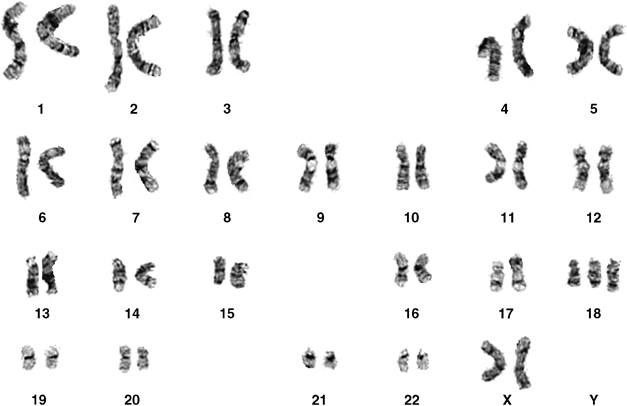
What is the chromosomal condition of the individual whose karyotype is seen in the image?
Monosomy X (Turner's Syndrome)
Trisomy 21 (Down's Syndrome)
Trisomy 13 (Patau Syndrome)
Trisomy 18 (Edwards's Syndrome)
The process of oogenesis results in
one egg cell and three polar bodies
4 sperm cells
one sperm cell and three polar bodies
4 egg cells
If chromosomes fail to separate properly during either anaphase I or ii, a chromosomal error occurs known as
disjunction
crossing over
non-disjunction
synapsis

Which of the following sex cells contains stored food for the developing embryo?
sperm cells
egg cells
all of the above
none of the above

