
 Worksheets
Year 9 - Biology A
Total questions: 75
Worksheet time: 2hrs 16mins

Which type of cell is this?
Animal
Plant
Bacterial
Virus
Which process involves the release of energy from food substances in all living cells?
breathing
nutrition
respiration
digestion


What is a stem cell?
a meristem
a zygote
a differentiated cell
an unspecialised cell
What occurs during stage 2 of the cell cycle?
the number of sub-cellular structures increases
the nucleus divides
the DNA replicates
the cell divides
What is meant when you say that a cell has differentiated?
cells have become enlarged
cells have specialised to complete a particular function
cells are unspecialised and can change to have any function
cells have undergone cell division by mitosis
A cell has four chromosomes.
During the cell cycle, how many chromosomes will the cell
have at the end of stage 1?
one
four
two
eight
At which stage of life does mitosis occur at a slower rate than cell death?
developing embryo
childhood
old age
adulthood


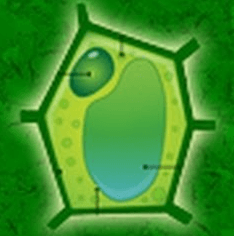


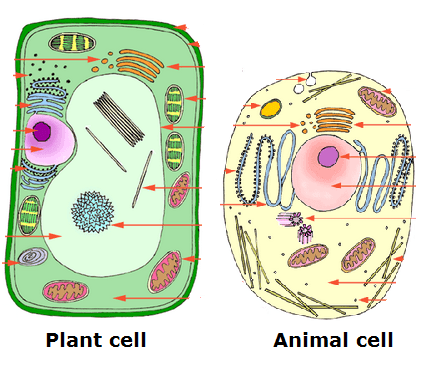
What distinguishes a plant cell from an animal cell? (How do you tell them apart) Hint: There's 3 ways (Check all 3)
Central Vacuole
Mitochondria
Cell Wall
Ribosomes
Chloroplasts
What do all living organisms have in common?
They all reproduce sexually.
They are all made of cells.
They all need blood to stay alive.
They are all made from chlorophyll.

The picture shows a piece of technology that has helped scientists.
Which of the following best explains how this piece of technology has helped scientists?
It has helped scientists to see other planets.
It has helped scientists to see other moons.
It has helped scientists see very large objects.
It has helped scientists see very small objects.
Which of these pictures most likely shows a plant magnified under a microscope?


Which is NOT something a scientist could observe using a microscope?
yeast cells budding into new cells
the organs of an organism
a thin slice of onion tissue
the cell walls of a plant leaf

This picture shows human skin viewed with a magnifying glass.
Which picture shows what the skin would look like under a microscope?


How many microns μm = 1 mm?
1,000
1,000,000
10,000
100,000

To calculate magnification of an electron micrograph we use......
magnification = image size x actual size
magnification = image size ÷ actual size
magnification = actual size ÷ field of view
magnification = ocular lens x objective lens

To calculate the image size of an electron micrograph if we use.....
Image size = Actual size x Magnification
Image size = Magnification ÷ Actual size
Image size = Actual size ÷ magnification
Image size = Magnification x Actual size

Josie measured the scale bar image to be 80 mm. What is the Magnification of this electron micrograph?
I = AM
160X
0.00625 X
0.16X
25,000X


Serena measured the image of one of the bacterial cells to be 32 mm. If the magnification of the image is 8,000X, what is the actual size of the bacterial cell?
4 μm
0.004 μm
256,000 μm
0.25 μm

What steps should Burt use follow to calculate the actual size of each bacterial cell?
Step 1: Calculate the magnification by measuring the scale bar image ÷ actual size
Step 2: Measure image of bacterial cell ÷ magnification
Step 1: Calculate the magnification by measuring the scale bar image x actual size
Step 2: Measure image of bacterial cell ÷ magnification
Step 1: Measure the image of the bacterial cell
Step 2: Divide the image size by the scale bar size
He can't, it is impossible to calculate

The scale bar of measures 3 mm but its actual size is 50 nm. What is the magnification of this image?
Remember: 1 mm = 1,000,000 nm
60,000X
60X
600X
6,000X

Why do we not use light microscopes to see things as small as viruses?
We cannot get enough light through the lenses to be able to see it
Viruses are too big to be seen with a light microscope
Electron microscopes are cheaper to use
Light microscopes don't let us see in color

How would we calculate magnification of these images?
Calculate Field of View (FOV)
Measure the images with a ruler then multiply by 1,000
Look at the scale bar and see what magnification it says
Measure the scale bar with a ruler and use the I=AM formula


Eyepiece = 10X
Objective lens = 55X
At the end of Mitosis, how many cells are there?
1
2
3
4
Where does Mitosis take place?
where growth and repair are happening
in your hair cells only
in your blood cells only

How many chromosomes are normally found in human body cells?
46
23
26
44
In which part of the body would the rate of mitosis
be happening the fastest?
the brain
the skin
the spinal cord
the eye
Which of these are smaller, simpler and contain bacteria cells?
Eukaryotes
Prokaryotes

