Wayground logo

Free Printable Worksheets

Font size

S
M
L
XL
Worksheets

Science- End of 5th Grade Review

Total questions: 45

Worksheet time: 23mins

Name
Class
Date
1.

A combination of two or more substances that can be easily separated and maintain their physical properties is called-

a)

a mixture

b)

a solution

c)

a mess

d)

a solvent

2.

Identify the things below by checking the boxes of things that are considered physical properties of matter.

a)

magnetism

b)

solubility

c)

density

d)

conductivity

e)

state of matter: solid, liquid and gas

3.

How do molecules of matter react when heat energy is added to them?

a)

they stop

b)

they speed up

c)

they slow down

d)

nothing happens

4.

What causes the day and night cycle on Earth?

a)

Rotation of the Sun

b)

Revolution of the Earth

c)

Gravitational pull from the moon

d)

Rotation of the Earth

5.

Sedimentary rocks may contain fossils.

a)

True

b)

False

6.

What are the three slow changes that can happen to Earth's surface?

a)

Weathering, Erosion and Flooding

b)

Weathering , Erosion and Deposition

c)

Weathering, Earthquakes, Volcanoes

d)

Weather and Climate

7.

The ability of a substance to dissolve is called...

a)

malleability

b)

ductility

c)

solubility

d)

conductivity

8.
The shaking of the Earth's crust caused by large pieces of rock underneath the Earth's surface moving against each other.
a)
Landslide
b)
Deposition
c)
Weathering
d)
Earthquake
9.
A huge piece of ice that slowly moves across the surface of the Earth and remains frozen during the entire year.
a)
Glacier
b)
Sand dune
c)
Delta
d)
Landslide
10.
The movement of weathered particles by water, wind, or ice.
a)
Weathering
b)
Erosion
c)
Deposition
d)
All of the above
11.

It takes ________ hours for Earth to complete one rotation.

a)

8

b)

16

c)

24

d)

36

12.
an imaginary line that circles the Earth halfway between the North and South Poles
a)
axis
b)
equator
c)
revolve/revolution
d)
seasons
13.
Which is the fourth planet from the sun?
a)
Mars
b)
Saturn
c)
Earth
d)
Jupiter
14.
What force holds the planets in motion around the sun?
a)
Magnetic
b)
Electrical
c)
Gravitational
d)
Air Resistance
15.

the substance, object or group in an experiment that is not changed

a)

Component

b)

Control

c)

Variable

d)

Option

16.
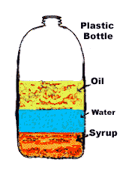
Which liquid is the least dense?
a)
oil
b)
water
c)
syrup 
d)
plastic bottle
17.
Which of these organisms is a vertebrate?
a)
polar bear
b)
redwood tree
c)
octopus
d)
bacteria
18.
Melted rock that has flowed from a volcano is called
a)
sediment 
b)
soil
c)
lava
d)
magma
19.
Inherited traits that help an organism survive in its environment
a)
Photosynthesis
b)
Adaptations
c)
Learned Behaviors
d)
Instincts
e)
Insulator
20.
Temperature when a substance changes from a liquid to a gas
a)
Nonrenewable Resources
b)
Weight
c)
Boiling Point
d)
Water Cycle
e)
Melting Point
21.
a renewable energy source that is produced through contemporary biological processes
a)
Biofuels
b)
Landforms
c)
Weathering
d)
Cementation
e)
Geothermal Energy
22.
absorbed from the air by plants in photosynthesis
a)
Alternative Energy
b)
Carbon Dioxide
c)
Compaction
d)
Density
e)
Oxygen
23.
Consumers that eat only other consumers
a)
Carnivore
b)
Omnivores
c)
Decomposers
d)
Herbivore
e)
Niche or Role
24.
An object that allows electricity and heat to travel through it
a)
Conductor
b)
Biofuels
c)
Insulator
d)
Carbon Dioxide
e)
Energy
25.
Organisms that eat other organisms for food
a)
Camouflage
b)
Matter
c)
Photosynthesis
d)
Prey
e)
Consumers
26.
Organisms that break down dead and decaying organisms and return nutrients to the soil
a)
Condensation
b)
Geothermal Energy
c)
Alternative Energy
d)
Decomposers
e)
Herbivore
27.
describes how different organisms eat each other, starting out with a plant gets its energy from the sun and ending with an animal.
a)
Food Chain
b)
Circuit
c)
Complete Metamorphosis
d)
Consumer
e)
Food Web
28.
State of matter when Particles are packed loosely and move freely
a)
Complete Metamorphosis
b)
Weight
c)
Mass
d)
Gas
e)
Liquid
29.
a renewable energy source that is generated by the force of falling water
a)
Solar Energy
b)
Geothermal Energy
c)
Food Web
d)
Hydroelectric
e)
Evaporation
30.
does not allow any light to pass through it
a)
Simple Machine
b)
Refraction
c)
Opaque
d)
Transparent
e)
Translucent
31.
Process in which water droplets are released from clouds Example: Rain, Sleet, Snow, Hail
a)
Precipitation
b)
Carbon Dioxide
c)
Closed Circuit
d)
Condensation
e)
Deposition
32.
State of matter when particles are packed tightly together and stay in their place
a)
Solid
b)
Gas
c)
Landforms
d)
Liquid
e)
Mixture
33.
The continuous process by which water is circulated throughout the earth and the atmosphere through evaporation, condensation, precipitation, and the transpiration of plants and animals
a)
Water Cycle
b)
Gas
c)
Biofuels
d)
friction
e)
Learned Behaviors
34.

What are the poles of a magnet called?

a)

East and South

b)

South and North

c)

North

d)

I don't know

35.

What is the geosphere?

a)

all the air and gases on the planet

b)

all the frozen water on the Earth

c)

the non-living soil, rocks, and minerals of the Earth

d)

the rivers, lakes, and oceans of the Earth

36.

What is the biosphere?

a)

all the air and gases on the planet

b)

made up of living things

c)

the non-living soil, rocks, and minerals of the Earth

d)

the rivers, lakes, and oceans of the Earth

37.

What is the hydrosphere?

a)

all the air and gases on the planet

b)

made up of living things

c)

the non-living soil, rocks, and minerals of the Earth

d)

the rivers, lakes, and oceans of the Earth

38.

What is the atmosphere?

a)

all the air and gases on the planet

b)

made up of living things

c)

the non-living soil, rocks, and minerals of the Earth

d)

the rivers, lakes, and oceans of the Earth

39.
Which part of the cell is often called "the brain of the cell"?
a)
nuclear membrane
b)
endoplasmic reticulum
c)
nucleus
d)
ribosomes
40.
What happens when water boils?
a)
The solid water becomes a liquid.
b)
The liquid water becomes a solid.
c)
The liquid water becomes a gas.
d)
Water vapor becomes liquid water.
41.

What planet is the largest?

a)

Jupiter

b)

Saturn

c)

Neptune

d)

Uranus

42.

Which planet is the closest to the sun?

a)

Mars

b)

Mercury

c)

Jupiter

d)

Earth

43.

Which planet DOES NOT have rings?

a)

Mars

b)

Jupiter

c)

Saturn

d)

Neptune

44.

Which planet is the hottest?

a)

Neptune

b)

Jupiter

c)

Earth

d)

Venus

45.

Which planet is a Gas Giant?

a)

Jupiter

b)

Mars

c)

Earth

d)

Venus