Wayground logo

Free Printable Worksheets

Font size

S
M
L
XL
Worksheets

Ecology Review

Total questions: 57

Worksheet time: 49mins

Name
Class
Date
1.
Abiotic factors in the environment are all __________. 
a)
living
b)
nonliving
2.
A group of populations that interact in an area is __________
a)
ecosystem
b)
community
c)
biome
d)
population
3.
Lions, birds, snakes and trees are all __________.
a)
abiotic factors
b)
biotic factors
c)
part of a niche
d)
in the same food chain
4.
Grass --> Grasshopper --> Mockingbird represents __________. 
a)
food chain
b)
food pyramid
c)
food web
d)
ecosystem
5.
Algae, grasses and trees are all __________. 
a)
decomposers
b)
consumers
c)
autotrophs/producers
d)
pyramids
6.
A trophic level represents a _________. 
a)
consumer
b)
feeding level
c)
speeding level
d)
cooking level
7.
An animal that eats plants and meat is a(n) __________.
a)
herbivore
b)
omnivore
c)
carnivore
d)
decomposer
8.
An organism`s role in its community is its __________, and where it lives is its _________.
a)
habitat; niche
b)
role in community; niche
c)
niche; role in the community
d)
niche; habitat
9.
What is the source of energy that flows through most of the food chains on Earth?
a)
plants
b)
the sun
c)
temperature
d)
wind
10.

Ecology is the study of .

a)

life

b)

Interactions among organisms and their environments

c)

interactions among organisms

d)

how traits are passed from parents to offspring
11.

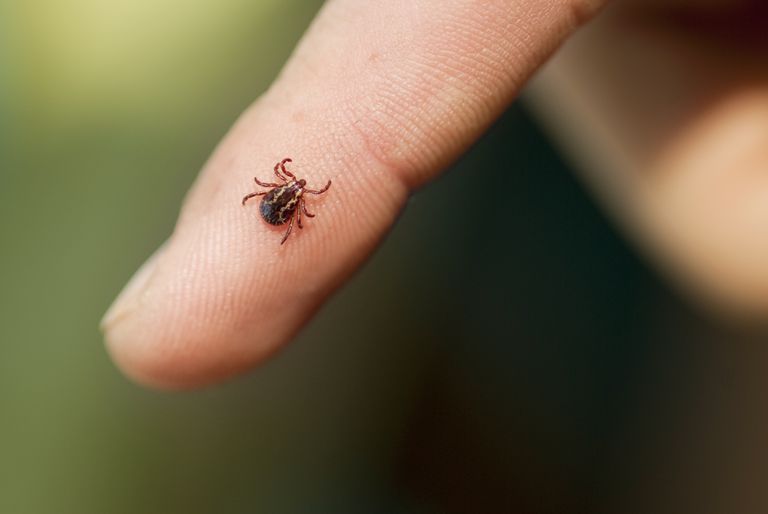
An ongoing relationship in which one organism benefits and the other is harmed.

a)

A. Predator & Prey

b)

B. Mutualism

c)

C. Commensalism

d)

D. Parasitism

12.

There are birds that eat the food from between the teeth of alligators, leaving the alligators with clean teeth and the birds with a meal. What type of ongoing relationship is this?

a)

A. Predator & Prey

b)

B. Mutualism

c)

C. Commensalism

d)

D. Parasitism

13.

Which of the following is a predator and prey relationship?

a)

A. Cow and grass.

b)

B. Vulture and a dead lion.

c)

C. Tick and a deer.

d)

D. Spider and a fly.

14.

Tell if the item is an abiotic factor or biotic.....

Water

a)

Abiotic

b)

Biotic

15.

An organism’s habitat is where it lives.

a)

True

b)

False

16.

Tell if the item is an abiotic factor or biotic factor.....

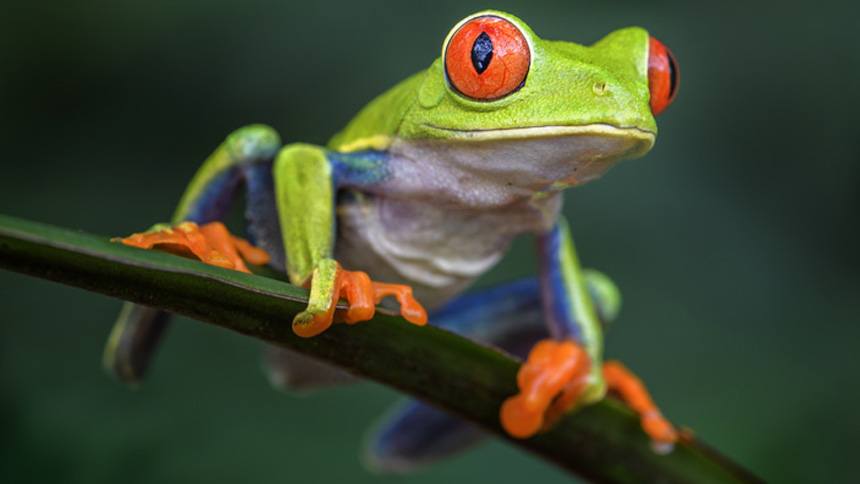
Tree Frog

a)

Abiotic

b)

Biotic

17.

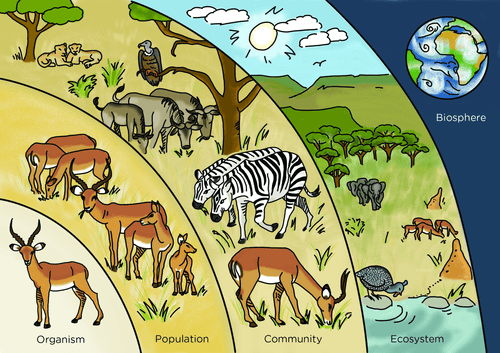
The living world is organized in levels. Biotic and abiotic factors also can be arranged into levels of biological organization. Put the words below in order from the least complex to the most complex

a)

Community, Organism, Biome, Population, Biosphere, Ecosystem

b)

Organism, Population, Community, Ecosystem, Biome, Biosphere

c)

Organism, Biome, Population, Community Biosphere, Ecosystem
18.

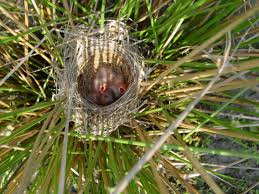
Bird builds nest in tree.

a)

Commensalism

b)

Mutualism

c)

Predator/Prey

d)

Parasitism

19.
An individual belonging to a specific species
a)
Biotic
b)
Community
c)
Organism
d)
Reptile
20.
All of the living and nonliving things in an area that interact with each other are called a/an ______.
a)
community
b)
habitat
c)
population
d)
ecosystem
21.
The image provided is an example of a(n):
a)
Producer
b)
Autotroph
c)
Consumer
d)
Insect
22.
The amount of energy that usually transfers from one trophic level to the next...
a)
10%
b)
20%
c)
80%
d)
50%
23.
An illustration that uses arrows to show the many possible directions in which matter and energy can pass through the organisms in an ecosystem.
a)
Food chain
b)
Food web
c)
Energy Pyramid
d)
Succession Map
24.
Which organisms are producers?
a)
Chemosynthetic bacteria and symbiotic bacteria
b)
Amphipods and zooplankton
c)
Tubeworms and zoarcid fish
d)
Octopuses and mussels
25.
Which organisms are both secondary and tertiary consumers in this food web?
a)
Chemosynthetic bacteria and amphipods
b)
Zooplankton and mussels
c)
Ratfish and octopuses
d)
Galatheid crabs and zoarcid fish
26.
In the energy pyramid here, which organisms have the most energy available?
a)
Producers
b)
Carnivores
c)
Herbivores
d)
Top Predator
27.
If there is 1000 Kcal available in the producers in trophic level 1, how much energy is available in the herbivores in trophic level 2?
a)
10 Kcal
b)
1 Kcal
c)
100 Kcal
d)
1000 Kcal
28.

At what population was carrying capacity met?

a)

250

b)

1000

c)

400

d)

720

29.

Density-independent limiting factors to population growth includes

a)

stress from overcrowding

b)

parasitism

c)

competition

d)

natural disasters

30.

What is a condition that halts population growth?

a)

limiting factors

b)

renewable resources

c)

climate

d)

conservation

31.
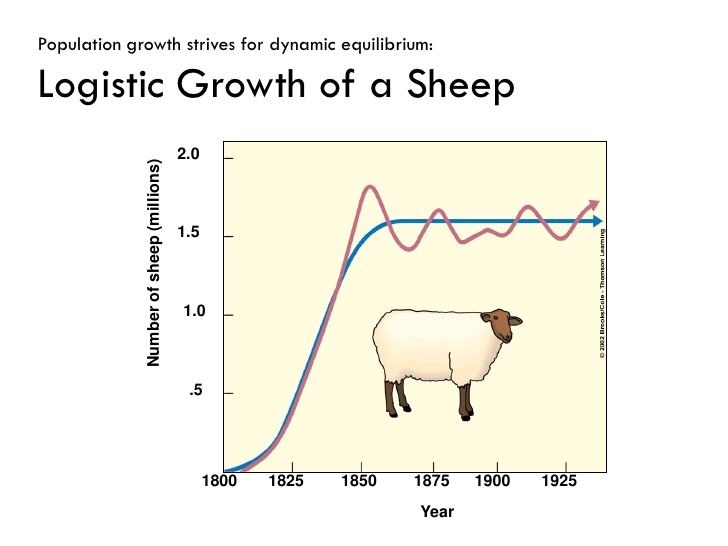
What type of growth is shown in the diagram?
a)
exponential growth
b)
logistic growth 
c)
predator-prey cycle
d)
boom-bust curve
32.
What is the approximate carrying capacity of Paramecium aurelia cultured alone?
a)
150
b)
400
c)
450
d)
500
33.

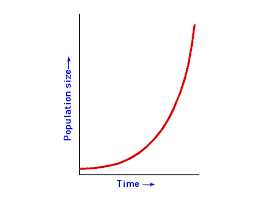
What type of growth curve is this?

a)

Logistic

b)

Exponential

c)

Abiotic

34.
The process of plants losing water through their leaves is called ____.
a)
condensation
b)
evaporation
c)
transpiration
d)
exhaling
35.
What is the only process that removes carbon from the atmosphere?
a)
combustion
b)
cellular respiration
c)
photosynthesis
d)
decomposition
36.
Respiration is the process by which ____________ is consumed and _______________ is produced.
a)
Carbon, Oxygen
b)
Oxygen, Carbon dioxide
c)
H20, oxygen
d)
Carbon, H2O
37.

Where are nitrogen-fixing bacteria found?

a)

In the atmosphere

b)

around the roots of plants

c)

In dead things

d)

in the water

38.
The direction of the flow of energy in a food web is represented by ___.
a)
Light bulbs
b)
Dotted Lines
c)
Arrows
d)
Bubbles
39.
Which of these is an example of an autotroph?
a)
Sunflower
b)
Krill
c)
Leopard
d)
Hummingbird
40.
Consumer that eats plants
a)
heterotroph
b)
herbivore
c)
producer
d)
community
41.

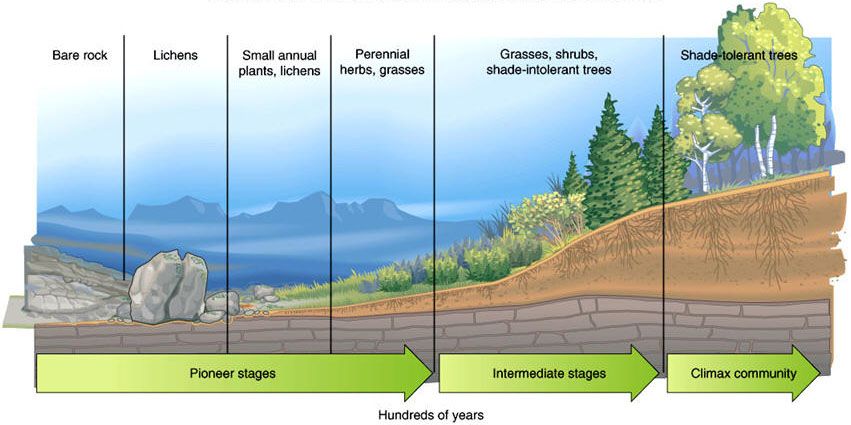
The picture display which type of succession?

a)

primary

b)

secondary

c)

tertiary

d)

all of the above

42.

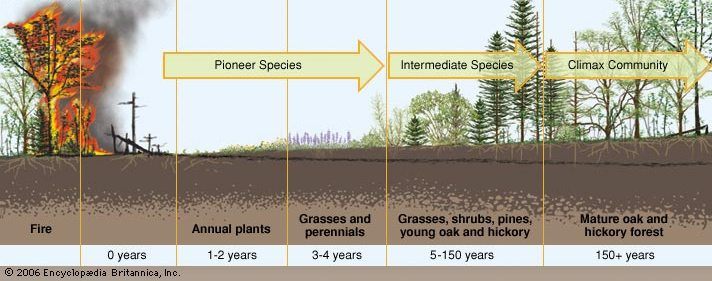
The picture displays which type of succession?

a)

primary

b)

secondary

c)

tertiary

d)

all of the above

43.

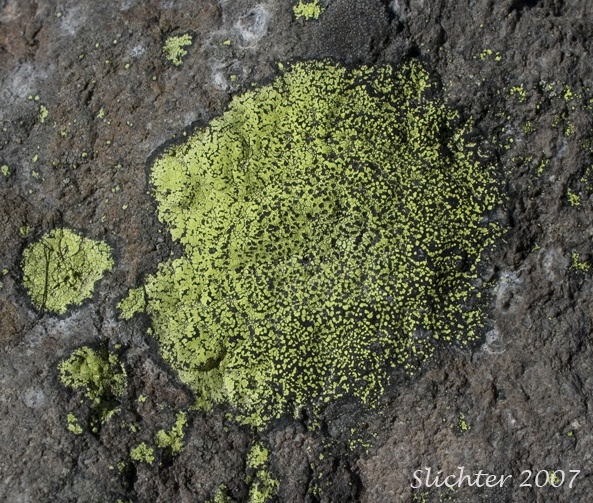
What is the name given to lichen/algae during primary succession?

a)

pioneer species

b)

volunteer species

c)

founder species

d)

conqueror species

44.

After a volcanic eruption, volcanic rock is present (but no soil). Which of the following states the most likely order of succession that would be seen?

a)

Lichens → Shrubs → Grasses → Trees

b)

Lichens → tree → shrubs→Grasses

c)

Grasses → Lichens → Shrubs → Trees

d)

Lichens → Grasses → Shrubs → Trees

45.
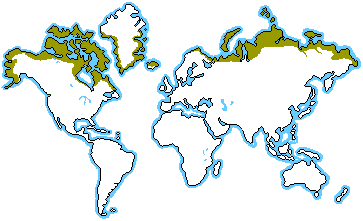
The area of the map shaded in green represents which of the following terrestrial biome
a)
Coniferous Forrest
b)
Deciduous Forrest 
c)
Desert
d)
Tundra
46.

Which land biome is covered mainly with conifer trees?

a)

Tropical Rain Forest

b)

Deciduous Forest

c)

Tundra

d)

Taiga

47.

Which biome is hot and humid all year round with plenty of rain?

a)

Tundra

b)

Tropical Rain Forest

c)

Taiga

d)

Temperate Forest

48.

Which land biome do we live in?

a)

Grassland

b)

Tundra

c)

Deciduous/Temperate Forest

d)

Taiga

49.

Which land biome is the coldest in temperature without any trees?

a)

Taiga

b)

Grassland

c)

Tundra

d)

Deciduous Forest

50.

Which biome is sandy and/or rocky with very little rain?

a)

Desert

b)

Tundra

c)

Grassland

d)

Tropical Rain Forest

51.

Which of the following are elements found in living things? (check all that are correct)

a)

Oxygen

b)

Sulfur

c)

Sodium

d)

Calcium

e)

Hydrogen

52.

Which of the following would cause a population's size to INCREASE? (check all that are true)

a)

death

b)

birth

c)

immigration

d)

emigration

53.

Which of the following would cause a population's size to DECREASE? (check all that are true)

a)

death

b)

birth

c)

immigration

d)

emigration

54.

Which of the following DOES NOT RETURN CARBON to the atmosphere?

a)

photosynthesis

b)

cellular respiration

c)

burning fossil fuels

55.
What type of solution is this cell in?
a)
Isotonic
b)
Hypertonic
c)
Hypotonic
d)
diffused
56.

Which is an example of a nucleic acid?

a)

DNA

b)

pasta

c)

amino acid

d)

lipid

57.
This biome is found around the equator and is home to a large amount of biodiversity.
a)
Deserts
b)
Tropical Rain Forests
c)
Savannas
d)
Chaparral