
 Worksheets
LC5 Year 9 Assessment 2020/21 Final
Total questions: 60
Worksheet time: 32mins
C1: Which ecosystem is located at 30 degrees north and south of the equator?
Tropical rainforests
Temperate forests
Tropical grasslands
Hot deserts
C2: Which ecosystem is located closest to the equator?
Hot deserts
Tropical grasslands
Hot deserts
Tropical rainforests
C3: Why is it hotter at the equator?
Distance from the sun to the earth's surface
The concentration of solar radiation
The difference in surface area from the equator to the poles
The density of the atmosphere solar radiation passes through
C4: This is a disease that affects ash trees causing bark damage...?
(a)

C5: Calculate the rainfall range in this rainforest climate graph
(a)
C6: What is the largest store in the nutrient cycle for tropical rainforests?
Biomass
Litter
Soil
C7: What is the name of the top layer of tropical rainforests?
(a)
C8: What is the name of the bottom layer of tropical rainforests?
(a)
C9: The rate of deforestation has (a) over time.
C10: Which of these is one cause of deforestation?
Urbanisation
Buying a chirstmas tree during the holidays
Overbreeding birds in the wild
Cutting down the tree in your backyard
C11: Which rainforest layer receives the most sunlight?
Under canopy
Forest floor
Canopy
Emergent layer
C12: The canopy contains most of the _____ in the rainforest.
Fungi
Air
Animals
Soil
C13: If the rainforests were to disappear, the amount of carbon dioxide in the atmosphere would ____.
Increase
Decrease
Increase briefly, then decrease
Stay the same
C14: The main rainforests are found in the following areas:
South America, Africa, South East Asia
South America, North America, Africa
South America, Africa, North East Asia
Europe, North America, Australia
C15: The climate in a Tropical Rainforest can be described as...
Cold, Wet and Humid
Humid, dry and Hot
Humid, wet and Hot
Cold, Wet and unstable
C16: The Emergent trees have __________ roots to help stop them _________________.
Buttress, Falling down
Big, Growing taller
Butted, Hurting other trees
Buttress, Growing too close together

C17: The leaves on the Emergent trees are smaller than the leaves on the trees that grow in the Shrub layer. This is because ...
At the shrub layer there is limited light for seeing
At the shrub layer there is limited light for photosynthesis
At the shrub layer there are many animals that eat leaves
At the shrub layer there is a lot of rain so the leaves are big for animals to hide under
C18: Which map best shows the location of tropical rainforests?
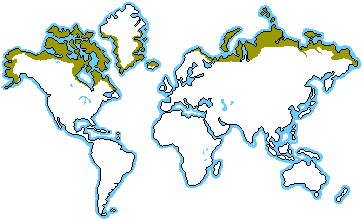
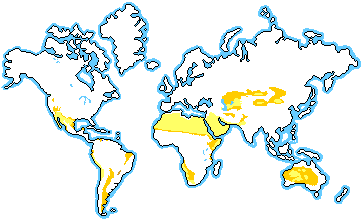
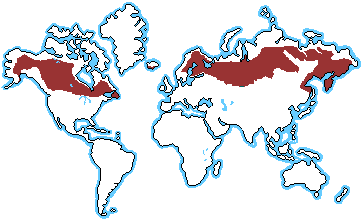
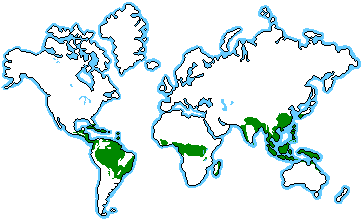
C19: Very little sun reaches this part of the rainforest.
equal
earth
floor
carnivorous
C20: Rainforests typically have more than, how much rainfall?
250 mm
1500 mm
2500 mm
500 mm
C21: How would you describe the soils of the tropical rainforest?
Deep and rich in nutrients.
Thin and poor in nutrients.
C22: Where are most of the nutrients locked up in the rainforest? Select all correct answers.
The soil.
The biomass - the living vegetation and animals.
The litter - dead wood, leaves, and animal remains on the ground.
C23: Which of the following are adaptations of plants in the tropical rainforest?
Drip tip leaves
Buttress roots
Succulents
Large leaves
C24: The term biotic refers to what?
The non-living parts of an ecosystem.
The living parts of an ecosystem.
Decomposers
C25: The non-living parts of an ecosystem are referred to as....?
Abiotic
Biotic
C26: Tavy (slash and burn) is a type of...?
(a)
C27: When farmers cut down the forest and burn the undergrowth this increases...?
(a)
C28: Deforestation upsets the hydrological cycle. When trees are cut down this reduces (a) rates, which affects condensation and cloud formation.
C29: What is the main reason for illegal logging?
(a)
C30: Which of the following is an example of a producer?
Pickleweed
Frog
Heron
Duck
P1: Which of the following needs to be higher for a population to naturally increase?
Death rate
Life expectancy
Birth rate
P2: Which two continents are projected to experience the greatest urban growth in the future?
Europe
Africa
Asia
North America
P3: Which of the following is the correct definition for natural increase?
When the death rate is higher than the birth rate
When people are expected to live longer
When the birth rate is higher than the death rate
When the birth rate is higher than life expectancy
P4: Which statement about Rio's favelas is false?
There are up to 1,000 favelas in Rio
Favelas are often built on steep hillsides where landslides are common
The number of people living in favelas has declined in recent years
Rocinha is the largest favela in Rio
Favelas are illegal settlements where people have built homes on land they do not own.

P5: Which of these is one of the biggest gangs in Rio?
The Purple Hand
The Red Command
The Blues Brothers
The Guardians of the Galaxy

P6: What is the capital city of Brazil?
Sao Paulo
Rio de Janeiro
Brasillia
South America

P7: What type of plate boundary is shown in the picture?
Conservative
Divergent
Convergent
Collision

P8: Volcanoes do not occur at conservative plate boundaries.
True
False

P9: What type of plate boundary is shown in the image?
Conservative
Divergent
Convergent
P10: Select all of the secondary effects from the list below.
Looting
Buildings collapse
Railway lines and roads destroyed
Disease spreading
P11: Which TWO are hazards of a volcano?
flooding
ash cloud
roadways washed away
lava
P12: What is the difference between a natural hazard and a natural disaster?
They are exactly the same
A hazard is what could happen, a disaster is after it has an impact on humans
I disaster is what could happen, a hazard is after it has an impact on humans
Hurricanes and tsunamis are natural disasters, but earthquakes and volcanoes are hazards
P13: Which of the following is the name of the programme used to improve Rio's favelas?
Deploying the military
Pacification
Improving surveillance
Removal of military
P14: Most of the world's megacities are in
Australia
Europe
Asia
Africa
P15: Most of the world's population live in megacities
True
False
P16: An example of a water-borne disease is (a) ?
P17: Which of the following are examples of strategies used as part of the Favela Barrio Project?
Naming roads
50% mortgages
Cable car system
TV scheme
P18: Jobs that are unregulated and don't contribute taxes are part of............................?
The formal economy
The informal economy
P19: Which of these is the correct definiton for a developing country?
A country that relies on industry with an unstable economy and low HDI
A country that still relies on subsistence farming with an unstable economy and low HDI
A country that relies on industry with a stable economy and low HDI
A country that relies on industry with a stable economy and a high HDI
P20: What is HDI?
Human Development Index
Huge Donut Industry
High Development Industry
Highly Dubious Imagination
P21: Which three indicators are used to measure the HDI?
Literacy rate, life expectancy and GNI per capita
Life expectancy, mean years of schooling and GNI per capita
Literacy rate, GDP per capita, mean years of schooling
P22: Which is the correct definition of a developed country?
A country with a well established economy and infrastructure. Typically with a high HDI
A country with a well established economy and infrastructure. Typically with a low HDI
A country without a well established economy and infrastructure. Typically with a high HDI
A country with a poorly established economy but well established infrastructure. Typically with a high HDI
V1: This shows the direct links between producers and consumers.
Producers
Food chain
Consumers
Decomposers
V2: They convert energy from the environment into sugars.
Decomposers
Producers
Consumers
Food web
V3: Development is the process of change which affect's people's standard of living and (a)
V4: What does population density mean?
Lots of people live in a country.
How many people live per km2 in a country or area.
The people in that country live a long time.
The towns and cities in that country are very crowded.
V5: Areas of sea, fresh or groundwater depleted of dissolved oxygen are known as (a) ?
V6: The police form deployed into the favelas were known as (a) ?
V7: These break down plant and animal matter and return the nutrients to the soil.
Producers
Decomposers
Consumers
Food chain
V8: Which of the following is the correct definition for urbanisation?
The increase in the number of people living in urban areas.
The increase in the proportion of people living in urban areas.
The increase in the proportion of people living in rural areas.
The increase in the number of people living in rural areas.

