
 Worksheets
Sixth-form end of Year Quiz
Total questions: 61
Worksheet time: 39mins
What are potential units for Power?
Joule/seconds
Watts
Horsepower
Zebraforce

What is the work done by friction for a block sliding down a slope giving the following conditions:
Mass of block = 1Kg
Coefficient of friction = 0.5
The angle of slope = 30 degrees
Vertical distance traveled of = 1m
Gravitational attraction = 9.81 ms^-2
17.0 Joules (3.s.f)
8.50 Joules (3.s.f)
4.905 Joules
2.83 Joules (3.s.f)
15.2 Joules (3.s.f)

Who is that?
Niels Bohr
James Chadwick
Erwin Schrödinger
Three children in a trench coat but one looks 40

Who is this famous scientist?
Lise Meitner
Marie Curie
Rosalind Franklin
Ada Lovelace
If you are traveling in a car which is traveling at the speed of light, and you turn on the headlights, how fast are the headlights traveling relative to you?
300,000,000 m/s
0 m/s
600,000,000 m/s
Infinite m/s
What is the resistivity of a wire with the following conditions:
Length = 2 m
Radius = 1 mm
Resistance = 4 Ohms
12.5 mΩ
12.5 μΩ
6.28 mΩ
6.28 μΩ
What are the stages in the life cycle of star much larger than the Sun?
nebula → protostar → main sequence → red giant → supernova → neutron star or black hole
nebula → protostar → main sequence → red giant → white dwarf → black dwarf
nebula → protostar → main sequence → red supergiant → supernova → neutron star or black hole
protostar → nebula → main sequence → red supergiant → neutron star or black hole → supernova
Approximately how far can an object fall in 5 seconds?
Given that we are in earth gravity, and it was dropped withno velocity.
5 m
25 m
50 m
125 m
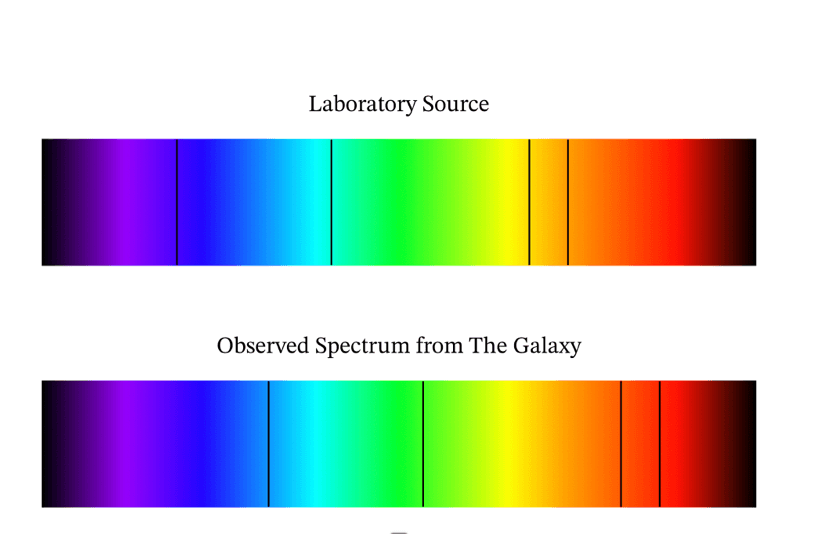
The Galaxy is moving ...
Away
Towards
Stationary
Find the frequency of an electromagnetic wave with a wavelength 2.75 × 10⁻⁸ m.
1.10 Hz
1.09 × 10¹⁶ Hz
9.17 × 10¹⁵ Hz
9.17 × 10¹⁶ Hz
A ____ is a discrete, quantized bundle of energy
Photoelectric effect
Photon
Quantized
Proton
The photoelectric effect helped to explain how light can behave like a _____
particle
wave
A brittle material is one which:
Doesn't deform plastically but breaks when the stress is too high
Deforms plastically
Deforms elastically and will return to its original shape
Deforms to a new shape with little force
Which scientist claimed that the location of a particle is uncertain and therefore, unknown?
Niels Bohr
Louis de Broglie
Werner Heisenberg
Erwin Schrodinger

Which graph represents a wire which has plastically deformed?
Left graph
Right graph
What is Young's Modulus?
StrainStress
StressStrain
ΔLAFL
∞
When flying, some birds use warm air currents to gain height.
What is the cause of these currents?
conduction
convection
evaporation
radiation
To convert from Celsius to Kelvin:
K = Degrees Celsius + (a) (2.d.p)
What is the quark structure for antiprotons?
u̅d̅
d̅d̅s̅
d̅d̅u̅
u̅u̅d̅
According to Coulomb's Law, The greater the separation distance between two charges the greater the magnitude of the electric force. True or False?
True
False
The mass of a single electron is equal to 9.109x10⁻³¹C. True or False?
True
False
What is the only direct method we have of measuring distances to stars?
Red shift method
Standard Candles
Parallax
Spectroscopy
Stars above the main sequence in an H–R diagram
have used up all of the helium atoms in their cores and have expanded in size to form supergiants.
have used up all of the hydrogen atoms in their cores and have expanded in size to form supergiants.
have used up all of the helium atoms in their cores and have expanded in size to form red giants.
have used up all of the hydrogen atoms in their cores and have expanded in size to for red giants.
The S.I. unit for electric field is__________?
nC
μC
n/C
N/m
none of the above
The absorption and emission lines present in a star’s spectrum determine the characteristics of
the elements in a star
the intensity of a star
the frequency of a star
all of the above
The phenomenon of splitting of white light into seven colours is know as
reflection
refraction
dispersion
diffraction
Angle between equipotential surface and lines of force is
0
180
90
45

A cell of internal resistance r and electromotive force (e.m.f.) E is connected in series with a resistor of resistance R.
The resistance R and the e.m.f. E remain fixed. The internal resistance r of the cell changes over time.
Which graph best shows the variation of the current I in the circuit with the internal resistance r?


Which graph could show how the resistance R of a filament lamp varies with the applied potential difference (p.d.) V, as V is increased to the normal operating p.d.?


Heavy elements are made during (Beyond Iron):
Nova
Fusion reaction in the core of all stars
Supernova
Fusion reaction of Supergiants

How much energy would it take to ionize an electron in the ground state?
1 eV
3 eV
7 eV
12 eV
When was Einstein awarded with the Nobel prize?
In 1921
In 1910
In 1955

Light is emitted by transitioning an electron form the 3rd to the second excited state of a hydrogen atom in the Bohr model. If the transition were from the n = 3 to the n = 1 level instead, the light emitted would have
lower frequency
longer wavelength
higher energy
larger amplitude
What did Albert's mother think of him?
he was a born genius
Albert was a freak
he will rule the world

For the string labeled 1/4, what is the harmonic number?
1st harmonic
2nd harmonic
3rd harmonic
4th harmonic
With which of the following theories is the formula E=mc2 most closely associated?
Relativity
Ohm's Law
Planck's Law
The Blackbody Effect
Where was Einstein born?
Ulm, Germany
Bulgaria
Switzerland

For the wave that is labeled "1/2", which equation would you use to find the frequency?
f = v/2L
f = 2v/2L
f = 3v/2L
f = 4v/2L

The horizontal position of a standing wave appears to be staying in one place.
True
False
Constructive interference is
When two waves affect one another in a positive way.
Produce a single wave of greater amplitude (add together)
Both

What is the smallest terrestrial planet?
Mars
Venus
Mercury
Earth
Our Sun gets its energy from...
fusing hydrogen nuclei into helium nuclei.
convection zones in its core.
coronal mass ejections.
nuclear fission.
What would the force between them be if both of the masses were doubled?
What's the acceleration of gravity of a planet with a mass of 1 x 1025 kg and a radius of 5x10⁶ meters?
.267 m/s2
2.67 m/s2
26.7 m/s2
267 m/s2
Stars that are 20 times the size of our Sun or bigger become this when they die:
Neutron star.
Pulsar.
White dwarf.
Black hole.
•What elementary particles are the building blocks for protons and neutrons?
•Quarks
• Leptons
• Photons
• Gluons
What do we call a particle that is not made up of any smaller particles?
• Atomic particle
•Minimum particle
•Original particle
•Elementary particle
•Base particle
What's the acceleration of gravity of a planet with a mass of 1 x 10²² kg and a radius of 5x10⁵ meters?
.267 m/s2
2.67 m/s2
26.7 m/s2
267 m/s2
•What type of elementary particles are electrons?
•Quarks
•Leptons
• Photons
Bosons
Two object each have masses of 9,000,000 kg and are 1 meter apart from each other. What's the force of gravity between them?
5402 N
6320 N
7541 N
7945 N

An iodine nucleus decays into a nucleus of Xe−131, a beta-minus particle and particle Y.
Which is a property of particle Y?
It has a lepton number of +1
It is an antiparticle
It is negatively charged
It experiences the strong interaction
If a lift is going up with acceleration, the apparent weight of a body is?
Higher than the true value
Lower than the true value
Same as the true value
How was Albert Einstein related to his wife?
She was his mom
She was his sister
She was his first Cousin
She was his second Cousin

