Wayground logo

Free Printable Worksheets

Font size

S
M
L
XL
Worksheets

Honors Bio Biochemistry Reveiw

Total questions: 72

Worksheet time: 1hrs 20mins

Name
Class
Date
1.
 Proteins have many different functions in a cell. Which of the following are possible functions of a protein?
a)
catalysts and building blocks of DNA
b)
enzymes and actively transports molecules across the cell membrane
c)
building blocks of DNA and structural components of cell membrane
d)
components of the cell membrane and main source of energy in cellular respiration
2.
Water is essential to all living things. One important attribute of water allows it to maintain a constant environment within cells. Which property of water allows it to do this?
a)
moderates temperature
b)
breaking of covalent bonds
c)
surface tension of water surface
d)
expansion of water when it freezes
3.
The human body maintains a temperature of around 98.6 degrees at all times. Enzymes are involved in almost every chemical reaction in the body. Which of the following describes the connection between these two statements?
a)
 Enzymes function best at a specific temperature
b)
The body needs to be warm to prevent hypothermia.
c)
The body is kept relatively warm to prevent too much enzyme action
d)
There is no connection between the two statements.
4.
A sugar, a phosphate group, and a nitrogen base form the building blocks of which organic compound?
a)
carbohydrates
b)
lipids
c)
nucleic acids
d)
proteins
5.
Water is often called the "universal solvent" because many substances can be dissolved in water. What property of water allows it to be such a versatile solvent?
a)
purity
b)
polarity and cohesion
c)
high heat capacity
d)
expansion upon freezing
6.
Which of the following best compares the structures of lipids and carbohydrates?  
a)
Both are made up of monosaccharide monomers, but lipids are hydrophobic and carbohydrates are hydrophilic.
b)
Both contain carbon and hydrogen, but carbohydrates also contain oxygen and lipids contain nitrogen.
c)
Both consist of carbon, hydrogen, and oxygen, but carbohydrates have repeating structural units and lipids do not.
d)
Both have a carbon backbone, but lipids also have an amino group and carbohydrates have a carboxylic acid group.
7.
Some proteins catalyze biochemical reactions. If a genetic defect prevented a protein catalyst from being produced, which of the following do you predict would happen in the cell?
a)
The cell would find a different type of protein to catalyze the reaction
b)
The reaction the protein catalyzes would proceed very slowly or not at all
c)
The reaction the protein catalyzes would only occur in some places in the cell
d)
The reverse reaction of the one the protein catalyzes would begin to proceed
8.
Which row in the chart below correctly pairs a food molecule with its building block?
a)
Row 1
b)
Row 2
c)
Row 3
d)
Row 4
9.
Which of these biological functions is made more effective by the hydrogen-bonding properties of water?
a)
lubrication of joints as a means of preventing injury
b)
sweating as a means of regulating body temperature
c)
transmitting signals and information as a means of  body movement
d)
breathing as a means of taking in oxygen and releasing carbon dioxide
10.
A scientist analyzing an unknown substance has determined that it consists only of carbon, hydrogen and oxygen. During experimentation, she determines that the substance is soluble, or dissolves, in OIL but not in water. Which of the following macromolecules is the unknown substance most likely to be?
a)
 carbohydrate
b)
lipid
c)
nucleic acid
d)
protein
11.
The table below lists some digestive enzymes found in the human small intestine. Based on the information in the table, what would be one effect of an injured pancreas?
a)
The blood levels of monosaccharides would increase.
b)
The absorption of amino acids would be more efficient.
c)
The body would be unable to process starches, proteins, and fats.
d)
The levels of the enzymes amylase, trypsin, and lipase would increase.
12.

The TOP 5 ELEMENTS abundant in LIFE are carbon, hydrogen, ______, ________, and ______.

a)

phosphorus

b)

calcium

c)

oxygen

d)

sodium

e)

nitrogen

13.

How do atoms become more stable?

a)

They bond with other atoms in order to have a full outer shell of electrons.

b)

They change their state of matter.

c)

The energy moves from potential to kinetic.

14.

How many electrons are found in the inner most electron shell?

a)

2

b)

8

c)

18

d)

6

15.

How many electrons are found in the second electron shell?

a)

2

b)

8

c)

18

d)

6

16.

How are the hydrogen atoms bonded to the oxygen atom in a water molecule?

a)

peptide bonds

b)

hydrogen bonds

c)

covalent bonds

d)

ionic bonds

17.

A process by which two molecules are joined by removing a molecule of water: SYNTHESIZES a DISACCHARIDE

a)

Dehydration Synthesis Reaction

b)

Hydrolysis reaction

c)

Catalytic Reaction

d)

Activation Energy reaction

18.

A chemical reaction in which a compound is split apart by water: BREAKS DOWN a polysaccharide into a MONOSACCHARIDE/

a)

Dehydration Synthesis Reaction

b)

Hydrolysis reaction

c)

Catalytic Reaction

d)

Activation Energy reaction

19.
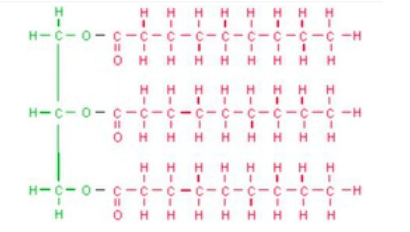
Which biomolecule is this a picture of?
a)
Protein
b)
Nucleic Acid
c)
Lipid
d)
Carbohydrate
20.
Which biomolecule is this a picture of? (Hint: it is made of amino acids)
a)
Proteins
b)
Nucleic Acids
c)
Lipids
d)
Carbohydrates
21.
Which biomolecule is responsible for insulation and LONG term energy storage?
a)
Proteins
b)
Nucleic Acids
c)
Lipids
d)
Carbohydrates
22.
Which biomolecule includes sugars and starches? (Hint: simple or complex)
a)
Lipids
b)
Proteins
c)
Carbohydrates
d)
Nucleic Acids
23.
Which biomolecule group includes fats, oils, and waxes?
a)
Proteins
b)
Nucleic Acid
c)
Lipids
d)
Carbohydrate
24.
The monomer (building block) of a nucleic acid is
a)
Monosaccharide
b)
Amino Acid
c)
Nucleotide
d)
Polysaccharide
25.
Monomers combine to form ________ through the process of ________.
a)
polymers; hydrolysis
b)
polymers; dehydration synthesis
c)
monomers; hydrolysis
d)
monomers; dehydration synthesis
26.
ALL polymers (large molecules) are made up of...
a)
monosaccharides
b)
monomers
c)
proteins
d)
None of these
27.

Polymer's split apart to form ________, by __________.

a)

monomers, hydrolysis

b)

monomers, dehydration synthesis

c)

amino acids, hydrolysis

d)

amino acids, dehydration synthesis

28.
Carbohydrates are made of... 
a)
C H O
b)
C H O N
c)
C H O N P
d)
C H O N S
29.
Proteins are composed of what smaller building blocks?
a)
amino acids
b)
nucleic acids
c)
fatty acids
d)
nucleotides
30.
Which biomolecule is also known as enzymes?
a)
Carbohydrate
b)
Lipid
c)
Nucleic Acid
d)
Protein
31.
Which biomolecule contain your genetics?
a)
Carbohydrate
b)
Lipid
c)
Nucleic Acid
d)
Protein
32.
What is the function of a nucleic acid?
a)
Stores genetic information
b)
Stores energy
c)
Quick source of energy
d)
Builds structures
33.
Identify the biomolecule
a)
monosaccharide
b)
disaccharide
c)
polysaccharide
d)
glycogen
34.
The chemical reaction that breaks down a molecule by adding water is
a)
Dehydration Synthesis
b)
Hydrophobia
c)
Hydrolysis
d)
Dehydration
35.
Identify this biomolecule.
a)
Carbohydrate
b)
Lipid
c)
Protein
d)
Nucleic acid
36.

The prefix "mono" means...

a)

Two

b)

One

c)

Many

d)

Few

37.

The prefix "poly" means...

a)

One

b)

Two

c)

Many

d)

Want a cracker

38.
Saturated fats have this type of structure:
a)
kinky with double bonds between carbons
b)
4-fused carbon rings
c)
straight with single carbon bonds
d)
rectangular with triple carbon bonds
39.
Why are lipids efficient for energy storage?
a)
they are short chains of nitrogen and oxygen.
b)
they are medium chains of hydrogen and oxygen.
c)
They are long chains of carbon and hydrogen.
40.

Which of these are examples of polysaccharides?

a)

DNA, RNA

b)

Fats, hormones

c)

polypeptides

d)

starches, cellulose, glycogen

41.
Which type of molecule is shown?
a)
Saturated Fat acid
b)
Monounsaturated Fatty acid
c)
Polyunsaturated Fatty acid
d)
Cholesterol
42.

Double bond between Carbon and Hydrogen chains.

Tends to be liquid at room temperature like oils.

a)

Polysaccharides

b)

Lipids

c)

Saturated Fats

d)

Unsaturated Fats

43.
The monomer, building block, of DNA and RNA; made up of a sugar, phosphate, and nitrogenous base
a)
Amino Acid
b)
Fatty Acid
c)
Nucleotide
d)
Monosaccharide
44.
The monomer, building block, of carbohydrates; simple sugar
a)
Amino acid
b)
Fatty Acid
c)
Nucleotide
d)
Monosaccharide
45.

How do atoms become more stable?

a)

They bond with other atoms in order to have a full outer shell of electrons.

b)

They change their state of matter.

c)

The energy moves from potential to kinetic.

46.

Why are Enzymes reusable?

a)

Once the enzyme has been used in a chemical reaction and the product is released from the active site, the enzyme is available for another reaction.

b)

The ACTIVE SITE on an enzyme matches a particular substrate and each enzyme acts on only one type of substrate.

47.

Why are Enzymes specific?

a)

Enzymes catalyze a reaction but are not CONSUMED or CHANGED by the reaction.

b)

The ACTIVE SITE on an enzyme matches a particular substrate and each enzyme acts on only one type of substrate.

48.

A process by which two molecules are joined by removing a molecule of water: SYNTHESIZES a DISACCHARIDE

a)

Dehydration Synthesis Reaction

b)

Hydrolysis reaction

c)

Catalytic Reaction

d)

Activation Energy reaction

49.

A chemical reaction in which a compound is split apart by water: BREAKS DOWN a polysaccharide into a MONOSACCHARIDE/

a)

Dehydration Synthesis Reaction

b)

Hydrolysis reaction

c)

Catalytic Reaction

d)

Activation Energy reaction

50.

which versatile element is shown as the "backbone" or organic compounds here?

a)

hydrogen

b)

carbon

c)

nitrogen

d)

phosphorus

51.

what type of bonds are displayed in this molecule?

a)

polar covalent

b)

nonpolar covalent

c)

ionic

d)

all of these are correct

52.

if soap has a pH of around 11 and coffee has a pH of around 5...which substance has a higher H+ concentration?

a)

soap

b)

coffee

c)

they should both be around the same

d)

impossible to tell with information provided

53.

the structure pictured on the bottom of the image would be classified as a(n) ___________. it is not yet a protein because it hasn't been twisted/folded into a 3D shape at this point.

a)

polypeptide chain

b)

polysaccharide

c)

nucleotide

d)

starch molecule

54.

plants take extra glucose and store it as starch. what type of metabolic reaction is taking place during the formation of starch from glucose?

a)

hydrolysis

b)

dehydration synthesis

55.

This molecule has a chemical formula of C6H12O6.

I. What is this molecule?

II. What class of biological molecules is it associated with?

a)

I. tryptophan

II. proteins

b)

I. glucose

II. carbohydrates

c)

I. triglyceride

II. lipids

d)

I. nucleotides

II. nucleic acids

56.

starch and glycogen are used for the same function: ________. however, one is used in plants and one is used in animals.

a)

structure

b)

hormones

c)

enzymes

d)

energy (glucose) storage

57.

which things could change the shape of a protein acting as an enzyme and render it useless? select all that apply

a)

drastic change in temperature

b)

drastic change in pH

c)

drastic change in sucrose concentration

d)

a drastic increase in nutrients available

58.

buffers are important in living organisms because they

a)

help maintain homeostasis

b)

allow extra glucose to be stored up and used later

c)

help with the digestion of certain molecules

d)

all of these

59.

which number(s) are pointing at the enzyme in this reaction?

a)

1 & 2

b)

3 & 5

c)

1 & 5

d)

2 & 3

60.
What is the relationship between enzymes and activation energy? 
a)
When an enzyme catalyzes a reaction, it decreases the activation energy of the reaction.
b)
When an enzyme catalyzes a reaction, it does not affect the activation energy of the reaction.
61.
Meat tenderizer contains an enzyme that breaks down meat. If meat is coated with tenderizer and then placed in a refrigerator, how would the enzyme be affected? Temperature can effect how an enzyme works
a)
It would break down the meat more slowly
b)
It would change the shape of the meat.
62.
If the enzyme has a pH ranging from 7 to 9 what effect would a pH of 3 have on the enzyme?
Enzymes work best at an optimal temperature and pH
a)
make it inactive
b)
no change
63.
The graph shows how the activity of an enzyme changes over a range of pH values. Which of the following conclusions can be drawn from this graph?
a)
pepsin works best at a pH near 2
b)
pepsin works best at a pH of 9
64.
The human body maintains a temperature of around 98.6 degrees at all times. Enzymes are involved in almost every chemical reaction in the body. Which of the following describes the connection between these two statements? 
a)
The body is kept relatively warm to prevent too much enzyme action
b)
Enzymes function best at a specific temperature.
65.
Enzyme -_______________ the activation energy required for a reaction.
a)
lower, decrease
b)
raise, increase
66.
What are signs that a chemical reaction has taken place?
a)
Color change
b)
Gas bubbles
c)
Solid forming
d)
All of the above
67.

In a catabolic reaction, energy is ________. (Hint: what a catastrophe!)

a)

Absorbed

b)

Created

c)

Destroyed

d)

Released

68.

In an anabolic reaction, energy is ________.

a)

Released

b)

Absorbed

c)

Created

d)

Destroyed

69.
What is the energy needed to start an chemical reaction referred to?
a)
Cascading Energy
b)
Potential Energy 
c)
Kinetic Energy
d)
Activation energy
70.
If an enzyme becomes over heated what effect, if any, will the heat have on the enzymatic activity? 
a)
The enzyme will not store much chemical energy.
b)
The enzyme will not be able to catalyze reactions.
c)
The enzyme will lose its net electrical charge.
d)
The enzyme will lose stored genetic information.
71.

What happens to an enzyme when it denatures?

a)

The activation energy of the reaction is doubled.

b)

The activation energy of the reaction is lowered.

c)

It's optimal conditions for temperature of the enzyme are doubled.

d)

The shape of the enzyme molecule is changed.

72.
What is the purpose  of an enzyme?
a)
give permission for the reaction
b)
raise activation energy
c)
speed up reactions
d)
control how many reactions occur