
 Worksheets
10th CBSE Science
Total questions: 40
Worksheet time: 2hrs 0mins
A metal high in the reactivity series.....
Forms unstable compounds.
Can be obtained by the reduction of the ore with the carbon.
Readily gains electrons.
Burns to form basic oxides.
Reacts readily with cold water to form Hydrogen.


This picture illustrates copper's
brittleness
malleability
ductility
Unknown element W has 2 valence electrons. Unknown element X has 7 valence electrons. Which formula shows the most likely outcome when elements W and X react?
WX
WX2
W2X
W2X2
The metal which can be cut with knife.
Iron
Silver
Sodium
Magnisium
Blood vessel carry blood from lungs to heart through:
Pulmonary artery
Pulmonary vein
Coronory artery
None of these
From which structure, the free oxygen gas produced
during photosynthesis is released?
Epidermis
Stomata
Cortex
Guard cell
Villi present on the internal wall of intestine help in
the
emulsification of fats
breakdown of proteins
absorption of digested food
digestion of carbohydrates
During vigorous physical exercise, lactic acid is formed
from glucose inside the muscle cells because
there is lack of oxygen
there is lack of water
there is excess of carbon dioxide
none of the above
Which chambers of human heart contain oxygenated
blood?
Left atrium and left ventricle
Left atrium and right ventricle
Right atrium and left ventricle
Right atrium and right ventricle
The process of conversion of glucose into pyruvic acid
occurs in
mitochondria
Cytoplasm
outside the cell
chloroplast
The breakdown of pyruvate to give carbon-di-oxide,
water and energy takes place in:
cytoplasm
mitochondria
chloroplast
nucleus
Digestion of starch starts from:
Stomach
Intestine
Oesophagus
Mouth
What is the mode of nutrition in fungi?
Autotrophic
Heterotrophic
Saprophytic
Parasitic
Instrument used to measure blood pressure is
barometer
thermometer
anemometer
sphygmomanometer
It is the site of gaseous exchange in human lungs.
villi
alveoli
trachea
larynx
The substance in plants and animals that act as an energy currency.
DNA
RNA
ADP
ATP
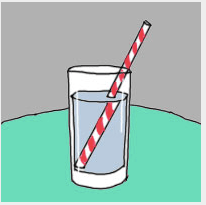
Why does the straw appear to be bent?
light is reflected
light is absorbed
light is turned
light is refracted
The type of mirror used in reflector in automobile lights is
Plane mirror
Concave mirror
Convex mirror
None of the above
A mirror having focal length –15 cm is _________________
Plane mirror
Concave mirror
Convex mirror
None of these
Assertion: For observing the traffic at the hairpin bend in the mountains a plane mirror is preferred over convex or concave mirror.
Reason: A convex mirror has a much larger field view than a plane mirror or a concave mirror.
Both Assertion and Reason are true and Reason is the correct explanation of Assertion.
Both Assertion and Reason are true but Reason is not the correct explanation of Assertion.
Assertion is true but Reason is false.
Assertion is false but Reason is true.
Which of the following characteristics are correct for the image formed in a plane mirror?
I. Upright
II. Inverted
III. Real
IV. Same size as the object
V. Virtual
I, II, III
I, III, IV
I, IV, V
III, IV, V

A positive sign in the value of magnification indicates that the image is
real
virtual
enlarged
near
A ray of light is travelling from a rarer medium to a denser medium. While entering the denser medium at the point of incidence, it
goes straight into the second medium
bends towards the normal
bends away from the normal
does not enter at all
If the image is formed in front of the mirror, then the image distance will be
positive or negative depending on the size of the object
neither positive nor negative
positive
negative
A small air bubble in a glass block when seen from above appears to be raised because of
refraction of light
reflection of light
reflection and refraction of light
none of the above
To get real magnified image in convex lens, the object position is
in between lens and F
in between F and 2F
at 2F
beyond 2F
A point object is placed at a distance of 20 cm from a convex mirror of focal length 20 cm. The image will form at
at infinity
at focus
at the pole
behind the mirror
Magnification produced by a rear view mirror fitted in vehicles
is less than one
is more than one
is equal to one
can be more than or less than one depending upon the position of the object in front of it
Which of the following can make a parallel beam of light when light from a point source is incident on it?
(a) Concave mirror as well as convex lens
(d) Concave mirror as well as concave lens
(b) Convex mirror as well as concave lens
c) Two plane mirrors placed at 90° to each other
Which of the following statements is true?
A convex lens has 4 dioptre power having a focal length 0.25 m
A convex lens has –4 dioptre power having a focal length 0.25 m
A concave lens has –4 dioptre power having a focal length 0.25 m
A concave lens has 4 dioptre power having a focal length 0.25 m
Under which of the following conditions a concave mirror can form an image larger than the actual object?
When object is kept at a distance greater than its radius of
curvature
When object is placed between the focus and centre of curvature
When object is kept at a distance less than its focal length
When the object is kept at a distance equal to its radius of
curvature
In which of the following, the image of an object placed at infinity will be highly diminished and point sized?
Concave mirror only
Convex mirror only
Convex lens only
Concave mirror, convex mirror, concave lens and convex lens
A full length image of a distant tall building can definitely be
seen by using
concave mirror
convex mirror
plane mirror
both concave and plane mirror

