Wayground logo

Free Printable Worksheets

Font size

S
M
L
XL
Worksheets

Biochemistry Test REVIEW

Total questions: 35

Worksheet time: 1hrs 1mins

Name
Class
Date
1.

If you need quickly available energy, how much can you get from this item?

a)

160mg

b)

37g

c)

3g

d)

8g

2.

Are LIPIDS found in this item?

a)

Yes

b)

No

3.

How many calories would you consume if you ate the whole container at once?

a)

230

b)

8

c)

1840

d)

460

4.
Which of the following answers links a biomolecule with one of its proper functions?
a)
Lipids - Store genetic information
b)
Carbohydrates - short term energy storage
c)
Nucleic Acids - Catalyze reactions
d)
Proteins - long term energy storage
5.
The four most common elements found in biomolecules are:
a)
Carbon, Nitrogen, Phosphorus, Bromine
b)
Sulfur, Nitrogen, Iron, Carbon
c)
Sulfur, Phosphorus, Carbon, Oxygen 
d)
Carbon, Oxygen, Nitrogen, Hydrogen
6.
Which biomolecule is responsible for insulation and energy storage?
a)
Protein
b)
Nucleic Acid
c)
Lipid
d)
Carbohydrate
7.
All polymers are made up of...
a)
monosaccharides
b)
monomers
c)
proteins
d)
None of these
8.
What are foods that are high in carbs?
a)
Eggs, fish, poultry
b)
Cheese, meats, vegetables
c)
Bread, potatoes, and pasta
d)
Multitude of oils, butter and condiments
9.
Which 2 molecules contains the elements C-H-O and function pertains to energy?
a)
Lipids and Protein
b)
Carbohydrates and Nucleic Acids
c)
Protein and Carbohydrates
d)
Carbohydrates and Lipids
10.
What is the function of a nucleic acid?
a)
Stores genetic information
b)
Stores energy
c)
Quick source of energy
d)
Builds structures
11.

Which biomolecule helps form muscles?

a)

Nucleic Acid

b)

Carbohydrate

c)

Protein

d)

Lipids

12.
Enzymes are considered to be 
a)
Lipids
b)
Carbohydrate
c)
Protein
d)
Nucleic Acid
13.
What is the purpose  of an enzyme?
a)
give permission for the reaction
b)
raise activation energy
c)
speed up reactions
d)
control how many reactions occur
14.
Where do substrates bind on an enzyme?
a)
voltage-gated channels
b)
surface receptor
c)
calcium channels
d)
active site
15.
Enzymes are capable of increasing the rate of a chemical reaction within a living cell.  Enzymes accomplish this through which of the following means?
a)
reducing the number of products   
b)
reducing the activation energy
c)
increasing the temperature of the cell
d)
increasing the concentration of reactants 
16.
Which biomolecule has sugars and starches?
a)
Lipids
b)
Proteins
c)
Carbohydrates
d)
Nucleic Acid
17.

Lipids are made up of which of the following?

a)

glycerol and fatty acids

b)

glycerol and monolipids

c)

fatty acids and phosolipids

d)

amino acids and nucleotides

18.
Which biomolecule includes sugars and starches? (Hint: simple or complex)
a)
Lipids
b)
Proteins
c)
Carbohydrates
d)
Nucleic Acids
19.
The monomer (building block) of a nucleic acid is
a)
Monosaccharide
b)
Amino Acid
c)
Nucleotide
d)
Polysaccharide
20.
What category should this molecule be classified as?
a)
A. Carbohydrates
b)
B. Lipids
c)
C. Proteins
d)
D. Nucleic Acids
21.
Where do substrates bind to enzymes?
a)
A. Active site
b)
B. Product
c)
C. Here
d)
D. Enzyme opening
22.
How is an enzyme specific to a substrate?
a)
Same color
b)
Same size
c)
Same name
d)
Same shape
23.
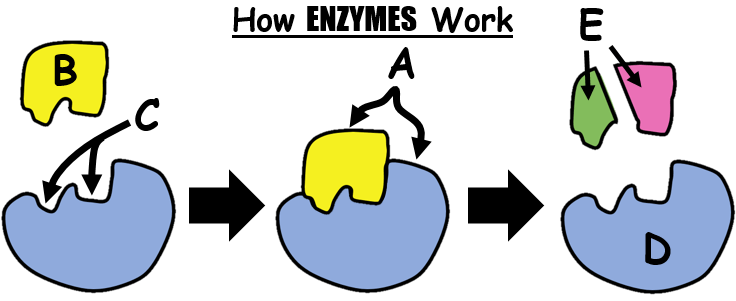
Letter D...
a)
active site
b)
enzyme
c)
substrate
d)
products
24.
What is a substance called if it speeds up a chemical reaction?
a)
reusable
b)
catalyst
c)
specific
d)
fragile
25.
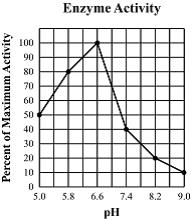
Which of the following conclusions can be drawn from this graph?
a)
The optimum pH of the enzyme is 6.6.
b)
The optimum pH of the enzyme is 5.8
c)
The enzyme’s activity increases as pH increases 5.0 to 9.0
d)
The enzyme’s activity is greater around pH of 8.0 .
26.
Letter E...
a)
active site
b)
enzyme
c)
substrate
d)
products
27.

Which macromolecule is MOST important for a hibernating bear?

a)

Carbohydrate

b)

Lipid

c)

Protein

d)

Nucleic Acid

28.

What is the name of the item that binds to the enzyme?

a)

substrate

b)

enzyme

c)

active site

d)

product

29.

MONOSACCHARIDE is the monomer of which macromolecule?

a)

carbohydrates

b)

lipids

c)

proteins

d)

nucleic acids

30.

What can cause enzymes to move more slowly, resulting in decreased reaction rates?

a)

high temperatures

b)

high pH

c)

low temperatures

d)

low pH

31.

Which biomolecule is most helpful to animals to help keep their body temperature normal in cold temperatures? This is also known as insulation....

a)

Carbohydrates

b)

Lipids

c)

Proteins

d)

Nucleic Acids

32.

Starch that is found in plants is an example of which macromolecule?

a)

Carbohydrates

b)

Lipids

c)

Proteins

d)

Nucleic Acids

33.

Which of the following explains how LIPIDS play a role in plants?

a)

produces fruit and vegetables

b)

gives the plant food (helps it to grow)

c)

makes up the cuticle layer (waxy coating on leaves)

d)

contains chlorophyll (the substance that give plants their green color)

34.

If Enzyme Y denatured, the level of which substance would increase?

a)

Base substance

b)

Ornithine

c)

Citrulline

d)

Arginine

35.

Which of the following does NOT happen when an enzyme is exposed to extremely high or low temperatures?

a)

it changes shape

b)

the enzyme denatures

c)

activity rate increases

d)

can no longer bind to substrate