wayground logo

Free Printable Worksheets

Font size

S
M
L
XL
Worksheets

solutions, mixtures & separating

Total questions: 75

Worksheet time: 57mins

Name
Class
Date
1.

What are mixtures?

a)

different materials placed together but keeping their own properties

b)

a mixture in which substances spread out evenly and will not settle

c)

the degree to which a material will dissolve in another substance

d)

the substance in a solution that has the greatest amount

e)

the substance in a solution that has the least amount

2.

What is a solution?

a)

different materials placed together but keeping their own properties

b)

a mixture in which the solute dissolves and the particles spread out evenly and will not settle

c)

the degree to which a material will dissolve in another substance

d)

the substance in a solution that has the greatest amount

e)

the substance in a solution that has the least amount

3.

What is solubility?

a)

different materials placed together but keeping their own properties

b)

a mixture in which substances spread out evenly and will not settle

c)

the degree to which a material will dissolve in another substance

d)

the substance in a solution that has the greatest amount

e)

the substance in a solution that has the least amount

4.

Which process would you use to separate and analyze the solutes in a solution. During this process bands of color form on filter paper to show the different substances in the solution.

a)

Chromatography

b)

Magnetic Attraction

c)

Filtration

d)

Floatation

e)

Sifting

5.
A combination of two or more substances where each keep their own properties
a)
Mixture
b)
Solution
c)
Substance
d)
Solute
6.
Trail mix, with nuts, raisins, pretzels and candy pieces is a good example of a mixture.
a)
True
b)
False
7.
Is cereal with milk a solution?
a)
Yes
b)
No
8.
If you spilled nails in a sandbox, what separation tool/method could you use to clean out the sandbox so it would be safe for children to play in?
a)
Filter
b)
Screen
c)
Magnet
d)
Evaporation
9.
What is a substance that is dissolved in another substance? 
a)
solution
b)
solute
c)
solvent
d)
compound
10.
Which of these is the best measure of how much space an object or substance takes up?
a)
mass
b)
length
c)
volume
d)
density
11.
How can you increase the concentration of a solution?
a)
Add more solvent.
b)
Add more solute.
c)
Increase the volume of the solution.
d)
Increase the amount of water in the solution.
12.
How do you know when you have a solution?
a)
When the liquid becomes cloudy.
b)
When the solid material dissolves  in the liquid. 
c)
When the solid material sinks to the bottom. 
d)
When the solid material floats on the top of the liquid. 
13.
When a solution evaporates, it leaves the dissolved solid material behind.
a)
True
b)
False
14.
Is water a solvent or a solute?
a)
Solute
b)
Solvent
15.
How can you dilute a concentrated solution?
a)
Add more solid material.
b)
Evaporation.
c)
Add more liquid. 
d)
Filter the solution.
16.
A process that causes liquid to dry up leaving any solid behind.
a)
Solution
b)
Property
c)
Dilute
d)
Evaporate
17.
A characteristic of a substance.
a)
Property
b)
Reactant
c)
Crystal
d)
Solution
18.
A saturated solution is______
a)
No more solute can be dissolved
b)
More solute can be dissolved
c)
The solvent and solution
19.
__________ are made up of solutes and solvents.
a)
Solutions
b)
Suspension
c)
Colloid
d)
mixtures
20.
Amount of solute in a given amount of solvent or solution
a)
Concentration
b)
Miscible
c)
Solute
d)
solubility
21.
Substance dissolved in a solution
a)
concentration
b)
solute
c)
solvent
d)
solution
22.
Capable of being dissolved
a)
Soluble
b)
concentration
c)
colloid
d)
molarity
23.
Which of the following is most likely the reason why the scientists stirred the solution at a high rate of speed?
a)
Stirring allows solvent to be dissovled
b)
Stirring allows solute to do the dissolving
c)
Stirring allows the solution to be unsaturated
d)
Stirring allows the solute to be more easily dissolved
24.

In sweet tea the solvent would be

a)

water

b)

tea

c)

sugar

d)

lemon

25.
When a certain amount of solvent cannot hold any more solute it is called a ________ solution.
a)
Diluted
b)
Saturated
26.

Which is not a separation technique?

a)

Filtration

b)

Distillation

c)

Evaporation

d)

Dissolving

27.

Which tool could you use to separate large and small particles?

a)

A sieve

b)

A distillation flask

c)

Chromatography

d)

Evaporating basin

28.

If something is insoluble in water, it will not...

a)

Separate after distillation

b)

Dissolve in water

c)

Dissolve in anything except water

d)

Separate after filtration

29.

In a solution of saltwater, what is the solute?

a)

Water

b)

Saltwater

c)

Salt

d)

There is no solute, it is insoluble

30.

Which part of a filtration is the "filtrate"?

a)

The filter paper

b)

The solid material left in the funnel

c)

The liquid that has gone through

d)

The conical flask

31.

What words should be used to best describe the concentration of a solution?

a)

Weak and strong

b)

Concentrated and dilute

c)

Dilute and strong

d)

Distillate and concentrated

32.

Which of the following techniques can we use to separate homogeneous mixtures?

a)

Crystallisation

b)

Distillation

c)

Evaporation

d)

All of the above

33.

Name the separation technique

a)

Centrifuge

b)

Bunsen burner

c)

Distillation

d)

Evaporation

34.

Name the separation technique

a)

Distillation

b)

Crystallisation

c)

Magnetic Separation

d)

Condensation

35.

Name the separation technique

a)

Filtration

b)

Evaporation

c)

Centrifuge

d)

Distillation

36.

Name the separation technique

a)

Filtration

b)

Evaporation

c)

Distillation

d)

Separation

37.

True or false: Magnets can be used to separate iron filings from sand

a)

True

b)

False

38.

True or false: Filtration can be used to separate substances in a solution

a)

True

b)

False

39.

Name the separation technique

a)

Distillation

b)

Filtration

c)

Sieving

d)

Crystallisation

40.

True or false: Sieving can be used to separate a mixture with two solid components of different sizes

a)

True

b)

False

41.

Charcoal powder is insoluble in water. When water is filtered, the charcoal powder becomes the _______.

a)

solute

b)

residue

c)

filtrate

d)

solvent

42.

What is the basis for separating the components of a mixture through distillation?

a)

freezing point of the substances

b)

room temperature

c)

decaying period

d)

boiling pint of the substances

43.

The image shows a mixture of concrete nails and saw dusts. What technique is best to use to separate the nails from the saw dusts?

a)

sieving

b)

chromatography

c)

decantation

d)

magnetic separation

44.

Which of the following techniques is used to separate the components of a solution?

a)

filtration

b)

decantation

c)

evaporation

d)

physical manipulation

45.

Dyes in water soluble markers may be separated by means of

a)

Simple distillation

b)

Crystallisation

c)

Chromatography

d)

Filtration

46.

Which technique is shown in the image?

a)

seiving

b)

filtration

c)

decanting

d)

crystallization

47.

The droplets of water that appear on the outside of a glass of cold water on a warm day are an example of?

a)

sublimation

b)

condensation

c)

evaporation

d)

sedimentation

48.

separates mixtures made of solid components large enough to pick out

a)

MAGNETIC SEPARATION

b)

MANUAL PICKING

c)

DECANTATION

d)

SIEVING

e)

FILTERING

49.
Salt dissolved in water.  
What method would you use to separate this mixture so that you can get the salt AND the water?
a)
sorting by hand
b)
distillation
c)
chromatography
50.
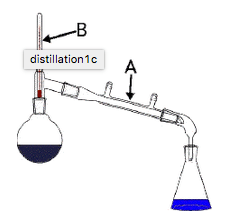
In the distillation apparatus shown, what are the parts labelled A and B?
a)
A = funnel, B = thermometer
b)
A = thermometer, B = funnel
c)
A = condenser, B = flask
d)
A = condenser, B = thermometer
51.
A solution that contains a large amount of solute is best described as 
a)
unsaturated
b)
concentrated
c)
dilute
d)
weak
52.
Which technique is shown the diagram below
a)
seiving
b)
filtration
c)
decanting
d)
crystallization
53.
Dyes in water soluble markers may be separated by means of
a)
Distillation
b)
Decanting
c)
Chromatography
d)
Centrifuge
54.
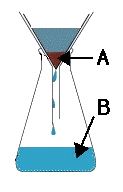
The diagram shows the apparatus for separating soil and water. What are the labelled parts?
a)
A = distillate, B = filtrate
b)
A = filtrate, B = residue
c)
A = residue, B = filtrate
d)
A = residue, B = distillate
55.
If you shake up the sand and water, the sand spreads through the water forming a cloudy ______.
a)
substance
b)
suspension
c)
sediment
d)
solution
56.
No matter what you do, sand will not dissolve in water, sand is _________ ?
a)
dissolved
b)
soluble
c)
insoluble
d)
aqueous
57.
Evaporation is a process that removes a...
a)
solvent (liquid part of solution)
b)
solute (material that dissolves in the solvent)
c)
distillate (liquid collected after a solution is distilled)
d)
impurity
58.

What is filtration?

a)

A method used to separate a solid from a liquid that dissolves in the liquid

b)

A separating technique used to separate a mixture of a solid and liquid where the solid does not dissolve in the liquid

59.

I am left behind in the filter paper ]. What Am I?

a)

Filtrate

b)

Solution

c)

Residue

60.

The part of the mixture that passes through the filter paper is called the

a)

residue

b)

filtrate

c)

suspension

61.

You can filter a solution. True/false?

a)

True!

b)

False!

62.
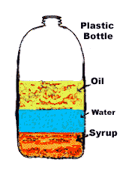
Which liquid is the least dense?
a)
oil
b)
water
c)
syrup 
d)
plastic bottle
63.
Why does ice float?
a)
Liquid water is less dense than solid water.
b)
Solid water is less dense than liquid water.
c)
Gaseous water is less dense than solid water.
d)
Liquid water is less dense than gaseous water.
64.
What two types of measurements make up DENSITY
a)
Mass and Volume
b)
Temperature and Mass
c)
Grams and Centimeters
d)
Volume and Weight
65.

Dirt

a)

Heterogeneous

b)

Homogeneous

66.

Air

a)

Heterogeneous

b)

Homogeneous

67.
Air
a)
Heterogeneous
b)
Homogeneous
68.
Vinegar
a)
Heterogeneous
b)
Homogeneous
69.
A combination that can be separated by physical processes is a .....
a)
Atom
b)
Compound
c)
Element
d)
Mixture
70.
What is a homogeneous mixture?
a)
a mixture that is the same throughout.
b)
a mixture that is made up of one type of atom.
c)
a mixture that is made up of one type of compound
d)
a mixture that cannot be separated through physical changes
71.
A mixture that is NOT evenly distributed is called ....
a)
Compounded
b)
Homogenous
c)
Heterogenous
d)
Salty
72.
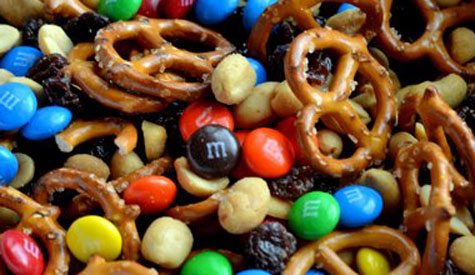
What type of mixture is this?
a)
homogenous mixture
b)
chemical
c)
heterogeneous mixture 
d)
solid mix
73.
Chicken soup is an example of what kind of substance?
a)
homogenous mixture
b)
solution
c)
heterogeneous mixture
d)
compound
74.
Aluminum
a)

Element - pure substance

b)

Compound - pure substance

c)
Homogeneous Mixture
d)
Heterogeneous Mixture
75.
NaCl
a)

Element - pure substance

b)

Compound - pure substance

c)
Homogeneous Mixture
d)
Heterogeneous Mixture