
Font size
 Worksheets
Assertion reason motion chapter
Total questions: 45
Worksheet time: 34mins

Use the graph to help you answer the question. According to the graph, how does the motion of the car compare to the motion of the truck?
The car is showing a greater rate of positive acceleration than the truck.
The truck is showing a greater rate of positive acceleration than the car.
The truck is showing a greater rate of negative acceleration than the car.
The car is showing a greater rate of negative acceleration than the truck.

Based on the graph, what can you say about the truck’s motion at 4 seconds?
The truck is traveling downhill.
The truck’s average speed is 20 m/s.
The truck has an instantaneous speed of 20 m/s.
The truck’s speed is the same as it is throughout because the line has the same slope.

Which of the following position vs. time graphs shows an object that is moving with a constant positive velocity?
A
B
C
D

A ball rolls down a ramp with a constant acceleration. What would the corresponding position vs. time and velocity vs. time graphs be for the motion of the ball down the ramp?
A
B
C
D

Which of the following position vs. time graphs shows an object increasing its speed?
A
B
C
D

What is occurring on this graph?
slowing down in the positive direction
moving at a constant speed in the positive direction
positive change in momentum
positive net force


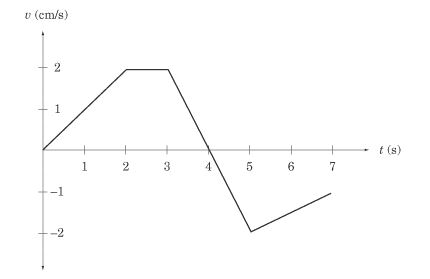
What is happening between 2 and 3 seconds?
The object is not moving.
The object is not accelerating.
The object is slowing down.
The object is speeding up.

What was the total distance traveled by the object during the entire time interval?
0 m
8 m
16 m
24 m
How long would it take a car, starting from rest and accelerating uniformly in a straight line at 5 m/s2, to cover a distance of 200m
9.0s
10.5s
12.0s
15.5s
A swimmer's speed in the direction of flow of river is 16 km h -1 . Against the flow of river, the swimmer's speed is 8 km h -1 . The swimmer's speed in still water and the velocity of flow of the river respectively are
12 km h -1 , 4 km h -1
4 km h -1 ,12 km h -1
24 km h -1 ,16 km h -1
16 km h -1 ,24 km h -1
A particle is thrown vertically upward. Its velocity at half of the height is 10 m /s then the maximum height attained by it is ( g = 10m/s2)
8m
20m
10m
16m
If the velocity is v = 2i + t2j - 9 k , then the magnitude of acceleration at t = 0.5 s is ___
1 m s -2
2 m s -2
zero
-1 m s -2
Identify the unit vector in the following.


If an object is dropped from the top of
a building and it reaches the ground at t
= 4 s , then the height of the building is
(ignoring air resistance) (g = 9.8 ms–2)
77.3 m
78.4 m
80.5 m
79.2 m
A ball is projected vertically upwards
with a velocity v. It comes back to ground
in time t. Which v-t graph shows the
motion correctly?


A unit vector is used to specify
only magnitude
only direction
either magnitude or direction
absolute value
Slope of displacement -time graph gives
velocity
speed
acceleration
displacement
Which one of the following does not belong to motion in one dimension (v-t) graph


y = -4x2
have a maximum or minimum value?
R(t) represents the rate at which people enter a line, measured in people per minute. What does R'(3) = 4 represent?
At t = 3 minutes, people are entering the line at a rate of 4 people per minute.
At t = 3 minutes, the rate at which people are entering the line is increasing at a rate of 4 people per minute per minute.
At t = 3 minutes, there are 4 people in line.
At t = 4 minutes, 3 people are in line.

B(t) represents the temperature of the biscuits after t minutes. What does the following notation represent?
The temperature of the biscuits at 10 minutes
The average temperature of the biscuits on the time interval 3 to 10 minutes.
The average rate of temperature on the interval 3 to 10 minutes.
The change in temperature of the biscuits on the time interval 3 to 10 minutes.
B(t) represents the temperature of the biscuits after t minutes. What does the following notation represent?
The temperature of the biscuits at 10 minutes
The average temperature of the biscuits on the time interval 3 to 10 minutes.
The average rate of temperature on the interval 3 to 10 minutes.
The change in temperature of the biscuits on the time interval 3 to 10 minutes.
A particle travels along the x-axis. The position of the particle at t = 4 is 10. Which of the following would give you the position of the particle at t = 7?


v(7)
v(4) + v(7)

The rate at which the temperature outside is changing is represented by the function O(t). What does the following represent?
The temperature after 12 minutes is 15 degrees.
The temperature has increased 15 degrees on the time interval 5 to 12 minutes.
The rate of change of temperature on the interval 5 to 12 minutes is 15.
The temperature at 5 minutes is 15 degrees.

H(t) represents the number of hats purchased at a store after t hours. What does the above notation represent ?
The number of hats sold on the time interval 4 to 8 hours was 32.
The number of hats sold at t = 8 hours was 32.
The rate at which hats were sold on the interval 4 to 8 hours was 32.
The number of hats sold at t = 4 hours was 32.
dyd(32x2−2x+4)=....
34x+2
34x2−2
34x−2
34x2+2
34x2+2x
Assertion : A body may be accelerated even when it is moving uniformly.
Reason : When direction of motion of the body is changing, the body must have acceleration
a) Assertion is correct, reason is correct; reason is a correct explanation for assertion.
(b) Assertion is correct, reason is correct; reason is not a correct explanation for assertion
(c) Assertion is correct, reason is incorrect
(d) Assertion is incorrect, reason is correct.
Assertion : Displacement of a body may be zero when distance travelled by it is not zero.
Reason : The displacement is the longest distance between initial and final position
a) Assertion is correct, reason is correct; reason is a correct explanation for assertion.
(b) Assertion is correct, reason is correct; reason is not a correct explanation for assertion
(c) Assertion is correct, reason is incorrect
(d) Assertion is incorrect, reason is correct.
Assertion : For one dimensional motion the angle between acceleration and velocity must be zero.
Reason : One dimensional motion is always on a straight line
a) Assertion is correct, reason is correct; reason is a correct explanation for assertion.
(b) Assertion is correct, reason is correct; reason is not a correct explanation for assertion
(c) Assertion is correct, reason is incorrect
(d) Assertion is incorrect, reason is correct.
Assertion : Displacement of a body is vector sum of the area under velocity– time graph.
Reason : Displacement is a vector quantity.
a) Assertion is correct, reason is correct; reason is a correct explanation for assertion.
(b) Assertion is correct, reason is correct; reason is not a correct explanation for assertion
(c) Assertion is correct, reason is incorrect
(d) Assertion is incorrect, reason is correct.
Assertion : The position-time graph of a uniform motion, in one dimension of a body cannot have negative slope.
Reason : In one – dimensional motion the position does not reverse, so it cannot have a negative slope.
a) Assertion is correct, reason is correct; reason is a correct explanation for assertion.
(b) Assertion is correct, reason is correct; reason is not a correct explanation for assertion
(c) Assertion is correct, reason is incorrect
(d) Assertion is incorrect, reason is correct.
Assertion : Position-time graph of a stationary object is a straight line parallel to time axis.
Reason : For a stationary object, position does not change with time.
a) Assertion is correct, reason is correct; reason is a correct explanation for assertion.
(b) Assertion is correct, reason is correct; reason is not a correct explanation for assertion
(c) Assertion is correct, reason is incorrect
(d) Assertion is incorrect, reason is correct.
Assertion : Velocity-time graph for an object in uniform motion along a straight path is a straight line parallel to the time axis.
Reason : In uniform motion of an object velocity increases as the square of time elapsed.
a) Assertion is correct, reason is correct; reason is a correct explanation for assertion.
(b) Assertion is correct, reason is correct; reason is not a correct explanation for assertion
(c) Assertion is correct, reason is incorrect
(d) Assertion is incorrect, reason is correct.
Assertion : The average and instantaneous velocities have same value in a uniform motion.
Reason : In uniform motion, the velocity of an object increases uniformly
a) Assertion is correct, reason is correct; reason is a correct explanation for assertion.
(b) Assertion is correct, reason is correct; reason is not a correct explanation for assertion
(c) Assertion is correct, reason is incorrect
(d) Assertion is incorrect, reason is correct.

