wayground logo

Free Printable Worksheets

NEW

Font size

S
M
L
XL
Worksheets

AP Unit 1 Review

Total questions: 60

Worksheet time: 30mins

Name
Class
Date
1.

In Darwin's thinking, the more closely related two different organisms are, the

a)

more similar their habitats are.

b)

less similar their DNA sequences are.

c)

more recently they shared a common ancestor.

d)

less likely they are to have the same genes in common.

e)

more similar they are in size.

2.

What is one way in which all living things on Earth are alike?

a)

All living things have hair.

b)

All living things have DNA

c)

The cells of all living things have chloroplast.

d)

All living things can move.

3.
The 20 different amino acids found in polypeptides exhibit different chemical and physical properties because of different
a)
amino groups attached to an alpha  carbon
b)
asymmetric carbons.
c)
carboxyl groups attached to an alpha  carbon
d)
side chains (R groups).
4.

Condensation between two amino acids results in a _________, joined by a _________ bond.

a)

dipeptide, peptide

b)

dipeptide, ester

c)

disaccharide, peptide

d)

disaccharide, ester

5.
Which question were the scientists trying to answer with this experiment?
a)
Where do cells come from?
b)
What came first the chicken or the egg?
c)
How are biomolecules formed?
d)
What gave rise to the Eukaryotic cell?
6.
Miller/Urey and other scientists have shown that:
a)
 Life on early Earth required material from space
b)
Cells survived in the primitive atmosphere
c)
Amino acids could be produced from inorganic molecules 
d)
Simple cells can be produced in a laboratory
7.
Which functional group is a base?
a)
Amine
b)
Carboxyl
c)
Methyl
d)
Sulfhydryl
8.
A(n) ______ is a substance with a pH less than 7
a)
Acid
b)
Alkaline
c)
Base
d)
Buffer
9.
How many electron pairs does carbon share in order to complete its valence shell?
a)
1
b)
3
c)
4
d)
8
10.

Which monomer is correctly matched with the type of bond that holds them together?

a)

lipid: carbohydrate covalent bonds

b)

nucleotide: ester linkages

c)

monosaccharide: hydrogen and phosphodiester bonds

d)

amino acids: peptide bonds

11.
Lactose, a sugar in milk, is composed of one glucose molecule joined by a glycosidic linkage to one galactose molecule. How is lactose classified?
a)
as a disaccharide
b)
as a polysaccharide
c)
as a monosaccharide
d)
as a hexose
12.
How do isotopes of the same element differ from each other?
a)
number of protons
b)
number of electrons
c)
valence electron distribution
d)
number of neutrons
13.
Water molecules require a lot of energy to separate one from the others.  This gives water a high
a)
density
b)
polarity
c)
solvency
d)
specific heat
14.
What would be the effect on the particles if more heat is supplied to the system?
a)
They would slow down
b)
They would stop moving
c)
They would speed up
d)
There would be no effect
15.
The specific heat is the amount of energy needed to raise the temperature one degree Celsius of 1 gram of a substance.
a)
True
b)
False
16.
What is the function of ATP in living things?
a)
provides energy for cells
b)
stores genetic information
c)
provides structure in the nucleus
17.
What does the "TP" in ATP stand for?
a)
2 phosphates
b)
tri (3) phosphates
c)
Two proteins
d)
tri (3) proteins
18.
Which of the following can be compared to a battery in need of recharging?  (empty wallet)
a)
ADP
b)
ATP
c)
Ribose
d)
Adenosine
19.

The electrons in a polar covalent molecule are shared...

a)

Evenly

b)

Unevenly

c)

Electrons are not shared

d)

None of the Above

20.

Is this molecule polar or non-polar?

a)

Polar

b)

Non-polar

21.
Which of the following is a polar molecule?
a)
CH4
b)
Xe
c)
H2O
d)
CO2
22.
Which of the following statements concerning saturated fats is not true?
a)
They have multiple double bonds in the carbon chains of their fatty acids.
b)
They contain more hydrogen than unsaturated fats having the same number of carbon atoms.
c)
They generally solidify at room temperature.
d)
They are more common in animals than in plants.
23.

Which of the following is considered fully saturated?

a)
b)
c)
d)
24.
A product that contains lots of hydrogenated oils is probably rich in:
a)
Saturated fat
b)
Unsaturated fat
c)
Monosaturated fat
d)
Trans fat
25.
Saturated fats are __________ at room temperature.
a)
liquid
b)
gases
c)
plasma
d)
solid
26.

Identity the structure:

a)

Carbohydrate

b)

Lipid

c)

Nucleic Acid

d)

Protein

27.

Identity the structure:

a)

Carbohydrate

b)

Lipid

c)

Nucleic Acid

d)

Protein

28.

Identity the structure:

a)

Carbohydrate

b)

Lipid

c)

Nucleic Acid

d)

Protein

29.

Identity the structure:

a)

Carbohydrate

b)

Lipid

c)

Nucleic Acid

d)

Protein

30.

Identity the structure:

a)

Carbohydrate

b)

Lipid

c)

Nucleic Acid

d)

Protein

31.

Identify the macromolecule in the picture

a)

phospholipid

b)

triglyceride

c)

steroid

d)

carbohydrate

32.

The molecules in the image can be classified as:

a)

waxes

b)

steroids

c)

fatty acids

d)

phospholipids

33.
If cells are grown in a medium containing radioactive 15N, which of these molecules will be labeled?
a)
both proteins and nucleic acids
b)
proteins only
c)
amylase only
d)
nucleic acids only
34.
Which of the following best summarizes the relationship between dehydration reactions and hydrolysis?
a)
Dehydration reactions eliminate water from lipid membranes, and hydrolysis makes lipid membranes water permeable.
b)
Dehydration reactions ionize water molecules and add hydroxyl groups to polymers; hydrolysis reactions release hydroxyl groups from polymers.
c)
Dehydration reactions assemble polymers, and hydrolysis reactions break down polymers.
d)
Dehydration reactions can occur only after hydrolysis.
35.
Which property is most closely associated with the hydroxyl functional group?
a)
Polar
b)
Nonpolar
c)
Basic
d)
Acidic 
36.

Which type of macromolecule is used for long term energy storage?

a)
b)
c)
d)
37.
Which of the following is correctly defined as the attraction of the hydrogen from one molecule to the oxygen of a different molecule?
a)
amphipathic
b)
hydrophobic
c)
hydrogen bonding
d)
adhesion
38.
Water drops that fall on a surface tend to form rounded drops or beads.  This is due to the __________ of water.
a)
adhesion
b)
cohesion
c)
density
d)
specific heat
39.
What is the molecule illustrated in the figure below?
a)
a trans polyunsaturated triacylglyceride
b)
a steroid similar to cholesterol
c)
a saturated fatty acid
d)
an unsaturated fatty acid
40.
Which two functional groups are always found in amino acids?
a)
ketone and aldehyde
b)
hydroxyl and aldehyde
c)
carboxyl and amine
d)
carbonyl and carboxyl
41.

Which of the following is NOT a part of the DNA nucleotide?

a)

Deoxyribose sugar

b)

Phosphate group

c)

Nitrogenous base

d)

Lysine amino acid

42.
Which 2 molecules form the sides (backbone) of the DNA ladder?
a)
deoxyribose sugar and adenine
b)
deoxyribose sugar and a hydrogen bond
c)
deoxyribose sugar and the nucleus
d)
deoxyribose sugar and phosphate
43.
The bond that joins amino acids are called:
a)
Peptide Bonds
b)
Ester Bonds
c)
Glycosidic Linkages
d)
Phosphodiester Bonds
44.

If a methyl group (-CH3), which does not like water, were at the 'R', the amino acid would likely be:

a)

Hydrophobic

b)

Hydrophilic

c)

Ionic

d)

Acidic

45.

The molecules in the image can be classified as:

a)

amino acids

b)

steroids

c)

fatty acids

d)

phospholipids

46.

Are the two means shown in the graph significantly different from each other?

a)

Yes, because the error bars don’t overlap

b)

Yes, because the error bars do overlap

c)

No, because the error bars do overlap

d)

No, because the error bars don’t overlap

47.

Ate the two means shown in the graph significantly different from each other?

a)

Yes, because the error bars don’t overlap

b)

Yes, because the error bars do overlap

c)

No, because the error bars do overlap

d)

No, because the error bars don’t overlap

48.

Which two points of data are significantly different from one another?

a)

A and D

b)

C and B

c)

C and E

d)

B and D

e)

B and E

49.
This part of the experiment serves as a basis of comparison; the one variable being tested has been omitted. 
a)
experimental group
b)
control group
c)
data
d)
variables
50.
Carbohydrates are made of... 
a)
C H O
b)
C H O N
c)
C H O N P
d)
C H O N S
51.
Lipids are made of... 
a)
C H O
b)
C H O N
c)
C H O N P
d)
C H O N S
52.

Proteins are made of...

a)

C H O

b)

C H O P

c)

C H O N P

d)

C H O N S

53.

Nucleic Acids are made of...

a)

C H O

b)

C H O P

c)

C H O N P

d)

C H O N S

54.
Which of these is NOT true?
a)
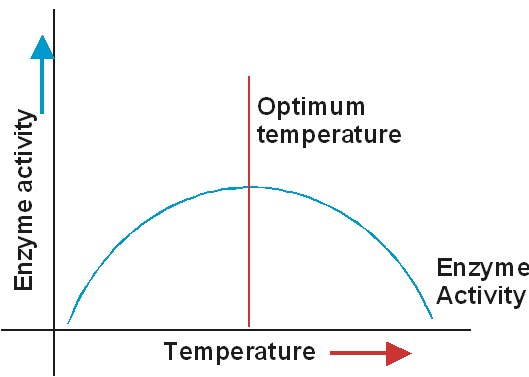
Enzymes can denature (change shape) when the temperature gets too high.
b)
Enzymes can only be used once in a chemical reaction. 
c)
Extreme pH can denature enzymes.
d)
Enzymes speed up chemical reactions. 
55.
At high temperatures enzyme activity declines because of:
a)
Denaturation
b)
Decreased Kinetic Motion
c)
Increased H-Bonding
d)
Dissociation of Ionic Compounds
56.

Molecules that stick to the same type of molecules.

a)

cohesion

b)

adhesion

c)

hydrophilic

d)

hydrophobic

57.

Ice floats on water because

a)

adhesion

b)

cohesion

c)

water expands when it freezes

d)

water shrinks when it freezes

58.

When salt is dissolved in water, water is the

a)

solvent

b)

solute

c)

solution

d)

reactant

59.

Capillary action is....

a)

adhesion

b)

cohesion

c)

change in matter (heat of fusion)

d)

both adhesion and cohesion

60.
Which is NOT a unique property of water?
a)
Frozen water floats on liquid water.
b)
Water covers most of the Earth’s surface and retains a large amount of heat.
c)
Water molecules stick to each other through hydrogen bonds.
d)
Water cools very rapidly.