
 Worksheets
Heating Cooling Pressure
Total questions: 55
Worksheet time: 25mins
Process of changing a liquid to a solid
boiling
freezing
condensation
melting
State of matter where particles are tightly packed and move very little.
Solid
Liquid
Gas
Plasma
State of matter in which particles are free to flow over each other and take the shape of their container
Solid
Liquid
Gas
Plasma
Measure of the average kinetic energy of a substance
Total Thermal Energy
Heat Exchange
Temperature
Total Internal Energy
The process of changing a gas to a liquid
Freezing
Boiling
Condensation
Melting
Matter is something that has ___________ and _____________.
mass and is always hungry.
heat and is using up energy.
mass and takes up space.
heat and does not use energy.

Can't be felt with your hand, but it takes the shape of the container.
liquid
solid
gas
matter

Can be felt with your hand and takes the shape of the container.
matter
solid
gas
liquid

Something that has a definite shape.
gas
liquid
solid
smiles

Water changing from gas to liquid.
condensation
cooling
heating
gas
in all directions
Air Pressure is the effect of
collisions of air molecules against surfaces

Pressure in gases is a measure of:
the number of collisions per second of the particles with the side of the container.
the force of the collisions of the particles with the side of the container.
the amount of space taken up by the particles in the container.
None of the above

Pressure can be exerted by solids, liquids and gases.
TRUE
FALSE

The pressure inside the balloon will:
Decrease
Increase
Remain the same
Not enough information to formulate an answer

The pressure of the gas in the balloon in the ice water will be:
Greater than that of the balloon in the boiling water.
Less than that of the balloon in the boiling water.
The same as that of the balloon in the boiling water.
Not enough information to answer the statement.

The reason gases can be compressed is because:
The particles are very close together.
The particles are merely vibrating.
The particles are unable to move.
The particles are very far apart.
If a hairspray can is heated, what can be expected of the pressure of the gas inside the can?
The pressure will increase
The pressure will decrease
The pressure will remain constant
The pressure will equalize

We can increase the pressure of a gas by:
Adding more gas.
Reduce the volume of the container.
Increase the temperature of the gas.
All three
the temperature scale on which 0 is the temp at which no more energy can be removed
absolute zero
Fahrenheit scale
Kelvin scale
Celsius scale
the temperature scale on which water freezes at 0 and boils at 100
Kelvin scale
conduction
Fahrenheit scale
Celsius scale
What is the freezing point of water?
36 degrees C
100 degrees C
0 degrees C
10 degrees C
What is the boiling point of water?
100 degrees C
98.6 degrees C
0 degrees C
36 degrees C
An ice cube melting is an example of which change of matter?
Liquid to solid
Solid to Liquid
Solid to gas
Gas to liquid

Wht will happen when heat is added?
Particles will increase speed
Pressure will increase
The chamber will expand
The number of molecules will increase

What will happen when the system is cooled?
The molecules will slow down
the temperature will decrease
the pressure will decrease
the lid might blow off

What is happening in this diagram
liquid water is vaporizing due to heat
air molecules are being pushed out of the can
the metal is getting warmer
the water vapor is condensing into liquid

What is happening to the can in this picture
the partial vacuum inside the can is pushing against the sides
the air and water pressure outside is pushing on the sides of the can
the water is being sucked up into the can
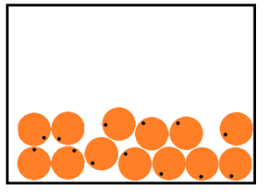

Which best explains why the sphere will not go through the ring after it is heated?
The particles in the sphere moved faster when heated.
The particles in the sphere slowed down when heated.
The particles in the sphere got closer when heated.
The particles in the sphere spread out when heated.

What happens to molecules when the temperature drops or lowers?
The molecules get closer together
The molecules start moving faster.
The molecules stop moving.
The molecules become smaller.

You watch your science teacher put a balloon in a bowl of liquid nitrogen and see the balloon has shrunk like a raisin. Which answer BEST explains how you know if HEAT ENERGY been ADDED or REMOVED.
HEAT ENERGY has been ADDED. I know this because the balloon has become LARGER meaning the molecule ARRANGEMENT is FARTHER APART.
HEAT ENERGY has been REMOVED. I know this because the balloon has become SMALLER meaning the molecule ARRANGEMENT is CLOSER.
HEAT ENERGY has actually stayed the SAME. I know this because the balloon has NOT CHANGED meaning the molecule ARRANGEMENT is also NOT CHANGED.

Water went up the test tube after heating, steaming and then turning over into the bowl of water because...
it wanted to go up
the water in the bowl was cooler than the air in the tube
the pressure in the tube was less than the pressure outside the tube
the water was sucked into the tube

The balloon inflated on the heated flask because....
the pressure inside the balloon was less than outside
the air molecules inside the flask were being heated and their volume was expanding
the air was cooler outside the flask so we made the air pressure outside less
because it wanted to inflate

The balloon on the flask stopped inflating because....
it wanted to stop inflating
the forces were in equilibrium
the flask started to cool
the pressure outside was greater than the pressure inside
How does heat energy reach the Earth from the Sun
Convection
Radiation
Conduction
Insulation
What is the definition of CONDUCTION?
When heat is transferred from objects like rays of light or electromagnetically.
a hot liquid or air that expands, becomes less dense, and rises or becomes more dense, and sinks.
When thermal energy transfers by collisions between particles.
When heat transfers through the heater or AC in your house.
What is the definition of CONVECTION
When heat transfers through waves.
When heat transfers from objects that are touching.
The transfer of thermal energy in a fluid (liquid/gas) by movement of warm / cool fluids.
Heat traveling from the sun
True or False: When water begins to boil air bubbles form in the liquid.
True
False
True or False: It is impossible to boil water at room temperature.
True
False
True or False: In the vast empty regions of space temperatures are extremely hot.
True
False

