
 Worksheets
U3 6th Grade Waves Study Guide
Total questions: 59
Worksheet time: 31mins

Which of the waves shown is transferring the greatest amount of energy?
A
B
C
It is impossible to tell which is transferring the most energy.
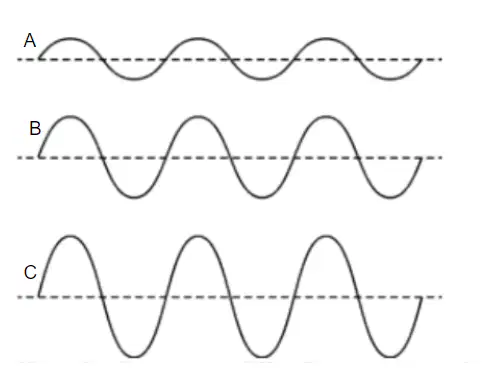
Which of the following waves is transferring the least energy?
A
B
C
It is impossible to tell which is transferring the least energy.
The greater the amplitude of a wave, the greater the...
longitudinal force
frequency of waves
amount of energy transferring
rarefaction
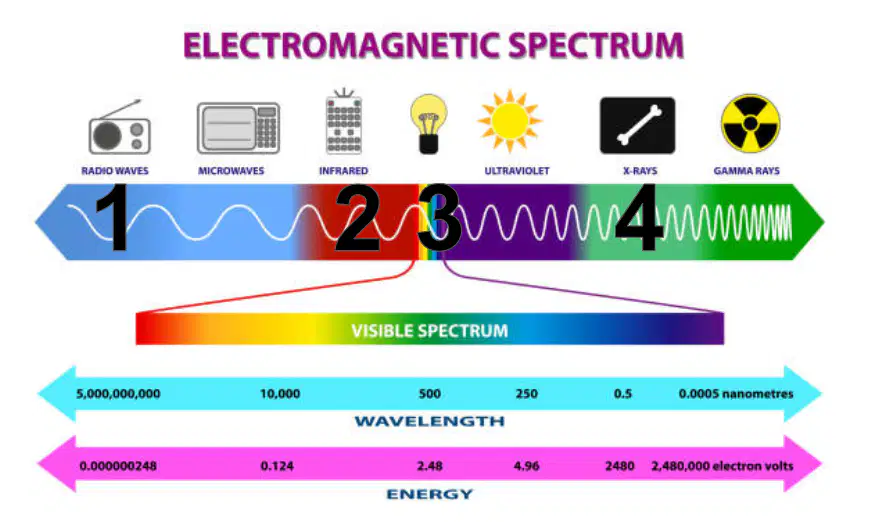
Which numbered area on the electromagnetic spectrum shown below contains visible light?
1
2
3
4
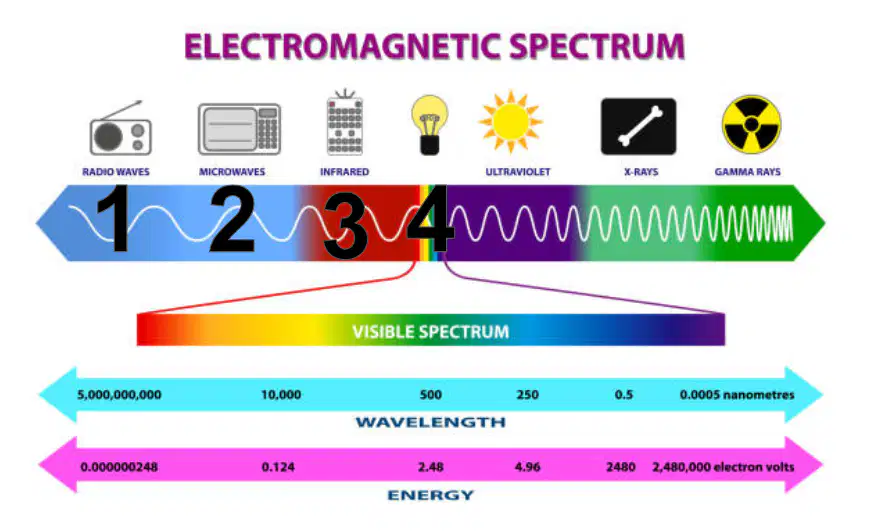
Which numbered area on the electromagnetic spectrum shown below contains visible light?
1
2
3
4

Which type of wave is just left of visible light (and has longer wavelengths) on the electromagnetic spectrum?
infrared
ultraviolet
x rays
gamma rays

Which type of wave is just right of visible light (and has shorter wavelengths) on the electromagnetic spectrum?
radio waves
microwaves
infrared
ultraviolet
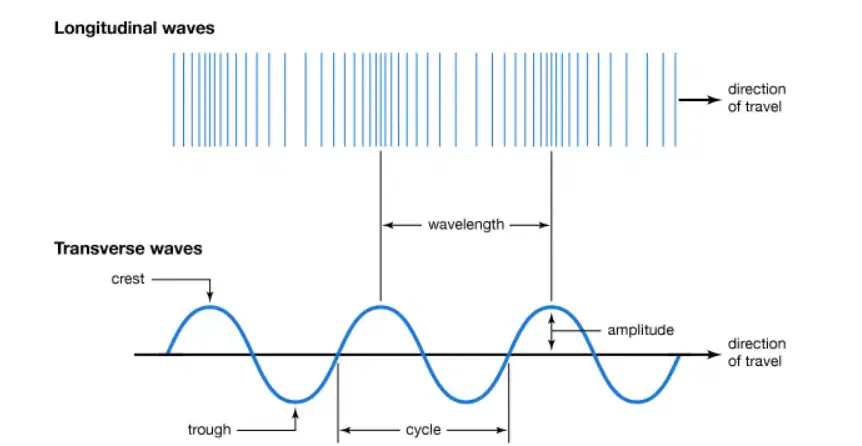
The images show a transverse wave and a longitudinal wave. Which of the following do both types of waves have?
crest
compression
trough
wavelength
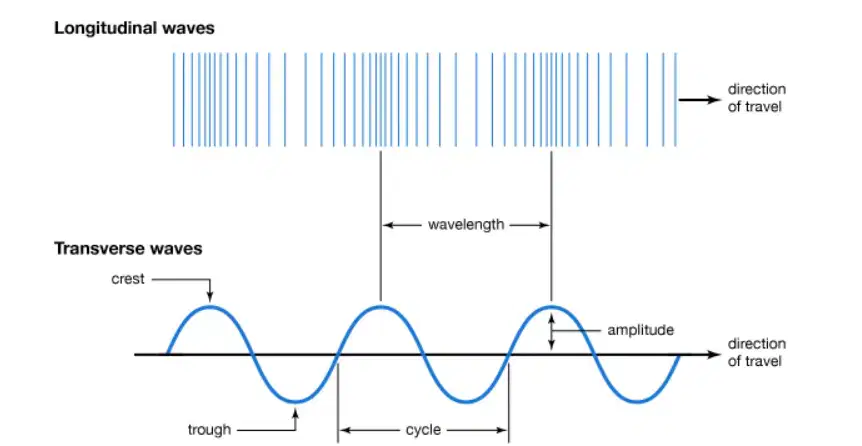
Which of the following is most associated with longitudinal waves?
trough
rarefaction
crest
amplitude

Which of the following is most associated with transverse waves?
compression
rarefaction
amplitude
density
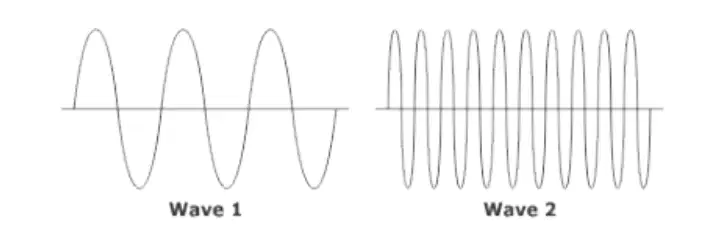
Which of the following is true?
Wave 1 has a greater amplitude than wave 2.
Wave 1 has a shorter wavelength than wave 2.
Wave 2 has a longer wavelength than wave 1.
Wave 1 has a longer wavelength than wave 2.

Which of the following is true?
Wave 1 has a higher frequency than wave 2.
Wave 2 has a longer wavelength than wave 1.
Wave 2's frequency is higher than wave 1's frequency.
Wave 1 has a shorter wavelength than wave 2.
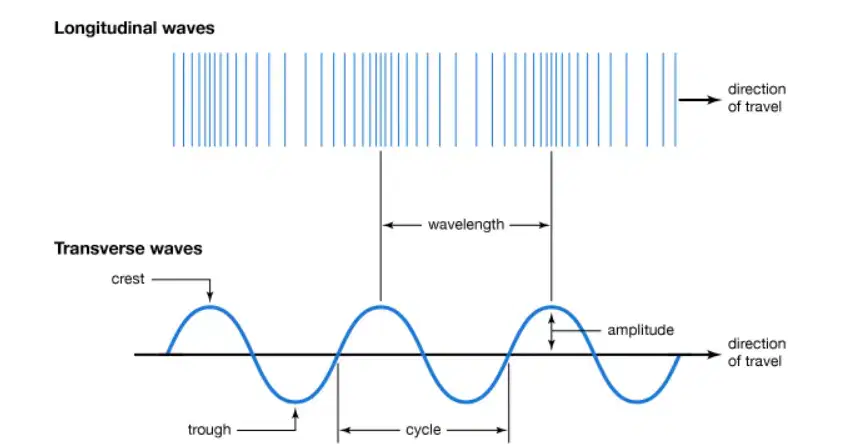
Which of the following best describes a major difference between longitudinal and transverse waves?
The energy in longitudinal waves travels perpendicular to the direction of travel while the energy in transvese waves moves parallel to the direction of travel.
The energy in transverse waves travels perpendicular to the direction of travel while the energy in longitudinal waves moves parallel to the direction of travel.
Transverse waves have compressions and rarefactions while longitudinal waves have troughs and crests.
Transverse waves have compressions and crests while longitudinal waves have troughs and rarefactions.
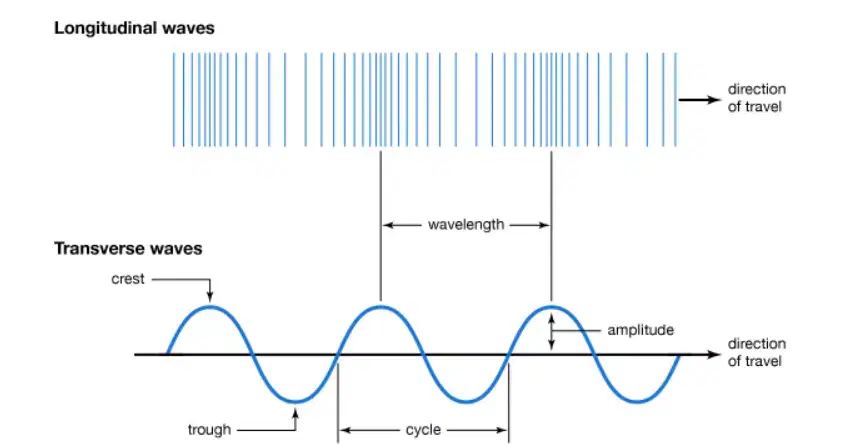
Which type of wave's energy travels parallel to the direction of travel/disturbance in compression?
transverse wave
longitudinal wave
microwave
infrared waves
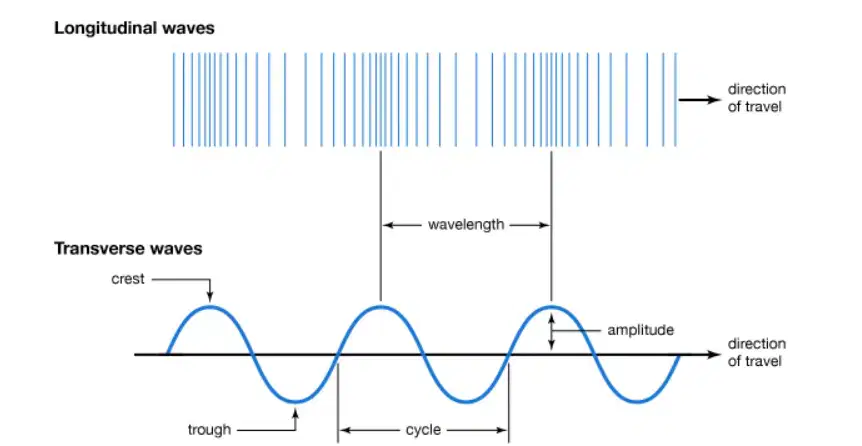
Which type of wave's energy travels perpendicular to the direction of travel?
transverse wave
longitudinal wave
sound waves
seismic waves

Which wave has a higher frequency?
A
B
It is impossible to determine which has a higher frequency.
The frequency is the same in both waves.
"The number of waves that occur in a certain amount of time, usually measured per second."
Which of the following terms best matches the definition above?
wavelength
compressions
rarefaction
frequency
Select the two pictures that show compression in a longitudinal wave.


Select the two pictures that show rarefaction in a longitudinal wave.
Select the 2 diagrams that show higher frequency sound waves.


Select the 2 diagrams that show lower frequency sound waves.

A higher frequency sound wave...
has higher amplitude
has more compressions and rarefaction in a given amount of time
has fewer compressions and rarefaction in a given amount of time
is impossible to determine
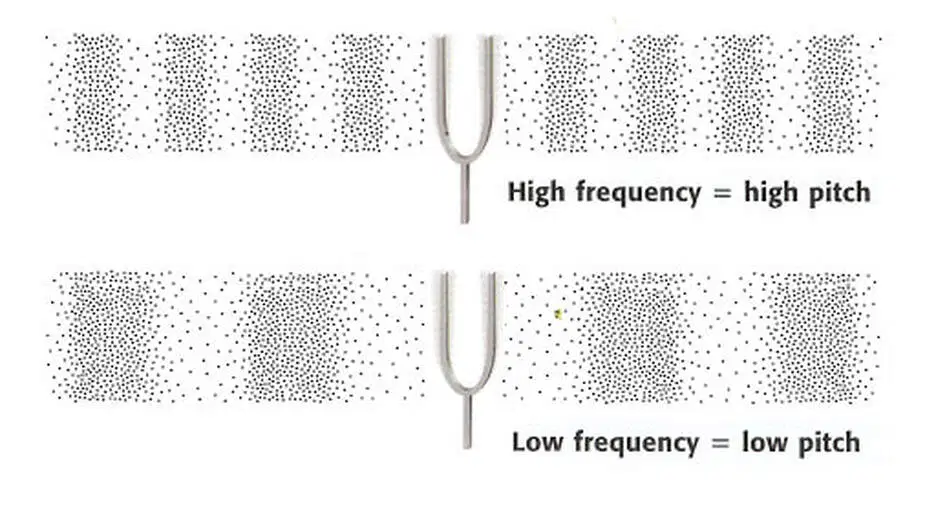
A lower frequency sound wave...
has higher amplitude
has more compressions and rarefaction in a given amount of time
has fewer compressions and rarefaction in a given amount of time
is impossible to determine
Which represents a high frequency sound wave?


Which represents a low frequency sound wave?


What type of wave is transmitted from the Sun to Earth through space?
chemical energy
electromagnetic energy
kinetic enery
electrical energy
Boon is going to a soccer game on a sunny, but cold morning. What color should he wear to collect as much heat from the sun's electromagnetic waves and stay as warm as possible?
white
blue
black
silver

Which of the following takes the light the eye receives and changes it into nerve signals so the brain can understand what the eye is seeing?
lens
cornea
pupil
retina
Which of the following is utilized by the eye to refract light, adjusting sight for both near and far objects?
lens
cornea
pupil
retina
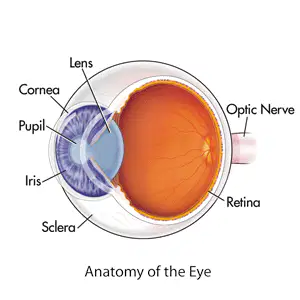
Which of the following is the clear transparent section of the eye which that covers the iris, pupil, and the eye chamber?
Lense
Cornea
Pupil
Retina
Which of the following is the opening at the center of the iris through which light passes
Lense
Cornea
Pupil
Retina
How does the color of an object affect the amount of energy it receives from sunlight?
Light colors absorb more energy and stay cooler than dark colors.
Light colors absorb more energy and get warmer than dark colors.
Dark colors reflect more energy and stay cooler than light colors.
Dark colors absorb more energy and get warmer than light colors.
Which of the following best explains how a person sees a red shirt?
Light is produced. All light waves reflect off the shirt The human eye sees the image as a red shirt.
Light is produced. Red light waves reflect off the shirt. The human eye sees the image as a red shirt.
Light is produced. All light waves are absorbed into the shirt. The human eye sees the image as a red shirt.
Light is produced. Red light waves are absorbed into the shirt. The human eye sees the image as a red shirt.
Which of the following best explains how a person sees the blue sky?
Light is produced. Blue light waves reflect off the sky. The human see the image as a blue sky.
Light is produced. All light waves reflect off the shirt The human eye sees the image as a blue sky.
Light is produced. All light waves are absorbed into the sky. The human eye sees the image as a blue sky.
Light is produced. Blue light waves are absorbed into the sky. The human eye sees the image as a blue sky.

Which of the following words best describes the part of the wave labeled as number 1?
crest
trough
wavelength
amplitude
Which of the following words best describes the part of the wave labeled as number 2?
crest
trough
wavelength
amplitude
Which of the following words best describes the part of the wave labeled as number 3?
crest
trough
wavelength
amplitude
Which of the following words best describes the part of the wave labeled as number 4?
crest
trough
wavelength
amplitude
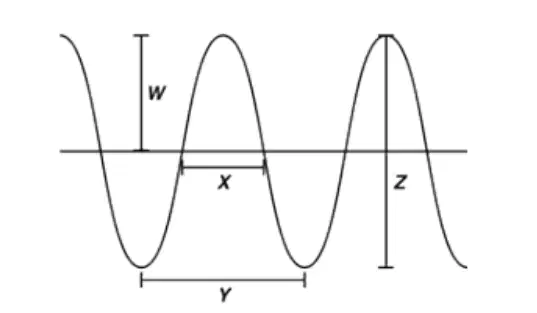
Which letter labels the amplitude?
W
X
Y
Z
Which letter labels the wavelength?
W
X
Y
Z

Which part of a longitudinal wave is labeled at Point A?
compression
rarefaction
wavelength
frequency
Which part of a longitudinal wave is labeled at Point B?
compression
rarefaction
wavelength
frequency
Which part of a longitudinal wave is labeled at Point C?
compression
rarefaction
wavelength
frequency

Which number represents a compression in this sound wave diagram?
1
2
3
4
Which is a statement that describes both light waves and sound waves?
Both are part of the electromagnetic spectrum.
Both sound and light travel in transverse waves.
The intensity of both sound and light decreases as we move away from the source.
Both sound and light travel in longitudinal waves.
Which best describes a sound wave?
Sound waves can travel through the vacuum of outer space.
Sound waves are unable to move through liquid water.
Sound waves are transverse.
Sound waves are longitudinal.
Which best describes a light wave? (pick 3)
Light waves can travel through the vacuum of outer space.
Light waves are longitudinal.
Light waves can travel through liquid water.
Light waves are transverse.
Which of the following is true?
Sound waves can travel through the vacuum of space, but light waves cannot.
Light waves and sound waves travel at the same speed.
Sound waves can travel through liquid water, but light waves cannot.
Both sound and light waves can travel through liquid water.

Which wave has a longer wavelength?
Wave 1
Wave 2
The wavelengths are the same for both waves.
It's impossible to know which wavelength is longer.
Which wave has a shorter wavelength?
Wave 1
Wave 2
The wavelengths are the same for both waves.
It's impossible to know which wavelength is longer.
Which wave has a higher frequency?
Wave 1
Wave 2
The frequencies are the same for both waves.
It's impossible to know which frequency is higher.
Which wave has a lower frequency?
Wave 1
Wave 2
The frequencies are the same for both waves.
It's impossible to know which frequency is higher.
Which of the following types of waves can be found on the electromagnetic spectrum?
seismic waves
visible light waves
longitudinal waves
mechanical waves

As wavelength increases...
amplitude increases
frequency increases
frequency decreases
wavelength decreases
As wavelength decreases...
amplitude increases
frequency increases
frequency decreases
wavelength decreases
Sound is produced by:
electrical signals in the brain
radiation from electromagnetic waves
The vibration of a medium
the presence of a vacuum
Which choice shows the path of sound traveling through the ear?
hammer → stirrup → anvil → eardrum → ear canal
ear canal → eardrum → hammer → anvil → stirrup
ear canal → eardrum → hammer → stirrup → anvil
eardrum → ear canal → hammer → anvil → stirrup
Which statement best explains how music is converted into electrical signals in a person’s brain?
Music makes the eardrum vibrate. The eardrum’s vibrations are then transmitted to the outer ear, which converts the vibrations into electrical signals that are sent to the brain.
Music makes the outer ear vibrate. The outer ear’s vibrations are then transmitted to the eardrum, which converts the vibrations into electrical signals that are sent to the brain.
Music makes the inner ear vibrate. The inner ear’s vibrations are then transmitted to the eardrum, which converts the vibrations into electrical signals that are sent to the brain.
Music makes the eardrum vibrate. The eardrum’s vibrations are then transmitted to the inner ear, which converts the vibrations into electrical signals that are sent to the brain.
Which best explains the relationship between the speed of sound and the medium through which it passes?
Sound travels slower in air because of the increased distance between air particles
Sound travels faster in air because of the decreased distance between air particles
Sound travels slower in solids because of the decreased distance between solid particles
Sound travels faster in solids because of the increased distance between solid particles

